Thursday, October 18, 2018
REMEMBERING OCTOBER 19 1977 WHEN THE APARTHEID REGIME CRACKED DOWN ON THE MEDIA AND JOURNALISTS IN AN ATTEMPT TO CONTINUE WITH THEIR REPRESSIVE AND OPPRESSIVE POLICIES
(UBJ members outside the hotel in Wentworth where they held their second annual meeting early in 1977. Some of the colleagues who I can recoginise are Charles Ngakula, Juby Mayet, Philip Mthimkulu, Thami Mazwai, Aggrey Klaaste, Mike Norton. I am also in the photo wearing a Union of Black Journalists t-shirt)
October 19 2018
By Subry Govender
At a time when most South Africans are expressing their concerns about the role of some journalists in our new democratic country, it is appropriate to recall the day 41 years ago when the former apartheid regime carried out the biggest and most extensive crackdown against the freedom of the press.
In a latest development, the freedom of the media once again came under the spotlight when the Sunday Times newspaper on October 14 apologised for publishing stories that had affected the lives of some officials who worked for government institutions such as the Hawks and SARS. The editor, Bongani Siqoko, said “we committed mistakes and allowed ourselves to be manipulated by those with ulterior motivies” when the newspaper carried stories on the Cato Manor Organised Crime Unit, the South African Revenue Service(SARS), and the Zimbabwean renditions.
The Cato Manor Organised Crime Unit, which was referred to as a “death squad” by the Sunday Times, led to the suspension of the leader of the squad, Major General Johan Booysen, and several other unit members.
Several senior officials at SARS, including the former acting Commissioner, Ivan Pillay, were forced to leave SARS after the Sunday Times carried stories about them operatring a “rogue unit” when this was rejected by all the officials concerned.
The development at the Sunday Times have taken place at a time when many journalists have to put up with the ulterior actions of politicians and others who want to “capture” the media for their own ends. The ruling ANC also attempted a few years ago to introduce measures to “capture” the media but this was abandoned following strong protests from journalists, media organisations and the public at large.
WORLD AND WEEKEND WORLD
Today, on October 19 2018, we recall one of the darkest days in South Africa’s journalism history 41 years ago when the country’s main black newspapers, World and Weekend World, were banned and ordered to cease publication along with Pro Veritate, a publication of the Christian Institute; and when editors and journalists were either banned, detained or interrogated and had their homes and offices raided and searched.
The action against the media, ordered by the infamous Minister of Justice, Jimmy Kruger, was carried out in conjunction with the banning of 18 anti-apartheid interest groups, civic, student, religious and media organisations; and banning and detention of their leaders and officials. Kruger and the State President at that time, Dr Nico Diederichs, signed the banning proclamations.
With the stroke of a pen, the state had removed two newspapers that had played a crucial role in keeping the people informed of the social, political and economical situation in the country at that time.
PERCY QOBOZA AND AGGREY KLAASTE
Mr Kruger just over a month earlier had described black consciousness leader, Steve Biko's death in detention as "It leaves me cold".
The notorious security police or "special branch" of the time carried out systematic raids against journalists, newspaper offices and other publications in Johannesburg, Cape Town, Port Elizabeth, East London, Durban and other cities and towns around the country.
In Johannesburg, security policemen arrested Mr Percy Qoboza, Editor of the World and Weekend World, at his offices at about mid-day, only a few minutes before he was due to hold a Press conference about the banning of his newspapers. He was taken to the then John Vorster Square police headquarters. Mr Qoboza was subequently issued with a five-year banning order. His deputy and news editor, Aggrey Klaaste, was also detained and locked up.
(Zwelike Sisulu, Juby Mayet and other colleagues taking part in a protest march in Johannesburg against the banning of the UBJ and other organisations on October 19 1977)
PRO VERITATE
The Editor of Pro Veritate, Cedric Maysom, was also detained and issued with a banning and restriction order.
The security police in Johannesburg also carried out raids and searches at the homes and offices of other journalists and organisations such as the Union of Black Journalists(UBJ), which was one of the 18 organisations banned. They also arrested and detained a number of journalists, including Joe Thloloe, who was the chairman of the UBJ at that time.
In East London, the security police raided the offices of the Daily Dispatch and served its editor, Donald Woods, with a five-year banning order; and searched homes of some of his reporters, including Miss Thenjiwe Mntintso who later skipped the country to go into exile because of harrassment and intimidation.
In Durban, the security police raided and searched the homes of Dennis Pather, who later became editor of the Daily News; and this correspondent.
I can clearly recall what happened when two white security policemen called at my former home at 30 Mimosa Road, Lotusville in Verulam in the unearthly hours of October 19.
They did not inform me that their political bosses had banned the UBJ and 18 other organisations and also banned the World and Weekend World.
They ransacked the house and confiscated papers and documents.
When representations were subsequently made to Mr Kruger for the release of detained journalists, he unapologetically responded by saying that the detentions were not meant to intimidate the Press and that his Government had good reasons to detain the journalists.
The clampdown against the media on October 19 1977 had a ironic twist two weeks later when it was reported that the Government was planning to print postage stamps to celebrate 150 years of Press Freedom in South Africa.
RAY SWART
A Durban lawyer who was national chairman of the then Progressive Federal Party, Ray Swart, launched a blistering attack against the National Party Government for talking of Press Freedom at a time when it was conducting one of the ruthless campaigns to suppress the media.
In an interview on October 28 1977, Mr Swart, a strong critic of the apartheid regime, told me that he was impressed that the Government should want to commemorate Press Freedom but he would be more impressed if it gave greater indication of what it considered Press freedom to be.
He had said: "It seems strange that they intend doing this after having just banning three newspapers, incarcerated one editor and banned another. I find it difficult to reconcile the actions of the Government. I suggest the stamps they intend issuing to commemorate Press freedom should have the faces of Mr Qoboza and Mr Woods."
Of course the Government of the day did not take up Mr Swart's recommendation and despite his, the country and world-wide condemnations of the action against the newspapers, editors and journalists, the state continued with its clampdown and suppression of the media much more forcefully. But despite some of the most stringent regulations and harassment and intimidation of media practitioners over the next 13 years, most journalists never gave up and used October 19 to continue with the struggles for Press Freedom.
They realised their dream of Press Freedom when the ANC and other organisations were unbanned and when Mr Nelson Mandela and other leaders were released in February 1990.
Now, 41 years into our new South Africa and after enjoying true Press Freedom, our country is continually facing attempts by some opportunistic politicians and business people who want to “capture” the media and journalists for their own ends.
The memory of October 19 1977 should ensure that we don't allow ourselves to follow the "Yaa Baas" route. ends - subrygovender@gmail.com
Tuesday, October 2, 2018
THE RE-OPENING OF THE INQUEST INTO THE BRUTAL MURDER OF DR HOOSEN HAFEJEE IN POLICE CUSTODY IN DURBAN 41 YEARS AGO IS LONG OVERDUE
THE SECURITY BRANCH OFFICERS RESPONSIBLE FOR HIS MURDER MUST BE BROUGHT TO JUSTICE IF THEY ARE STILL ALIVE
Oct 2 2018
By Subry Govender
When on August 3 1977 Dr Hoosen Hafejee, a dentist trained at the Nagpur University in India, was found dead at the Brighton Beach police station only four hours after being detained, I was at this time based at the Daily News at 85 Field Street in Durban.
I received a call from his brother, Mr Yusuf Hafejee, who telephoned from his home town in Pietermaritzburg to inform me of the shocking death of his newly-trained doctor brother.
I immediately informed my news editors, David James, about yet another shocking death in police custody. It was reported at that time that Dr Hafejee was the 41st person to have died under police custody since the early 1960s.
Mr James advised me to obtain and check all the information regarding Dr Hafejee’s death. We published our first story on the same day on August 3 1977 and I continued to keep in contact with Mr Yusuf Hafejee for all the follow-ups.
The security branch at that time were ruthless and even detained and interrogated Dr A D Gangat and his wife, Dr Fatima Sakoor, about their connections with Dr Hafejee and what they knew about him. Dr Gangat studied with Dr Hafejee at the Nagpur University and apparently Dr Hafejee had contacts with the ANC in exile.
Ten days after the death of Dr Hafejee, another local activist, Mr Bayempin Mzizi, was found hanging in a cell also at the Brighton Beach Police Station on August 13 1977. Mr Mzizi, who was 54-years-old, was found hanging from a bar of a cell window. A strip of his jacket had been torn off and was tied to the cell bars and made into a noose around his neck.
After qualifying as a dentist in India in 1974, Dr Hafejee returned home in 1975.
He started work at the King George V Hospital in Durban.
Only four hours after being detained at the Brighton Beach police station, Dr Hafejee was found hanging from the leg of his trousers, which were attached to the cell door. He was found by the duty officer at 4am on August 3 1977.
The tragedy was that the Chief State Pathologist who conducted the post-mortem, Professor L. Gordon, in his report stated that Dr Hafejee’s death was consistent with hanging.
Dr Hafejee’s brother, Yusuf, his parents and his siblings could not accept that their brother had taken his own life. Yusuf was confident that the security police had murdered his brother.
Yusuf Hafejee disclosed that there were 68 abrasions and bruises on his brother’s body. These must have been inflicted by the security branch policemen who interrogated him.
Yusuf showed me colour photographs of his brother’s body which clearly distinguished the abrasions and bruises.
In November 1977 Mr Yusuf Hafejee submitted a set of the colour photographs to Amnesty International in London to highlight the circumstances under which his brother had died. Amnesty International convened a press conference and its general secretary at that time, Mr Martin Ennals, called on the South African Government to order a thorough inquiry into the death of Dr Hafejee.
Amnesty International also informed the family that it would make arrangements for a top Danish Pathologist, Dr Sigurd Riebur Albrectson, to come to South Africa in February 1977 to give evidence during the inquest hearing into Dr Hafejee’s death.
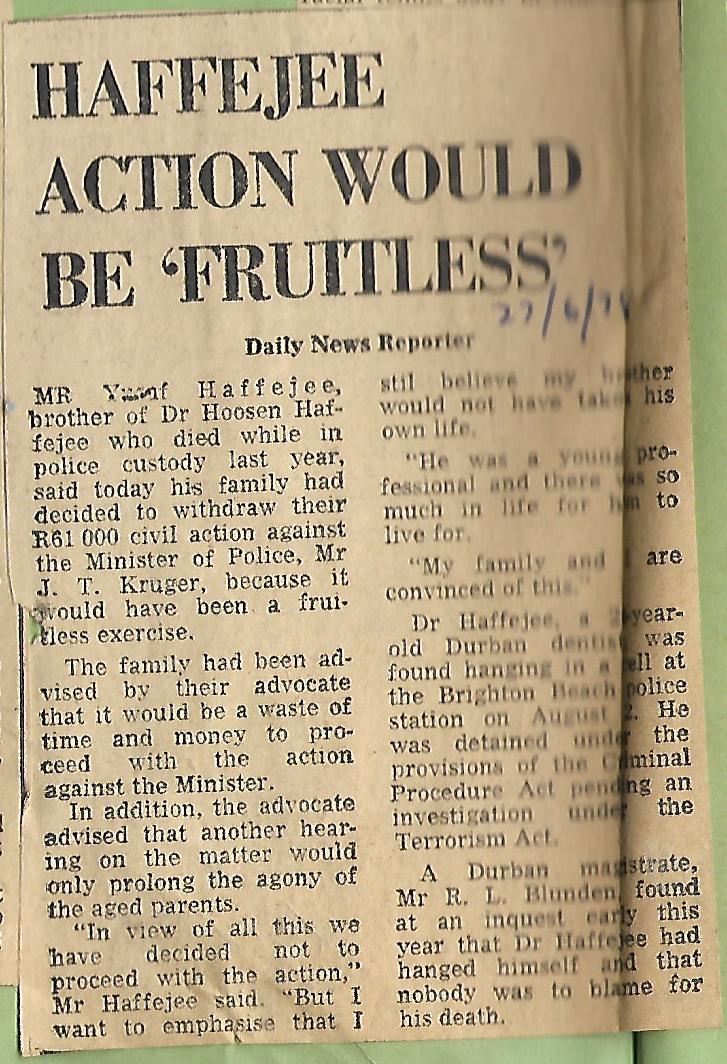
The family had initiated a law-suit in December 1977 to sue the then Minister of Justice, Jimmy Kruger, but this was dropped in June 1978 after Mr Yusuf Hafejee said the family had decided it would be a fruitless exercise.
The family made the decision after they were advised that another hearing on the death of their brother would only prolong the agony of their aged parents.
But he insisted that they were sure that their brother was murdered by the security police.
“I still want to emphasise that I still believe my brother would not have taken his own life.
“He was a young professional and there was so much in life for him to live for. My family and I are convinced of this.”
Now, 41 years later, after the new democratic Minister of Justice, Michael Masutha, had signed an order for the inquest into Dr Hafejee’s death in custody in re-opened, it is hoped that the truth will be finally known.
Those responsible for his murder, if they are still alive, must be brought to justice and pay the full penalty.
I have not spoken to Yusuf Hafejee for some time but I am certain that he would like to see those responsible for his brother’s death being brought to justice. Ends – subrygovender@gmail.com
Tuesday, September 18, 2018
REMEMBERING BLACK CONSCIOUSNESS LEADER - STEVEN BANTU BIKO
On September 12 2018, the South African Government, the Steve Biko Foundation, the Azanian Peoples Organisation(AZAPO) and the people at large paid tribute to the leader of the black consciousness movement, Steven Bantu Biko, who died 41 years ago after being tortured and brutally beaten by the former apartheid security police.
Five years after Biko's death, the Press Trust of SA Third World News Agency, which was established in 1980 by struggle journalist Subry Govender, wrote and distributed the following article around the world on the 5th anniversary of the death of Steve Biko.
The article was published on August 16 1982 at a time when Subry Govender was banned and house-arrested.
5TH ANNIVERSARY OF THE DEATH OF STEVE BIKO
On September 12 1977 the majority of South Africans and the world at large were shocked into silence and disbelief when one of the brightest young black leaders met an untimely and gruesome death at the hands of the notorious apartheid security police.
The young man in question was Steven Bantu Biko, the 30-year-old leader of the black consciousness movement. He died of head wounds and brain damage 25 days after being detained along with a fellow black consciounsess leader and close friend, Peter Jones, at a road block in the Eastern Cape on August 18 1977.
Biko became the 43rd South African political detainee to die under mysterious circumstances while under police custody.
Today, five years later, Biko still haunts the conscience of white South Africans and the government that was responsible for his brutal death.
Black South Africans, on the other hand, remmber him as a martyr of the ongoing liberation struggle in South Africa.
BPC AND SASO
The Azanian Peoples Organisation(AZAPO), which replaced the Black Peoples Convention(BPC) and the South African Students Organisation (SASO) that were banned after Biko's death, has organised a series of events to mark the fifth anniversary of his death.
The activities include "Biko week", which will be held from September 5 to September 12, and a play on the life and death of the late black consciousnes leader.
LIBERATION UNITY MOVE
At the time of his unfortunate death, Biko, who was the banned president of the BPC, was reportedly involved in moves inside the country to unify the forces of the African National Congress(ANC) and the Pan Africanist Congress(PAC) in an attempt to co-ordinate the struggles against white minority rule.
It is understood that Biko and Jones were on this particular mission when they were stopped at a road block between King William's Town and East London and detained under the country's notorious security laws.
But what was reported to be merely an arrest for breaking his banning orders turned out to be one of the saddest events in the history of the country.
He was held in solitary confinement with no proper washing facilities at a cell at the headquarters of the security police in Port Elizabeth. And later kept naked, hand-cuffed and leg-shackled to the iron bars of his cell.
On September 11 when he was found to be in a state of collapse in the cell he was transported, lying naked in the back of a landrover, to a Pretoria prison more than 1 200km away. This, the authorities said, was done out of compassion for Biko because the medical facilities in Pretoria were far better than those in Port Elizabeth.
But the next day Steve Biko died a miserable and lonely death on a mat on the stone floor of the prison.
Immediately after his death reverberated throughout South Africa and the world, the then South African Minister of Justice, Jummy Kruger, made small talk of the tragedy when he told a cheering meeting of the ruling National Party in the Transvaal that Biko had starved himself to death.
JIMMY KRUGER – “IT LEAVES ME COLD”
He echoed the callousness and satisfaction of the Pretoria apartheid regime when he said:
"I am not sad, I am not glad, it leaves me cold."
His callousness knew no bounds even when it transpired that Steve Biko died of brain injuries. Kruger's response was typical:
"A man can damage his brain in many ways."
He went onto imply suicide by saying:
"I don't know if they were self-inflicted. But I often think of banging my own head against a wall."
Even the security police in charge of Steve Biko at the time of his death, a Colonel Goosen, tried to absolve himself and his men from any blame by saying that he had taken all measures to ensure the safe-keeping of detainees, and to make sure that they did not escape or injure themselves. But in trying to find excuses, he made a gigantic slip that really landed him in the soup.
SECURITY POLICE – “ASSAULTING TEAM”
He said: "I am proud that during Biko's interogation , no assault charges had ever been laid against my ASSAULTING TEAM." He later changed the phrase to "interrogating team".
But the truth of the matter was that Steve Biko died of at least five brain lessions caused by the application of external force to his head.
The official inquest into Biko's death, however, found that no one was responsible and cleared the security policemen of any blame.
Five years later, while black South Africans again remember Biko, it was worth recounting the short life of the man who was chiefly responsible for conscientising and politicising the young people during the 1970s.
Biko was born to humble parents in the small town of Ginsberg in the Eastern Cape where he completed his early schooling and his matriculation. He proceeded to Durban to do a doctor's degree at the University of Natal Black Medical School where he soon became involved in the activities of the multi-racial National Union of South African Students (NUSAS).
“COLONIALISM AND IMPERIALISM”
But his association with NUSAS led to disillusionment when he and his friends found that the "black man" could never gain liberation by joining the debating chambers of white-controlled organisations.
It was against this background that Biko and his colleagues established the South African Students Organisation(SAS0) and later the Black Peoples' Convention(BPC) to cater for non-students working outside the apartheid system.
Biko set the two organisations on their course when he outlined the philosophy of black consciousness by saying that blacks had to shake off all forms of colonialism and imperialism - cultural, economical and psychological - in order to win physical freedom.
But his leadership was shortlived. The Pretoria authorities, sensing that he was a force to be reckoned with, slapped him with a five-year banning order in 1974 and restricted him to his home district of King William's Town.
BIKO – CHARISMATIC AND VOCIFEROUS
Despite the restrictions and security police harrassment, Biko continued to harness the thinking of the young people and to be in the forefront of international spotlight. He was such a charismatic and vociferous opponent of apartheid that scores of diplomats and international personalities used to literally search him out in the backdrop of Ginsberg for his views.
Therefore, when his death came suddenly and cruelly on September 12 1977, black South Africa and the world cried "murder" at the Pretoria authorities. To their shock and amazement the official inquest into his death found that no one was responsible and the security policemen who were responsible for his detention were cleared of all blame.
BIKO – THE MARTYR WAS BORN
A leader who succeeded in bringing about a "fresh revolution" and who had out-manouvred an almost Nazi-system, is no more but his actions and ideals still live on in new organisations and projects.
And they will certainly not disappear.
For when Biko the man died on September 12 1977, Biko the martyr was born. - ends (Press Trust of South Africa Third World News Agency – August 16 1982)
Saturday, August 25, 2018
ISAAC GOVENDER – ONE YEAR REMEMBRANCE HELD AT THE BETHLEHEM BAPTIST CHURCH IN NORTHDALE, PIETERMARITZBURG ON SAT AUGUST 25
RUTHINSAMY MUNSAMY ISAAC GOVENDER
A large number of family members and friends attended the one-year memorial service for our uncle, Ruthinsamy Munsamy Isaac Govender, at the Bethlehem Baptist Church in Northdale, Pietermaritzburg, on the afternoon of Saturday, August 25 2018.
Mr Govender passed away nearly one year ago at the ripe-old age of 95 at his home in Bombay Road, Northdale on September 16 last year (2017).
Family members arrived from far afield as Dundee, Chatsworth, Phoenix and Verulam for the service.
The church’s leader, Pastor Julius, one of the congregant’s, Eden, another senior congregant, Mrs Julius, paid tribute to Mr Govender in speeches and spiritual songs.
One of the extended Muniamma family’s representative, Subry Govender, also delivered a brief speech to introduce a radio documentary that he specially produced as a tribute to Mr Isaac Govender.
Mr Govender said Mr Isaac Govender was survived by his elder children – Ruth, Abel, Selvie, Meryl, Dhayanithie -; grand-children; great-grand-children; two sisters – Mrs Savundalay Padaychee of Dundee and Mrs Amoy Moodley of Chatsworth; one sister-in-law, Mrs Soundler Govender of Chatsworth; and scores of nephews, nieces and their families.
“He had survived five brothers and three other sisters. Our uncle or mamha - who was well-known to all as Isaac Govender – was a unique human being – who throughout his life was a person who propagated kindness, goodwill and better relations with all family members, friends, and society in general.
“In order to remember this great soul, I have compiled this radio documentary as a tribute from the greater and extended Muniamma family.
“Please listen carefully and I hope at the end of this documentary that all of us would learn something from his rich life.”
FAMILY MEMBERS WHO ATTENDED THE MEMORIAL SERVICE FOR RUTHINSAMY MUNSAMY ISAAC GOVENDER
Friday, August 24, 2018
TAMIL SONG ABOUT HOW CHILDREN DISREGARD THEIR PARENTS UNTIL IT IS TOO LATE
THIS IS A BEAUTIFUL SONG AND ALL CHILDREN SHOULD LISTEN AND REFLECT
Wednesday, August 22, 2018
DR KHORSHED GINWALA - ONE OF THE STRUGGLE HEROES WHO MADE HER MARK IN THE STRUGGLES FOR OUR NON-RACIAL AND DEMOCRATIC SOUTH AFRICA by SUBRY GOVENDER
July 11 2018
(Dr Khorshed Ginwala with President Nelson Mandela, I C Meer and Roy Padaychie)
During the struggles for a free, non-racial and democratic society in the 1960s, 1970s, 1980s and 1990s there were scores of low profile activists who played vital roles in this regard. One of the activists who concentrated her struggles in the social and community fields to realise our political freedom is 89-year-old Dr Khorshed Ginwala-Rustomjee. In his series in our Struggle Heroes and Heroines – Subry Govender – writes about the life of Dr Ginwala who played a vital role since the 1960s for the attainment of our freedom in April 1994.
Sometime early in 1980 a group of community, social and political anti-apartheid activists got together in Durban to discuss the establishment of a progressive newspaper to contribute to the struggles against minority rule and domination.
At this time the newspapers that were dominant in the media field in Durban were the Daily News, Mercury, Sunday Tribune, Sunday Times, Post and the Ilanga.
The anti-apartheid activists came to the conclusion that there was an urgent need for a non-establishment newspaper to promote the struggles. They then decided to launch an alternative newspaper called Ukusa.
One of the community and social activists who played a leading role in this brave and courageous venture at a time of acute repression, intimidation and state killings was Dr Khorshed Ginwala-Rustomjee, a prominent anti-apartheid social and community activist who was involved in numerous social and welfare organisations in Durban at this time.
She obtained the backing of the ANC, which was outlawed but active at underground levels at that time. The ANC’s support for the Ukusa project was relayed to Dr Ginwala through Pravin Gordhan, who at this time was involved in the underground activities of the ANC.
Dr Ginwala joined the late Griffith Mxenge, the late Archie Gumede, Dr A E Gangat and this correspondent in the Ukusa venture.
“I did not play any high-profile role in the anti-apartheid political activities at this time as I was already involved in numerous social and welfare organisations,” Dr Ginwala told me in an interview at her flat in Durban sometime in 2008.
(Dr Khorshed Ginwala and Ela Gandhi at a Dr Monty Naicker function in 2010)
SOCIAL AND WELFARE WORK
“But my work in child welfare and several other social and community organisations were all aimed at contributing to the over-throw of the minority government and the establishment in its place of a non-racial and democratic society.”
She conceded that she was during this period an “underground” member of the ANC. Her younger sister, Frene Ginwala, the democratic South Africa’s first Speaker of Parliament in 1994, was in exile for most of the 1970s and 1980s as an activist of the ANC.
Dr Ginwala’s leadership in the Ukusa project took place at a time when she was involved in a number of social and community organisations to promote the well-being of the poor, marginalised and disenfranchised people.
At this time in 1980, Dr Ginwala was president of the Durban Child Welfare Society, formerly the Durban Indian Child Welfare Society; the National Council of Child Welfare; the Durban Benevolent Society for the Unemployed; the Medical Womens’ Association; University Womens’ Association; Full-Time Doctors Association; and the Mahatma Gandhi Memorial Trust, an organisation that she had been associated with since 1960.
Dr Ginwala today at the age of 89 is still the president of the Mahatma Gandhi Memorial Trust but because of ill-health, she has passed on her duties to former judge, Thumba Pillay.
(Dr Ginwala with her husband, Rustom, and her three sons in the 1960s)
ANTI-SOUTH AFRICAN INDIAN COUNCIL
Dr Ginwala was also involved in the anti-South African Indian Council(SAIC) campaigns in the 1980s when the National Party Government had attempted to co-opt the country’s Indian-origin people.
The Ukusa project during its short life span played a key role in mobilising people of all races together in one of the biggest marches in Durban in 1989 and subsequently in the marches on the segregated beaches and the whites-only Addington Hospital. Workers, civic, student and sports organisations all came together in a massive show of power against the apartheid government. Unfortunately, the Ukusa newspaper did not last because the National Party government at that time had embarked on a number of repressive measures to sabotage progressive media organisations in Durban and around the country.
“It was very painful for all of us for having to see Ukusa closing down because Dr Gangat, Archie Gumede, Griffith Mxenge and others wanted the newspaper to play a progressive role in the struggles against oppression and repression at the hands of the minority regime,” she told this correspondent.
(Dr Ginwala with two of her three sons)
MEDICAL STUDENT IN DUBLIN, IRELAND
Dr Ginwala’s awareness of the oppression of the African, coloured and Indian-origin people at the hands of the colonial and apartheid systems started when at the age of 19 she went to Dublin in Ireland to study medicine.
“Here I met students from all over the world and also South Africans who were in exile. They made me aware of the oppression being committed by the white regimes and this made me think how I should become part of the struggles as well.”
As a member of the Parsee community, Dr Ginwala knew from her parents what oppression was all about. The Parsees - originally from Iran – fled to India many centuries ago because of the oppression they suffered as a minority community.
Her grand-father, Sorabjee Ginwala, who was from the village of Ankleswar in the district of Surat in the state of Gujerat, came to South Africa in the early 1900s but later moved to Mozambique. Her father, Naswan Noshir Ginwala, who was born in Mozambique, travelled to Johannesburg as a young man to obtain a permit to stay in South Africa. Her father was an up and coming businessman who specialised in the oil industry.
“When it was time for my father to get married he went back to India. I was born in Mumbai in 1929 and was taken as a baby to Mozambqiue.
“When I was only six-months-old my parents moved to Kempton Park in Johannesburg where my father had an oil factory.”
Here in Johannesburg her sister, Frene, and brother, Solly, were born. Her brother died at the age of 21 after a long illness following a tragic motor accident in Mozambique.
(Dr Ginwala with one of her grand-daughters)
STARTED SCHOOL IN JOHANNESBURG
Young Khorshed grew up in Kempton Park and went to the St Anthony’s Primary School and also the Johannesburg Indian School where she completed her standard six.
“After I completed my standard six my parents sent me to Mumbai where I completed my matric and obtained the Senior Cambridge Certificate. I was 19 or 20 years when my parents made arrangements for me to travel to Dublin to study medicine. I graduated in 1953 and did my internship in England.
“It was during this period that I became fully aware of the oppression of the African, coloured and Indian-origin people in South Africa at the hands of the white minority government. I met a lot of South Africans who influenced my political thinking.”
After she qualified, Dr Ginwala returned to Johannesburg to re-join her parents. She started work as a medical doctor at the Baragwanath Hospital (now the Chris Hani Baragwanath Hospital) in the city.
After she married Rustom Rustomjee, a Durban insurance consultant, she moved to the coastal city in 1955. During this period she came into contact and interacted with leaders of the Natal Indian Congress such as Dr Kesaval Goonam, Dr Monty Naicker, Professor Fatima Meer, Ismail Meer, J N Singh, and countless other activists.
(Dr Khorshed Ginwala with members of her family)
TOOK OVER THE MEDICAL PRACTICE OF DR KESAVAL GOONAM IN PRINCE EDWARD STREET, DURBAN
During her early years in Durban, Dr Ginwala took over the practice of Dr Goonam in Prince Edward Street for about three years.
“I also joined the practice of Dr M G H Mayat for a year or two before joining the paediatric department of the King Edward V111 Hospital in 1961. I remained here until 1963 when I left to open my own practice in Cato Manor in 1963. During this period, I came first hand with the struggles of the people. I interacted with local leaders and provided whatever assistance I could,” she said.
She, thereafter, set up a practice in Isipingo and later in the mid-1960s she started a practice in Chatsworth.
“Once again I found myself in the midst of the social and community struggles of the people and made contacts with the local activists such as Roy Padaychie and Satish Juggernath.”
(Dr Ginwala with family members outside her home in Durban)
HOSPITAL ADMINISTRATION
In 1969 after consultations with various people, Dr Ginwala travelled to England to study Hospital Admininstration. Once again she interacted with leaders and members of the ANC in exile.
She returned in 1972 and served at R K Khan Hospital as the principal officer and superintendent until 1978.
During this period, Dr Ginwala and her family moved out of their home in Asherville to Reservoir Hills. They first settled in Tulip Place in Asherville in 1964 and later moved to Nerina Road in the Asherville district.
In the mid-1980s she played an active role in the Reservoir Hills branch of the Natal Indian Congress and later was elected chairperson of the ANC branch in Reservoir Hills in the early 1990s.
After she resigned from R K Khan Hospital in 1978, she, thereafter, joined the Faculty of Medicine at the University of Natal Medical School (now Nelson Mandela Medical School) as a senior lecturer and Acting Head until 1992.
(Dr Ginwala with grand-daughters)
PRIMARY HEALTH CARE FOR THE DISADVANTAGED
During this time she began work on primary health care which took her services to rural areas deep into Inanda and other areas. She was also a member of the progressive medical association, NAMDA
“I continued to work part-time at the medical school until 1994. At all times I was interacting with the ANC and contributing to the emergence of our new non-racial democracy in April 1994.”
When Nelson Mandela became President of the new non-racial democracy in 1994, it, therefore, came as no surprise when the new President appointed her as South Africa’s ambassador to Italy. She served in this position until 1999.
“Although I was not known as a political activist, I am very happy that I played some role behind the scenes and in the background to bring about our non-racial and democratic society that we enjoy today. It has been a long struggle and my wish now is that all the people must enjoy the fruits of our freedom. It must not be restricted to the privileged few.”
In recent years one of the projects she has committed most of her time and energy on is the Mahatma Gandhi Memorial Centre, an organisation that she had been involved with since 1960.
MAHATMA GANDHI MEMORIAL CENTRE
In the 1980s and 1990s, Dr Ginwala worked with activists and MGMC Committee members such as Ela Gandhi, Edith Skweyiya, Jeff Hadebe, Andrew Malangeni, Thumba Pillay, Kresan Naicker, Jean Manning, Yezdi Phiroz and Billy Nair.
When I interviewed her in 2008 she told me about the plans to build a memorial, library, and a health centre at the property that Gandhi had purchased in the former Prince Edward Street in the 1890s.
Together with her hard-working committee members, Dr Ginwala obtained the support of the South African and Indian governments, including the KZN Provincial Government, in 2012 to build the Mahatma Gandhi Memorial Centre. This dream was realised in October last year.
I visited Dr Ginwala at her flat in Durban recently when I wanted to inform her that I was recording her life in my “Struggle Heroes and Heroines” column. I was unable to interact with her because of her ill-health but she did recognise me and gave me the struggle salute.
Dr Ginwala may not have been a political leader or activist in the mould of Ahmed Kathrada, Dr Yusuf Dadoo, Dr Kesaval Goonam, Dr Monty Naicker, I C Meer, Professor Fatima Meer, Billy Nair or Mewa Ramgobin, but there’s no doubt whatsoever that she was a committed social and community activist who played a significant role in the struggles for a free South Africa.
In our interview in 2008 she was clear that her involvement in the struggles was not only aimed at over-throwing the apartheid regime, but also to create a society where the most disadvantaged and under-privileged would be able to improve their social and economic conditions.
“I was solely involved to ensure that in the free and democratic South Africa, the disadvantaged and under-privileged people will have the opportunities to improve the quality of their lives.”
At a time when South Africans are observing the 100th birth anniversary of Nelson Mandela, Dr Ginwala would also, no doubt, be sorely disappointed and disillusioned at the resurgence of racism and hatred in the country. She would definitely say this is not the value that Mandela had fought for and died. – ends July 11 2018 (subrygovender@gmail.com)
Wednesday, August 1, 2018
NELSON MANDELA AND SOUTH AFRICA'S PEOPLE OF INDIAN-ORIGIN BY SUBRY GOVENDER Mandela and SA’s Indian-origin people
JULY 20 2018
As South Africans continue to observe the 100th birth anniversary of freedom icon, Nelson Mandela, veteran correspondent, Subry Govender, has dug deeper into his archives to bring you Mandela’s words of advice and encouragement when he addressed the country’s people of Indian-origin in Chatsworth, Durban, in 1994.
Seven months after being elected as the first democratic President of South Africa in May 1994, Nelson Mandela visited KwaZulu-Natal in November of that year to speak to the different communities.
One of the official functions he addressed was at Chatsworth - home to more than 500 000 citizens of Indian-origin. He made the visit and addressed the community as a whole at a time when there was increasing anxiety about the anti-Indian sentiments that were emerging once again; when land invasions were taking place on farms owned by Indian-origin farmers in a number of areas on the North Coast and South Coast and when the sudden spike in violent crime rate began to claim a number of lives.
Mandela, speaking to a large crowd of people, re-emphasised that they had nothing to fear in the new South Africa.
Trying to re-assure the people, he said:
“We are confident that as the light of knowledge conquers the darkness of evil, the benefits of the new era for peace and prosperity, freedom and tolerance will now be clear.
“We are one nation of many cultures and religion. No community or religion has anything to fear from non-racialism and democracy. On the contrary all communities and religions now enjoy equal respect without preference.”
Mandela then went onto make it crystal clear that in the new, non-racial and democratic South Africa, no community should feel threatened for affirming one’s identity.
“No longer do communities in affirming their identities should feel themselves in conflict or separated from the rest of society,” he told the people.
“The changes are the mark of the transformation through which our society is growing. If and radical as the changes must be they pose no threat to any community.”
Mandela then used the occasion to urge Indian-origin South Africans not to allow themselves to be marginalised but to become a full part of the new South Africa.
“Members of the Indian community,” he said, “who were forced by apartheid to count themselves as part of a minority are now free to become part of the majority”.
“Exercise that freedom. Reject the past. Join hands for a better life.”
In another act of statesmanship, Mandela surprised those present when he quoted from the Indian scriptures to call on the people to be confident and positive about the future South Africa.
He said: “As the Hindu scriptures say and I quote: ‘We are what our deep driving desire is. As our desire is, so is our will. As our will is, so is our deed. As our deed is, so is our destiny.’
“The destiny of the Indian community is the better life for all. We are one South African nation united in one common destiny. Let this central thought guide our deeds in our urgent task in building this new society.”
(Dr MONTY NAICKER AND DR YUSUF DADOO)
South Africa’s first democratic President also used the platform to praise the role played by leaders of the Natal Indian Congress in the liberation struggles from the early 1900s to 1994. Some of the leaders he mentioned included Dr Yusuf Dadoo, Dr Monty Naicker, Dr Kesaval Goonam, Ismail Meer, Mrs Fatima Meer, and J N Singh.
(DR KESAVAL GOONAM)
(PROF FATIMA MEER)
This is what he said about their contributions and the sacrifices by leaders such as Mewa Ramgobin, George Sewpersadh, D K Singh, Dr Farouk Meer, M J Naidoo, Ms Ela Gandhi, Dr Jerry Coovadia, Paul Devadas David, Billy Nair, Sunny Singh, R Ramesar and A H Randeree and countless other stalwarts since the early 1960s.
(BILLY NAIR AND AHMED KATHRADA)
“The spirit of freedom and peace which was embodied in the Natal Indian Congress as an ardent opponent of oppression and division lives on. Forced by the constraints of apartheid to work for a century through a political organisation restricted to one community, it is now infused in the larger body politics, a component of the creative energy which is working to make our country free from which oppression, hunger and deprivation.”
The statements made by Nelson Mandela 24 years ago are memorable insights that need to be repeated over and over again today.
They are words of wisdom that bring hope to those South Africans who today feel their colour and ethnic groupings have become more pronounced in what should be a non-racial society.
Our new President, Cyril Ramaphosa, has taken advantage of Mandela’s 100th birth anniversary by responding to those political elements who are sowing seeds racial hatred and disquiet.
When addressing a Mandela Day function at Mvezu, the birthplace of Mandela, in the Eastern Cape on Wednesday, July 18, Ramaphosa reminded the racial mongers that Mandela, where ever he is, would be deeply concerned about the resurgence of racism and ethno-nationalism.
Ramaphosa, without pulling any punches, made it clear that there was no place for racism and ethnic chauvinism in the new South Africa.
He said: “There’s no place for racism in South Africa, no place for tribalism in our country. We are called upon to speak out when the values for which Mandela lived and for which so many fought for are denigrated by those who have no interest in the progress of our country.”
Now that Ramaphosa has taken the lead against the racial hatred being perpetrated against fellow South Africans, one hopes that other ruling ANC leaders and officials would also speak out against this crime on a regular basis. By doing this they will definitely have an impact on those elements that President Ramaphosa says are denigrating Mandela’s values and principles for a free, non-racial, democratic, united and peaceful South Africa. Ends – subrygovender@gmail.com (July 20 2018)
Subscribe to:
Posts (Atom)