Saturday, November 24, 2018
TRIBUTE TO COMNRADE PADDY KEARNEY – WHO CONTRIBUTED ENORMOUSLY TO THE STRUGGLES FOR A NON-RACIAL AND DEMOCRARTIC SOUTH AFRICA
(Paddy with Archbishop Denis HURLEY and Chris Nicholson in the background after he was released 17 days in 1985)
(PADDY KEARNEY (CENTRE) WITH BISHOP RUBIN PHILIP AND SWAMINATHAN GOUNDEN)
November 24 2018
(PADDY KEARNEY WITH JOURNALIST WIFE CARMEL RICKARD)
One of the activists who worked with churches to promote the struggle against apartheid, Paddy Kearney, has passed on in Durban on Friday, November 23 (2018) at the age of 76. Kearney, who was the Director of the Diakonia Council of Churches for 28 years, was one of the “behind the scenes” activists who contributed enormously to the struggles against apartheid and white minority rule. Veteran journalist, Subry Govender, who befriended the social activist since the early 1970s, profiled the life of Kearney, who at the time of his death was chairperson of the Denis Hurley Centre Trust.
(PADDY KEARNEY CELEBRATING 10 YEARS OF THE ESTABLISHMENT OF DIAKONIA WITH MEMBERS OF HIS STAFF)
It was in the mid-1980s when the struggle against apartheid was being heightened on all fronts that Paddy Kearney became a strong "behind-the-scenes" activist. At this time, he was the Director of the Diakonia Council of Churches which he had spearheaded at the request of the late Catholic Archbishop, Denis Hurley, in 1974.
(PADDY KEARNEY ADDRESSING A MEETING AT DIAKONIA IN DURBAN)
“My entry into anti-apartheid activism had a great boost when M J Naidoo, who was president of the Natal Indian Congress at that time, recruited me into the Release Mandela Campaign,” Paddy Kearney told me in an interview.
In addition to M J Naidoo, Paddy Kearney also came under the influence of leaders of the calibre of Dr Beyers Naude, founder of the Christian Institute and one of the General Secretaries of the South African Council of Churches; as well as Archie Gumede and Griffith Mxenge, who were also involved with the Release Mandela Campaign at that time.
Born in Pietermaritzburg in August 1942 to parents who were descendants of Irish immigrants, Paddy Kearney from an early age came under the influence of the Catholic faith.
(PADDY KEARNEY ADDRESSING A MEETING AT THE UNIVERSITY OF NATAL)
But his social and political awareness took shape when the father of apartheid, Hendrik Verwoerd, wanted to introduce a law that would require black people to apply for permits to attend churches in so-called white group areas.
“Archbishop Hurley wrote against this and other apartheid evils in his pastoral letters that were read out at St Mary’s Church in Pietermaritzburg. I was still a young school boy when it became clear to me that the Archbishop was saying that apartheid was totally unacceptable. That was very interesting to me because here was a leading figure in the Church who was saying that what the government was doing was fundamentally wrong. I was very proud of him because he spoke out so strongly against apartheid.”
(Paddy being watched by two of his staff members while a security policeman take him away in 1985)
(PADDY KEARNEY WITH MEMBERS OF HIS STAFF AFTER BEING RELEASED FROM DETENTION IN 1985)
(PADDY KEARNEY WITH HIS POARENTS AFTER GRADUATING AS A TEACHER)
Paddy Kearney was first jolted to do something practical about the apartheid situation when he was a teacher at the Inanda Seminary, north of Durban, in 1971. He was teaching English and one of the set books was Macbeth. At this time Macbeth was being presented at the Alhambra Theatre in Durban and Paddy Kearney wanted to take his pupils to watch the play but he could not do so because the show was restricted to whites only.
“It made me take action and I wrote a letter to the Daily News complaining that I was unable to take my pupils to watch the play because of the apartheid system. The actors, some of whom had come from Britain, read that article and they phoned me at the school and said they had no idea that people were being restricted from seeing the play. They said ‘We will come and present it at Inanda Seminary and you can invite all the black schools in Durban who are studying Macbeth to come there and we will give them an outdoor performance for free’. We made all the arrangements and hundreds of children sat on the lawns of the school grounds following the play with their set books open.”
After spending a year at Inanda Seminary, Paddy Kearney went to the United States as a Fullbright Scholar during the 1972-1973 academic year when he obtained his Masters Degree. After his return, he lectured at the University of Natal for three years. At the same time he worked closely with Archbishop Hurley as a member of the Catholic Church's Justice and Peace Commission. It was during this period that he was asked by Archbishop Hurley to set up Diakonia. He did all the preparatory work for the establishment of the organisation but without any intention of becoming involved on a full-time basis.
(Paddy Kearney at amemorial service for Ahmed Kathrada in 2016 that was disrupted by ANC Youth league members)
“I said to the Archbishop, okay I will help you get it started, I will do the secretarial work, I will call and facilitate the meetings and then we will find someone to be in charge. We did all of that and found a person to whom we offered the job. But she turned down the offer. I had a re-think after this and told the Archbishop that I will take up the position of Co-ordinator of Diakonia but I had no idea that I would still be in that position 28 years later!”
It was during the mid-1980s that Paddy Kearney became involved with organisations such as the Natal Indian Congress, Detainees Parents Support Committee, Release Mandela Campaign and the United Democratic Front. It was no surprise when he came under the scrutiny of the dreaded security police at that time and was detained in 1985 for 17 days. He was released from detention by a court order in what became known as the “Hurley case” because Archbishop Hurley was the one who brought an application for Paddy’s release, with the help of Chris Nicholson, then Director of the Legal Resource Centre.
“We always had worship on Monday mornings at Diakonia and I was getting ready for that when someone came to the door and said that the security police were looking for me. Before I could respond, the security policemen rushed in. A Captain Van Sittert told me that they had come to arrest me. They then began looking into the rubbish bin, pulling files down from the cupboards and causing a commotion. They then took me to my flat to look for things there and thereafter drove me to C R Swart Square Police headquarters. I was interrogated there for the next 17 days, but held at the La Lucia Police Station.”
(Paddy Kearney participating in the Gandhi Salt March in Durban
Like other anti-apartheid activists, Paddy Kearney also looked forward to the advent of the new democracy in April 1994. As Director of Diakonia, Paddy Kearney played a major role in preparing the flock to vote in the elections.
“We had been preparing for it you know for two years at Diakonia and doing a lot of work of bringing together not only church groups but all NGOs who were interested in promoting democracy.
(Paddy Kearney with the Active Citizens Movement in 2017)
“We started doing programmes in education for democracy, voter education, and preparing people to be observors and monitors. We also were training people to work with visitors who came from overseas to witness the elections. It was a culmination of a long period of preparation for people to get ready for the elections.”
Paddy Kearney stepped down from Diakonia in 2004 after serving the organisation for 28 years as a full-time staff member, after two years as a volunteer. After his retirement he researched and wrote the biography of Archbishop Denis Hurley titled "Guardian of the Light" which was launched in Durban in August 2009.
Paddy Kearney continues to be involved as a consultant to the KwaZulu-Natal Christian Council, as well as Chair of the Gandhi Development Trust and of the Denis Hurley Centre Trust.
(Paddy Kearney with Dr Dilly Naidoo(second from right) with Farouk Meer, Sunny Singh, Swaminathan Gounden, Paddy Kearney and Bishop Reuben Philip)
Twenty three years into our new democracy, Paddy Kearney believes that South Africans should be ever vigilant and speak out against injustice and corruption. He's also of the view that it's only through proper vigilance that the values of the struggle era can be protected and enhanced.
“I think we have to be very vigilant. You know the struggle for democracy is never over. As soon as you start relaxing or become complacent, then I think problems can arise in the country and that’s the very difficult situation in which we find ourselves now. Over the past few years I think we have not been sufficiently vigilant and so we have lost something of the moral fibre that had been part of the struggles for a democratic South Africa.”
He has also been a regular at non-government meetings and in organisations where concerned people have expressed their disquiet at the current socio-economic and political state of the country under the leadership of President Jacob Zuma. Paddy was one of the activists who attended the recent official launch of the non-government forum, Active Citizens Movement(ACM), of which he is a patron together with Judge Thumba Pillay, Dr Albertina Luthuli, Professor Jerry Coovadia and Zuleika Mayet.
“I am happy that over the past year or so we have seen something of the tide turning against leaders who have lost their morals, values and principles.
(Paddy Kearney With Jean-Marie Ntamubano, a refugee from Burundi who is now the Manager of the Denis Hurley Centre.)
Paddy Kearney made this statement at a time when former President Zuma had failed the country after allegations had been made that he was caught up in corruption and had come under the influence of certain people who were only interested in furthering their own interests. He would no doubt now be pleased that President Cyril Ramaphosa is trying his utmost best to weed out the corrupt people in Government through the State Capture Commission being headed by Justice Zondo. It’s a huge task at re-building the values that were central to the anti-apartheid struggle. Ends – subrygovender@gmail.com
Monday, November 5, 2018
THYNA SUBRAMONEY WINS THE LADIES SECTION OF THE 29TH MERCURY MILLION TOURNAMENT
(THE MERCURY PUBLISHED THIS PHOTO OF THE LADIES AND MENS' WINNERS OF THE 29TH MERCURY MILLION GOLF TOURNAMENT ON THE FRONT PAGE ON MONDAY, NOV 5 2018)
A 66-year-old Durban woman golfer, who has been playing the sport for the past 18 years, won the ladies section of the 29th Mercury Million golf tournament at the Wild Coast resort during the Nov 2 and 3 (2018) weekend.
Mrs Thyna Subramoney, who is a member of the Mount Edgecombe Golf Club, shot an overall total of 66 points during the two-day event. She scored 38 points on Sunday (Nov 3) and 28 points on Saturday (Nov 2) despite the severe howling winds and poor weather conditions.
Her achievement follows a recent victory at a club tournament at Mount Edgecombe.
“I am very excited because I have been playing in the Mercury Million for nearly 15 years and have not achieved the top prize before,” she said.
“Although I won other prizes during the Mercury Million tournaments, I had not achieved the ultimate prize of being the sole winner of the ladies tournament.”
Thyna Subramoney started playing golf in 2001 after she had more time on her hands early in 2 000.
(Thyna with Daya Naidoo and two other golfing colleagues at Mount Edgecombe)
“All my children got married and left home and I had some time on my hands to take up golf.”
She became a member at Mount Edgcombe as a novice and slowly picked up the finer points of the game.
“I wanted to play golf because I was getting tired of just being a spectator when Subry went out every weekend to play the game. I told him that I had enough of being his caddy and that I now want to also play,” she said.
(Thyna with her golfing friends, Anjie Valjee, Daya Naidoo, Sam Valjee and Mara Naidoo during a golfing tournament at Champagne Sport)
After attaining her first handicap she joined her journalist husband, Subry Govender, to play in tournaments all over KwaZulu-Natal, Drakensberg Gardens, Champagne Sport, and in Gauteng and Swaziland.
In October 2016 she achieved one of golf highest honours when she scored a hole-in-one at the Mount Edgecombe Golf Course.
“It was one of my highlights of my playing career and now, winning the ladies section of the Mercury Million, is yet another exciting achievement.”
<
(Thyna with her golfing friend, Anjie Valjee, and Subry Govender)
She said her son, Kennedy Pregarsen Subramoney, and her twin grand-sons, Divarshan and Dasendran, who are 17-year-old, and her third grand-son, Darshan, are also avid golfers.
“Our whole family are golfers and I hope one day that we will have top world professional golfers emerging from our family.”
On Monday, Nov 5 (2018), Thyna Subramoney made the front page of The Mercury when the newspaper published a photo of the winners of the ladies and mens’ sections of the Mercury Million tournament. Ends – subrygovender@gmail.com (Nov 5 2018)
<
(Thyna with her golfing friend, Anjie Valjee, and Subry Govender)
She said her son, Kennedy Pregarsen Subramoney, and her twin grand-sons, Divarshan and Dasendran, who are 17-year-old, and her third grand-son, Darshan, are also avid golfers.
“Our whole family are golfers and I hope one day that we will have top world professional golfers emerging from our family.”
On Monday, Nov 5 (2018), Thyna Subramoney made the front page of The Mercury when the newspaper published a photo of the winners of the ladies and mens’ sections of the Mercury Million tournament. Ends – subrygovender@gmail.com (Nov 5 2018)
Monday, October 22, 2018
THE PLIGHT OF THE MARGINALISED
BIN PICKERS
BY SUBRY GOVENDER
If you think life is becoming tough with the current trends in our economy, spare a thought for those who are living on the margins of our society. Early today (Oct 22 2018) while going on my usual walk alongside the road at a beach on the North Coast, I was taken aback by noticing some men digging into bins.
The bins were placed by residents outside their houses for the municipal trucks to collect and cart them off to the municipal dumps.
I was shocked that human beings were digging into the bins. I approached some of them who looked very pitiful and really downtrodden. I inquired what they were looking for in the bins?
They were not only looking for empty tin cans but also other items that they could sell. Some of them even had collected some sandwiches they found in the bins.
One of the men, an old person who was dressed in very dirty long pants and shirt, said: “We have nothing to eat. We are looking for anything that we can sell and make some money.”
The man, who looked as if he had not eaten for some days, said they all lived in squatter settlements and were struggling to make a living.
Asked whether they don’t have children who could take care of them, he said: “They are also living in the jondolos and they don’t work.”
Many cultural and social organisations are doing a lot to help these hapless people. It seems they cannot reach all the people on the side-lines of society.
Witnessing the “bin pickers” made me wonder whether all those politicians and their business friends, who are stealing billions of taxpayers’ money, ever spare a thought for the marginalised and the poor who live on the fringes of society?
One sincerely hopes that these politicians and their business friends will take some time off from their busy corrupt schedules and visit those on the fringes of society.
The poor and the marginalised must also be given opportunities to improve their lives socially and economically. They cannot be used only as cannon fodder during election time. ends - subrygovender@gmail.com
Sunday, October 21, 2018
PHOENIX – NORTH OF DURBAN – IS BEING TURNED INTO A SLUM BY THE NEW DEMOCRATIC MUNICIPALITY
(PARTS OF THE REDFERN SPORTS FIELD BEING DESTROYED BY THE LOCAL ETHEKWINI MUNICIPALITY)
(FILTH AND RUBBISH THAT ARE FOUND ALMOST EVERYWHERE ALONG EASTBURY DRIVE IN PHOENIX)
October 21 2018
By Subry Govender
(FILTH AND RUBBISH FOUND ALMOST EVERYWHERE ON EASTBURY DRIVE)
I was driving on the road alongside the railway line in Phoenix, Eastbury Drive, early today when I was once again taken aback and shocked at what greeted me. Large piles of rubbish, filth, and all kinds of unwanted material were dumped on both sides of the road at several spots. This is not the first time that this reckless destruction of the environment has engulfed this area and several other places in what is supposed to be the residential area of Phoenix.
What is really going on? Is the municipality showing any concern for the environment in Phoenix and other residential areas inhabited mainly by those who are considered to be disadvantaged and marginalised?
(MR JOHN PILLAY OF THE "SAVE OUR REDFERN SPORTS FIELDS" STANDING ON THE SOCCER FIELD THAT IS BEING DESTROYED BY THE ETHEKWINI MUNICIPALITY)
Then when I turned on the road leading to Unit 11, near the Ferndale school, I noticed a large piece of land, which used to be a playground for school children and a sports field for footballers and cricketers, being dug up and levelled by tractors and bulldozers.
I don’t know what is going to be built on this piece of land but I was informed that houses are to be built here.
Once again another playground and sports field is being torn apart and ripped away from the children of Phoenix. What are the children going to do after school hours if there are no sports field or playgrounds for them to fine tune their talents in soccer, cricket, and other sports?
The capture of every piece of playground and sports field in Phoenix for the construction of houses will turn the residential area into a large slum. Is this what the new democratic municipality want to see? Why can’t the municipality build more houses in large tracts of vacant land that are found outside Phoenix?
(YOUNGSTERS WHO WANT TO PLAY SOCCER BEING DEPRIVED OF THEIR SPORTSFIELD BY CORRUPT MUNICIPAL OFFICIALS WHO ARE IN LEAGUE WITH UNSAVOURY ELELMENTS)
It’s actions like these by the municipality is driving many young people into all kinds of anti-social activities such as drugs and alcohol. The lives of thousands of young people are being destroyed because it seems the municipality is adopting a don’t care attitude.
It seems that the municipality want to see the destruction of the residential areas where people of colour live and eke out a livelihood.
SAVE OUR REDFERN SPORTSFIELD
(Mr Johnny Pillay standing on ground that has already been excavated)
I spoke to one of the community leaders and sports administrators, Mr John Pillay, at the sportsfield on Sunday, October 21 (2018). Mr Pillay and some of his colleagues have established the “Save Our Redfern Sportsfields” to highlight the destruction of their sports fields, playgrounds and open spaces.
He told me that they only realised three weeks ago that their sports field was being destroyed for a housing development when they found that excavators were digging up and levelling the large sports field.
“We took some pictures and established the ‘Save Our Redfern Sportsfield Committee’. We sent our objections to all the councillors, ministers, and the council because there have been no consultations.
“This is the only sports field serving Redfern, Wet Fern and the children from Inanda, Bester, and other residential areas around us.
“Previously during the FPL days, football clubs such as Berea, Tongaat Crusaders, and Manning Rangers used to use this ground. Our children used to join these clubs.
“It was one of the most vibrant sports fields in Phoenix. But now the community is devastated with what is going on.”
(A SECTION OF THE REDFERN/FERNDALE SPORTSFIELD THAT HAS ALREADY BEEN RIPPED APART BY THE MUNICIPALITY)
Mr Pillay said some councillors had responded to their concerns and had taken up the matter.
“We have had some reaction from Councillor Samir who has been quite helpful. Councillor Stanley Moonsamy, about a year ago, showed us a document that placed a moratorium on building on sports fields. I tried to get hold of him but unfortunately he is not available at all.
“We have had some discussions with George Mari and he has written to the Public Protector. My big worry is that this excavation is continuing and the destruction is continuing and continuing.”
Mr Pillay said the destruction of sports fields was ongoing and it seemed that “the authorities just don’t care about us”.
WE ARE BEING DESTROYED
(HUGE TRUCKS BEING USED TO DESTROY THE REDFERN/FERNDALE SPORTS FIELD)
“The situation is serious. We are trying to meet with MEC Ravi Pillay but he has not yet responded to us. It seems this issue is not being taken seriously by the ruling party. We as a community are just being taken for granted. Our main concern is how did this happen, when did this happen, who was responsible and how did this happen without consultation taking place with the community of Redfern and greater people of Phoenix?
“We in Redfern are very concerned about what is going on because this is of sentimental value to us. We are a united community with settlements around us. We want to create a community that is united and this field was one of the focal points of our unity. Now we are not only being betrayed but the future of our children is also being destroyed.
“We are very concerned that at the rate this municipality is functioning our children will have no sports fields or open spaces to play. This ultimately will lead to the children resorting to all kinds of anti-social activities.”
(PART OF THE SPORTSFIELD ALREADY DUG UP)
“TO PLAY OR NOT TO PLAY”
While I was writing this article, I received a letter that Mr Bhana Morar wrote to the Public Protector about the soccer fields of Ferndale and Eastbury being destroyed for the enrichment of the wealthy elite.
In an emotional plea, Mr Morar points out that the two soccer fields had been used for more than 40 years by the community of Phoenix.
After outlining the history and struggles by the people for equality, Mr Morar called for an urgent investigation into the sale of the soccer fields to a construction company.
He wrote: “This sporting facility is a thriving venue for the many residents in a Black township which cannot continuously be pushed from pillar to post to suit the rise of the corporate elite of Black Economic Empowerment ventures.
“We urgently request your reputable office to investigate the sale of the recreational site (soccer fields) – Eastbury and Ferndale – , which has been in use for more than 40 years by the local community of Phoenix.”
Mr Morar referred to the rich legacy of Curries Fountain and asked: “When will we start to create the likes of Paula and Seelan, Smiley Moosa, and Dharam Mohan if the primary building foundation of such soccer institutions are continuously being taken away from a deserving community?”
POLITICAL PARTIES
AND THEIR COUNCILLORS MUST
TAKE RESPONSIBILITY FOR THE
CONTINUED DESTRUCTION OF
PHOENIX
CORRUPTERS AND CORRUPTEES MUST BE ERADICATED
The continued destruction of Phoenix raises the question of the role of councillors, municipal officials and the political parties that operate in the area.
While some councillors may be trying to work with community leaders like Mr John Pillay but it seems that most of them are not active at all.
Why are most of the officials not doing their job and highlighting the degeneration of Phoenix? Are they not concerned that this residential area is being turned into a large slum?
These so-called officials politicians are being paid huge salaries. If they cannot work in the interests of the community at large then they must just find alternative ways to earn a living. You are not doing the people of Phoenix any favours.
They must speak out and act against the social destruction of Phoenix or just get out! – ends (subrygovender@gmail.com)
(MR JOHN PILLAY WITH SOME OF THE YOUNGSTERS WANTING TO PLAY SOCCER BUT THEIR ASPIRATIONS ARE BEING DASHED BY THE DESTRUCTION OF THE FERNDALE/REDFERN SOCCER FIELD)
Thursday, October 18, 2018
REMEMBERING OCTOBER 19 1977 WHEN THE APARTHEID REGIME CRACKED DOWN ON THE MEDIA AND JOURNALISTS IN AN ATTEMPT TO CONTINUE WITH THEIR REPRESSIVE AND OPPRESSIVE POLICIES
(UBJ members outside the hotel in Wentworth where they held their second annual meeting early in 1977. Some of the colleagues who I can recoginise are Charles Ngakula, Juby Mayet, Philip Mthimkulu, Thami Mazwai, Aggrey Klaaste, Mike Norton. I am also in the photo wearing a Union of Black Journalists t-shirt)
October 19 2018
By Subry Govender
At a time when most South Africans are expressing their concerns about the role of some journalists in our new democratic country, it is appropriate to recall the day 41 years ago when the former apartheid regime carried out the biggest and most extensive crackdown against the freedom of the press.
In a latest development, the freedom of the media once again came under the spotlight when the Sunday Times newspaper on October 14 apologised for publishing stories that had affected the lives of some officials who worked for government institutions such as the Hawks and SARS. The editor, Bongani Siqoko, said “we committed mistakes and allowed ourselves to be manipulated by those with ulterior motivies” when the newspaper carried stories on the Cato Manor Organised Crime Unit, the South African Revenue Service(SARS), and the Zimbabwean renditions.
The Cato Manor Organised Crime Unit, which was referred to as a “death squad” by the Sunday Times, led to the suspension of the leader of the squad, Major General Johan Booysen, and several other unit members.
Several senior officials at SARS, including the former acting Commissioner, Ivan Pillay, were forced to leave SARS after the Sunday Times carried stories about them operatring a “rogue unit” when this was rejected by all the officials concerned.
The development at the Sunday Times have taken place at a time when many journalists have to put up with the ulterior actions of politicians and others who want to “capture” the media for their own ends. The ruling ANC also attempted a few years ago to introduce measures to “capture” the media but this was abandoned following strong protests from journalists, media organisations and the public at large.
WORLD AND WEEKEND WORLD
Today, on October 19 2018, we recall one of the darkest days in South Africa’s journalism history 41 years ago when the country’s main black newspapers, World and Weekend World, were banned and ordered to cease publication along with Pro Veritate, a publication of the Christian Institute; and when editors and journalists were either banned, detained or interrogated and had their homes and offices raided and searched.
The action against the media, ordered by the infamous Minister of Justice, Jimmy Kruger, was carried out in conjunction with the banning of 18 anti-apartheid interest groups, civic, student, religious and media organisations; and banning and detention of their leaders and officials. Kruger and the State President at that time, Dr Nico Diederichs, signed the banning proclamations.
With the stroke of a pen, the state had removed two newspapers that had played a crucial role in keeping the people informed of the social, political and economical situation in the country at that time.
PERCY QOBOZA AND AGGREY KLAASTE
Mr Kruger just over a month earlier had described black consciousness leader, Steve Biko's death in detention as "It leaves me cold".
The notorious security police or "special branch" of the time carried out systematic raids against journalists, newspaper offices and other publications in Johannesburg, Cape Town, Port Elizabeth, East London, Durban and other cities and towns around the country.
In Johannesburg, security policemen arrested Mr Percy Qoboza, Editor of the World and Weekend World, at his offices at about mid-day, only a few minutes before he was due to hold a Press conference about the banning of his newspapers. He was taken to the then John Vorster Square police headquarters. Mr Qoboza was subequently issued with a five-year banning order. His deputy and news editor, Aggrey Klaaste, was also detained and locked up.
(Zwelike Sisulu, Juby Mayet and other colleagues taking part in a protest march in Johannesburg against the banning of the UBJ and other organisations on October 19 1977)
PRO VERITATE
The Editor of Pro Veritate, Cedric Maysom, was also detained and issued with a banning and restriction order.
The security police in Johannesburg also carried out raids and searches at the homes and offices of other journalists and organisations such as the Union of Black Journalists(UBJ), which was one of the 18 organisations banned. They also arrested and detained a number of journalists, including Joe Thloloe, who was the chairman of the UBJ at that time.
In East London, the security police raided the offices of the Daily Dispatch and served its editor, Donald Woods, with a five-year banning order; and searched homes of some of his reporters, including Miss Thenjiwe Mntintso who later skipped the country to go into exile because of harrassment and intimidation.
In Durban, the security police raided and searched the homes of Dennis Pather, who later became editor of the Daily News; and this correspondent.
I can clearly recall what happened when two white security policemen called at my former home at 30 Mimosa Road, Lotusville in Verulam in the unearthly hours of October 19.
They did not inform me that their political bosses had banned the UBJ and 18 other organisations and also banned the World and Weekend World.
They ransacked the house and confiscated papers and documents.
When representations were subsequently made to Mr Kruger for the release of detained journalists, he unapologetically responded by saying that the detentions were not meant to intimidate the Press and that his Government had good reasons to detain the journalists.
The clampdown against the media on October 19 1977 had a ironic twist two weeks later when it was reported that the Government was planning to print postage stamps to celebrate 150 years of Press Freedom in South Africa.
RAY SWART
A Durban lawyer who was national chairman of the then Progressive Federal Party, Ray Swart, launched a blistering attack against the National Party Government for talking of Press Freedom at a time when it was conducting one of the ruthless campaigns to suppress the media.
In an interview on October 28 1977, Mr Swart, a strong critic of the apartheid regime, told me that he was impressed that the Government should want to commemorate Press Freedom but he would be more impressed if it gave greater indication of what it considered Press freedom to be.
He had said: "It seems strange that they intend doing this after having just banning three newspapers, incarcerated one editor and banned another. I find it difficult to reconcile the actions of the Government. I suggest the stamps they intend issuing to commemorate Press freedom should have the faces of Mr Qoboza and Mr Woods."
Of course the Government of the day did not take up Mr Swart's recommendation and despite his, the country and world-wide condemnations of the action against the newspapers, editors and journalists, the state continued with its clampdown and suppression of the media much more forcefully. But despite some of the most stringent regulations and harassment and intimidation of media practitioners over the next 13 years, most journalists never gave up and used October 19 to continue with the struggles for Press Freedom.
They realised their dream of Press Freedom when the ANC and other organisations were unbanned and when Mr Nelson Mandela and other leaders were released in February 1990.
Now, 41 years into our new South Africa and after enjoying true Press Freedom, our country is continually facing attempts by some opportunistic politicians and business people who want to “capture” the media and journalists for their own ends.
The memory of October 19 1977 should ensure that we don't allow ourselves to follow the "Yaa Baas" route. ends - subrygovender@gmail.com
Tuesday, October 2, 2018
THE RE-OPENING OF THE INQUEST INTO THE BRUTAL MURDER OF DR HOOSEN HAFEJEE IN POLICE CUSTODY IN DURBAN 41 YEARS AGO IS LONG OVERDUE
THE SECURITY BRANCH OFFICERS RESPONSIBLE FOR HIS MURDER MUST BE BROUGHT TO JUSTICE IF THEY ARE STILL ALIVE
Oct 2 2018
By Subry Govender
When on August 3 1977 Dr Hoosen Hafejee, a dentist trained at the Nagpur University in India, was found dead at the Brighton Beach police station only four hours after being detained, I was at this time based at the Daily News at 85 Field Street in Durban.
I received a call from his brother, Mr Yusuf Hafejee, who telephoned from his home town in Pietermaritzburg to inform me of the shocking death of his newly-trained doctor brother.
I immediately informed my news editors, David James, about yet another shocking death in police custody. It was reported at that time that Dr Hafejee was the 41st person to have died under police custody since the early 1960s.
Mr James advised me to obtain and check all the information regarding Dr Hafejee’s death. We published our first story on the same day on August 3 1977 and I continued to keep in contact with Mr Yusuf Hafejee for all the follow-ups.
The security branch at that time were ruthless and even detained and interrogated Dr A D Gangat and his wife, Dr Fatima Sakoor, about their connections with Dr Hafejee and what they knew about him. Dr Gangat studied with Dr Hafejee at the Nagpur University and apparently Dr Hafejee had contacts with the ANC in exile.
Ten days after the death of Dr Hafejee, another local activist, Mr Bayempin Mzizi, was found hanging in a cell also at the Brighton Beach Police Station on August 13 1977. Mr Mzizi, who was 54-years-old, was found hanging from a bar of a cell window. A strip of his jacket had been torn off and was tied to the cell bars and made into a noose around his neck.
After qualifying as a dentist in India in 1974, Dr Hafejee returned home in 1975.
He started work at the King George V Hospital in Durban.
Only four hours after being detained at the Brighton Beach police station, Dr Hafejee was found hanging from the leg of his trousers, which were attached to the cell door. He was found by the duty officer at 4am on August 3 1977.
The tragedy was that the Chief State Pathologist who conducted the post-mortem, Professor L. Gordon, in his report stated that Dr Hafejee’s death was consistent with hanging.
Dr Hafejee’s brother, Yusuf, his parents and his siblings could not accept that their brother had taken his own life. Yusuf was confident that the security police had murdered his brother.
Yusuf Hafejee disclosed that there were 68 abrasions and bruises on his brother’s body. These must have been inflicted by the security branch policemen who interrogated him.
Yusuf showed me colour photographs of his brother’s body which clearly distinguished the abrasions and bruises.
In November 1977 Mr Yusuf Hafejee submitted a set of the colour photographs to Amnesty International in London to highlight the circumstances under which his brother had died. Amnesty International convened a press conference and its general secretary at that time, Mr Martin Ennals, called on the South African Government to order a thorough inquiry into the death of Dr Hafejee.
Amnesty International also informed the family that it would make arrangements for a top Danish Pathologist, Dr Sigurd Riebur Albrectson, to come to South Africa in February 1977 to give evidence during the inquest hearing into Dr Hafejee’s death.
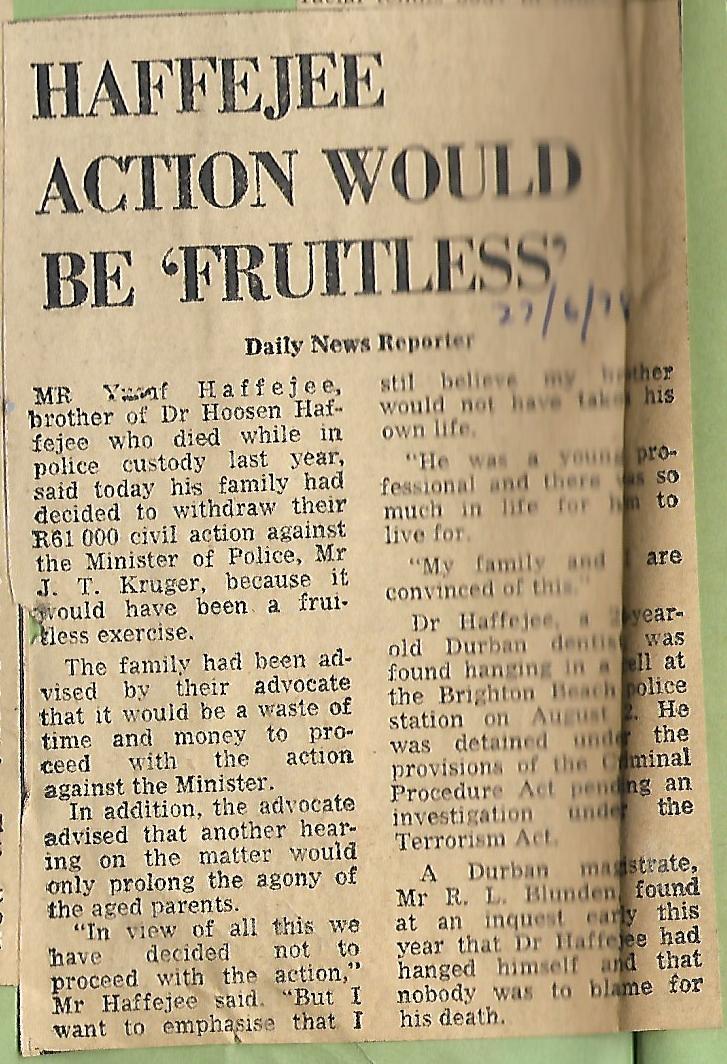
The family had initiated a law-suit in December 1977 to sue the then Minister of Justice, Jimmy Kruger, but this was dropped in June 1978 after Mr Yusuf Hafejee said the family had decided it would be a fruitless exercise.
The family made the decision after they were advised that another hearing on the death of their brother would only prolong the agony of their aged parents.
But he insisted that they were sure that their brother was murdered by the security police.
“I still want to emphasise that I still believe my brother would not have taken his own life.
“He was a young professional and there was so much in life for him to live for. My family and I are convinced of this.”
Now, 41 years later, after the new democratic Minister of Justice, Michael Masutha, had signed an order for the inquest into Dr Hafejee’s death in custody in re-opened, it is hoped that the truth will be finally known.
Those responsible for his murder, if they are still alive, must be brought to justice and pay the full penalty.
I have not spoken to Yusuf Hafejee for some time but I am certain that he would like to see those responsible for his brother’s death being brought to justice. Ends – subrygovender@gmail.com
Subscribe to:
Posts (Atom)


original-width="853" data-original-height="1248" />