Wednesday, February 28, 2024

MADHO AND MANILALL RAMNANAN BROTHERS – ANOTHER PIONEER FAMILY THAT MADE SIGNIFICANT CONTRIBUTIONS TO THE DEVELOPMENT OF OTTAWA VILLAGE


MADHO AND MANILALL RAMNANAN BROTHERS – ANOTHER PIONEER FAMILY THAT MADE SIGNIFICANT CONTRIBUTIONS TO THE DEVELOPMENT OF OTTAWA VILLAGE

 THE RAMNANAN FAMILY OF OTTAWA WHO MAINTAIN CLOSE CONTACT WITH THEIR ANCESTORAL VILLAGE OF NAWAPURA IN THE DISTRICT OF AGIMGURTH/CHIRACTOE IN THE STATE OF BIHAR IN NORTH INDIA


(The well-known Ramnanan brothers - Mr Madho Ramnanan, (seated right), and Manilall Ramnanan, (seated left), seen here with their mother - Mrs Ramnanan Jaichoo - and five of their other brothers.)


By Subry Govender

One of the business families that made a huge contribution to the social, cultural, economic, community and educational development and upliftment of the Ottawa village since the 1940s was the Ramnanan clan.

The Ramnanan family lived on a property at the corner of the Old Main Road and Kissoon Road in the area known as Uplands. They ran a trading store from the property and also a T-room and butchery on a property across the road.

The head of the family business in the 1960s, 1970s, 1980s, 1990s and right up to 2011 was Mr Madho Ramnanan, who also participated fully in community and cultural projects. He was also one of the local leaders who was an active member of the Ottawa Civic Association.

I interacted with Ishwar Madho, who is the third eldest of Mr Madho Ramanan’s six children –  Jay Madho, who still lives in Ottawa; Dan Madho, who is now late, lived in Verulam; Ishwar who lives in Verulam; Provina Jugdeo who has settled in Phoenix; Nirmala Sivapersadh who is also in Phoenix and Shobana Bhugwandeen who resides in Verulam.

I also interacted with Anil Manilall, the second son of Manilall Ramnanan, the younger brother of Madho Ramnanan, who was also involved in the family businesses and in the community, educational, cultural and religious development of Ottawa in the 1950s, 1960s, 1970s and 1980s.


(Mr Madho Ramnanan, businessman and community leader, who made a major contribution to the educational, cultural, economic and social development of Ottawa village along with his brother, Manilal Ramnanan, and other members of their extended family.)

Mr Madho Ramnanan, who was a school teacher, took control of the Ramnanan business empire after his father, Ramnanan Jaichoo, passed on in 1952.

His grand-father worked at the Armstrong  Brothers’ sugar estates along with his six brothers and sisters.  They had followed in the footsteps of their ancestor, Jaichoo, who had worked in the surrounding sugar estates as an indentured laborer.

Mr Jaichoo arrived in the former Natal Colony from the village of Nawapura in the district of Agimgurth/Chiractoe in the state of Bihar in North India in 1902 when he was recruited to work on sugar estates in and around Ottawa and Mount Edgecombe.

After he completed his 10-year indenture, Jaicho married Anaree Naun, a local woman. They stayed in barrack-style houses on the sugar estates before moving to Inanda. In 1940, he purchased a piece of land at the corner of the Old Main Road and Kissoon Road from a Mauritian family, known as Dinanshaws.

By this time Jaicho and his wife had six children, the eldest of whom was Ishwar’s grand-father, Ramnanan Jaicho.

(First generation descendant of the Ramnanan dynasty, Ramnanan Jaichoo, seen here with his wife. They had 13 children - seven sons and six daughters.) 


The grand-father thereafter purchased sugar cane land in Inanda and Phoenix. He and his three brothers worked tirelessly to develop their cane-fields in Inanda and Phoenix. At the same time, they were also involved in bus transport, milling, general dealers and butchery businesses.


(Mr Madho Ramnanan seen here with his wife. )


Madho Ramnanan was the eldest of his father and mother’s 13 children. He was at this time an educator who taught at various local schools, including Mt Edgecombe Primary, Wild Memorial in Inanda and Fairbreeze Primary School in Tongaat.

When their grand-father passed on in 1952, Madho Ramnanan, resigned from the teaching profession and took control of the business empire. Madho Ramanan moved from Inanda to Ottawa and took control of the General Dealer business named Ramnanan’s Trading Centre situated in the area known as Uplands.

Ramnanan also built a brick and tile shop and house on the property that was first purchased by their ancestor in the 1940s. At the same time Ramnanan was a share-holder in the Republic Stationery, North Coast Stationery, and Power Stationery businesses.

According to Ishwar, his father was also involved in community work in Ottawa in the Ottawa Civic Association and with leaders of the calibre of Mr Sivasankar Badlu, K C Moonisami, Lutchman and a few others negotiated the sale of the new Jhugroo State-Aided School to the Department of Education in Natal in the 1970s. After they received the payment for the school, Mr Ramnanan and his colleagues purchased a piece of property owned by Munoo Maharaj and his family in Maharaj Road. Here they built the Ottawa Civic Hall. The property and the land thereafter were taken over by the Ethekwini Municipality in the 1990s.

According to Ishwar Madho, the descendants have been keeping in touch with the family members of their ancestors in the village of Nawapura in the state of Bihar in North India since 1959. One of their uncles, Harry Ramnanan, first visited their family members in India in 1959.

According to Anil Manilall, his father, Manilall Ramnanan, was compelled to leave school in standard nine in order to help in the family business in Ottawa after the death of their grand- father, Mr Jaichaoo Ramnanan. Manilall Ramnanan was at this time a pupil at Sastri College.

The businesses his father was involved in, included the general dealer’s shop – known as the Ramanan’s Trading Store, and the tea room and butchery.

Anil Manilall recalled that after the family’s bus business in Inanda was sold to Putco, the family embarked on a decentralisation of their businesses. This resulted in Manilall Ramnanan being given control of the Top Shop cafĂ©. The name of this shop was changed to Coastal Suppliers.

Manilall Ramnanan, his brother, Madho and other siblings also became shareholders in Republic Stationery, North Coast Stationery and Power Stationery.

Since 1954, Manilall became very active in the community affairs of Ottawa. He was a founding member, together with his brother, Sewmungal, of Flash Entertainers. He was also involved in the building of the new Jhugroo Primary School and, according to Anil Manilall, served in various positions in the education committee of the school. He was also a member of the Ottawa Advisory Board.

He was also a member and office bearer of the Verulam and District Child Welfare Society and a member of the Verulam Crematorium Trust.

(Mr Manilall Ramnanan (second row right) seen here with fellow members of the Ottawa branch of the Red Cross during a beach outing in the 1960s after their voluntary work helping the people in various fields. Others in the picture are (l to R back row): Mr Barly Balmohan, Pastor Daniel, Chotoo, Mr Dicky Maharaj, and Mr Padaychee. Front row: Marimuthu (Subry) and Mr Moses.) 


Mr Manilall Ramnanan was also a member of the Ottawa branch of the South African Red Cross Society. Other local leaders in the Red Cross with Mr Ramnanan included Mr Moses, Mr Dicky Maharaj, and Mr Manmohan Barley and young Chotoo of Uplands and Marimuthu (Subry) of Tin Town, who were junior members.

Manilall was awarded a Silver Medal for his service to the society.

As a member of the Red Cross, he also served as a Quartermaster at various events and festivals, including the annual Mount Edgecombe Easter Festival, Verulam Fair, and during the annual Kavadi and other religious events hosted by the Moodley family of Kissoon Road in Ottawa. This Kavady festival still continues today.

He was also an active member and office bearer of the Ottawa Indian Ratepayers’ Association.  He was also involved in the sale of the school to the Government and the construction of the Ottawa Community Hall in Maharaj Road.

Upon the sale of the school, he was also involved in the formation of the Ottawa Civic Association, which was formed following a recommendation by Anil Ramnanan and which included personalities such as Mr S Badlu, Mr P Kandhailal, Mr D Duttoo, Mr Madho Ramnanan, Mr G Munn and others. The property was transferred to the Civic Association by Anil’s law office.

As a matter of information, Mr Anil Manilall, and his wife, Meera, were the first attorneys in Ottawa.

Anil Manilall recalled that his late mother, Rookmin Manilall, and her sister-in-law, Subhagwathee Ramjiawan, founded the Ottawa Arya Bhasha Paatshala, a Hindi school.

“The school participated in cultural activities and eisteddfods that brought great honour to Ottawa and the North Coast Region of the Hindi Shiksha Sangh of South Africa, which was a national organisation.”

Mr Anil Manilall served as vice-president of the Hindi Shiksha Sangh for seven years from 1987 to 1994.

Expanding on the Manilall Ramnanan family history, Mr Anil Manilall says it was his father who shipped a vehicle to India in 1967 when the Ramanan family members visited India. The family members who travelled on the trip included his father’s mother, his brother Sewpersadh, sister Dhanwanthee, his mother Rookmin, younger sister Shakeela, and younger brother, Rajiv, who was only one-year-old at that time.

When Mr Ramnanan and his family members arrived in Mumbai, they used the vehicle to travel to many parts of India and their ancestoral village in Bihar.

This visit by the Ramnanans to India was reported widely in the local media.

“Ever since then, we have kept in close contact with our ancestoral village family members whenever we visit India.”


Anil Manilall is the second son of Manilall Ramnanan. His other siblings are Sadhanand (Praggie); Roshiela (Betty), now late, having been married to Gay Rattan; Prashiela (Popsie); Shakeela; Rajiv and Navitha.

The extended Ramnanan Madho/Manilall/Jaichoo family today runs into five generations and number more than 100 descendants. Most of the descendants have made significant progress in their lives by being involved in business, academic and other professions. They have also been involved in sporting and religious activities. Ends – subrygovender@gmail.com Jan 15 2022 Update Oct 31 2023

MUNGAL JHUGROO FAMILY – OTTAWA PIONEER FAMILY


MUNGAL JHUGROO FAMILY – OTTAWA PIONEER FAMILY

LOVE AND MARRIAGE ACROSS SOCIAL LINES  AND  PIONEER FAMILY HISTORY


                   (Budhoo Mungal and 
Subadra Sewnarain)


By Subry Govender


Our little village of Ottawa, during the midst of its development from the early 1900s to the 1990s, became well-known for a number of marriages across language, religious and cultural lines. These marriages included Hindi and Tamil language groups and Muslims, Hindus and Christians.

There were also marriages between young lovers from what some families believed was unacceptable because of social differences at that time.


One such marriage that involved two of the pioneer families was that of Budhoo Mungal, who was part of the Mungal-Jhugroo extended family, and Subadra Sewnarain, who was part of the extended Mehgraj/Maharaj family.

Budhoo Mungal and Subadra Sewnarain fell in love in 1959 when they worked at the Flash Clothing factory, which was owned by Mr S S Maharaj, a great humanitarian, community leader who spearheaded the construction of the new Jhugroo primary school and former “Indian” undefeated singles and doubles tennis champion in South Africa.

The Maharaj extended family, after whom Maharaj Road in Ottawa was named, objected to the relationship between Budhoo Mungal and Subadra because, according to their beliefs at that time, the two lovers belonged to different social groupings within the Hindi-speaking community.

But S S Maharaj, who was in no way related to the extended Maharaj family, came to the rescue of the young lovers.

He made arrangements for the young couple to be married at the old Jhugroo school, which was situated where Globes Shopping Centre now stands. The entire Maharaj family stayed away from the wedding with the exception of Minora Maharaj, daughter of Munoo Maharaj. Minora Maharaj had married S S Maharaj’s younger brother, D S Maharaj, who was a teacher at the old Jhugroo school and also a top musician.

She and Subadra were very close friends and there was no way that she could stay away from the wedding.

Minora’s father, Munoo Maharaj, Mr Manilall Maharaj and teacher Mr S S (Krishna) Maharaj’s wife, Sursathy, were all first generation descendants of Mr Badri Maharaj, who came to the former Port Natal sugar colony from the state of Bihar or Uttar Pradesh in North India.

Badri Maharaj and some of his children practised as priests, in addition to their daily jobs in the sugar estates and in the teaching profession. This made them to consider themselves to be of higher social standing within the Hindi community.

Besides Minora Maharaj, Subadra’s parents and close relatives, Roopanands, attended her marriage to Budhoo Mungal at the old Jhugroo school.

Subadra came from a large family – seven sisters and one brother. They were the children of second generation Sewnarain Meghraj.  Meghraj was a Sadhu.  Mr Megraj and his family were sugar farmers north of Tongaat but sometime in the 1930s they moved to Ottawa. They settled in an area in what is now known as Maharaj Road. They wanted the road to be named Meghraj Road but the children of Badri Maharaj wanted it to be named Maharaj Road.

The Meghraj family conceded to the Maharaj family as they did not want to provoke any differences with their Maharaj family members.

Budhoo Mungal, for his part, was the son of Mungal Jhugroo.  Mungal Jhugroo’s father was the pioneer Mr Jhugroo, who came down from the Bihar state in North India to work as a farmer on the sugar estates in Ottawa and surrounding areas.  Budhoo Mungal was the son of Mungal Jhugroo and his second wife, Ramkali. Mr Jhugroo married for the second time after his first wife, died while giving birth to their son, Parthab.  Parthab’s mother’s sister was Sanjaria Jhugroo.

Mr Parthab was a well-known vegetable farmer in the Tin Town area of Ottawa and a community leader.  Mr Parthab was a businessman as well – he owned Ottawa Sand Supply which was located adjacent to a piggery at the time – now Highway Poultry occupies the land.   He played a prominent role in the building of the new Jhugroo school.


(Mr Parthab Mungal, who is the elder brother of Budhoo Mungal, seen here with his wife and children. Mr Partab lived near the new Jhugroo Primary School in School Road.)


Both Budhoo Mungal and Parthab went onto become part of a large family after his father and mother progressed to have two more sons and six daughters.


(Budhoo Mungal on the day of his marriage to Subadara is seen with family members. One of them on the right is Mr H A Beharee, who was one of the famous teachers who taught at Jhugroo Primary School)


They were: Parvathy, who married teacher H A Beharee who lived on Munn Road; Dewanthee Dharampaul, who lived her early life in Beatrice Street in Durban; Heera Mungal, who married Roowanthee and lived on Munn Road until his passing a few years ago; Thara Deeplal, who married Dewkee and lived in Tagore Street in Tongaat; Rookmin  - married Mungal Manawar - lived in Port Shepstone and then moved to Verulam; Chanan Mungal, who married Rashida Bob Khan, lives in Ottawa; Chooran Mungal, who married Sita Ramdhaney and lived in Ottawa; Sukrani who married Krish Praladh – lived in Tongaat; and Jasodhi, who married a person named Maharaj and lived in Verulam.

Budhoo Mungal, in addition to working as a machinist at Flash Clothing, was also an intermediary at the Durban court, and went on to become a security officer at M L Sultan Technikon.  His hobbies and passion included: fishing, motor mechanic, a keen hunter, and snake catcher.

Budhoo Mungal’s wife, Subadra, was a daughter of the second wife of Sewnarain Meghraj. Her father married his second wife, Ramdhai, after his first wife also died during child birth.

Subadra had a half-sister named Shanti, who married into a Singh family who lived in Blackburn Estate. Her husband worked as driver for Tongaat Hullett.

Subadra’s other siblings were:

Devika, who married Ram Rampersad who owned a sand supply truck company in Pinetown. They have three sons and two daughters who all have successful careers. One son, Nashen, owns his own trucking company, M & R Trucking, based in Amanzimtoti.

Then Susheila, who lived in Ottawa; Rajcoomar, who was fondly called Boyan, lived in Ottawa; Radha, married accountant Ronald Ramkissoon and they have two daughters; Kalawathee (Rabitha) married Inder and they live in Newlands after first staying in Shallcross; Khusielawathee (Asha) married Anand Beeky (Sanjaria Jhugroo’s grandson) and they live in Maharaj Road, Ottawa.

Returning to Budhoo Mungal and Subadra they conceived four children – Beena Devi (Sharda), Andisha, Bramdaw (Ravin) and Tanuja. 

Sharda, a lawyer (B D Singh and Associates) and former educationist, is married and lives in Ottawa. Andisha, who was married to the late Santosh Maharaj – son of Mr S S Maharaj – lives in Munn Road, Ottawa.

Ravin Mungal, who is an entrepreneur, owns a shipping and forwarding company (Custo Clear Shipping). He also lives in Ottawa.

The fourth sibling, Tanuja, is the only one who lives outside Ottawa. A marketing manager for a multi-national company specialising in supply of generic medicines - she is married and lives in Westville.

In compiling this history about the Mungal family, I interacted at length with Andisha Maharaj about the family’s connections to both the pioneer Jhugroo and Maharaj families.

Andisha Maharaj, who is the convenor of the Ottawa Environmental Society, is a community activist in her own right.


(Mrs Subadra Mungal, who is 83-years-old, still lives in Munn Road, Ottawa.)


She told me that whatever information she had gained about the early history of the two extended families was obtained through conversations with her mother, father and other members of the family.

When asked about the love marriage between her father and mother, Andisha Maharaj said they had nothing to be ashamed of although they were marginalised in some ways.

“My parents fell in love and got married. They broke down the caste divides that existed at the time.  Theirs was the first marriage to take place outside their homes. During those days it was customary for weddings to take place from one’s home and the invite was printed on handkerchiefs.”

The Maharajs relented their attitude to the Subadra family only after their father, Budhoo Mungal, passed away in 1978 at the age of 48.


BUDHOO MUNGAL FULLY SERVED THE PEOPLE OF OTTAWA 


Andisha Maharaj has very strong recollections of her father who took an active interest in the welfare of Ottawa residents at that time.

“He was at everyone’s beck and call in the village.  He was the first-person people would reach out to for any assistance.  The people used to call him to tackle burglars  and to take care of dangerous snakes which used to leap from tree to tree, especially in mango plantations.

“Dad was an excellent motor mechanic.  He built the first beach buggy owned by SS Maharaj.  All the work was done onsite – from axle to engine to moulding the fibre glass for the buggy.  The engine he had fitted on was VW.  The buggy was more often with us than with Mr S S Maharaj.   It was a statement vehicle!”

Budhoo Mungal remained a strong ally of Mr S S Maharaj as he and his wife continued to work for S S Maharaj in his factory after their marriage. 

“Dad partnered SS Maharaj on the Flash Free Funeral Services.  He did all the paperwork and oversaw the arm of S S Maharaj’s social outreach programme.


BUDHOO MUNGAL WAS A CLOSE FRIEND OF FLASH CLOTHING FACTORY OWNER - MR S S MAHARAJ

“Dad and SS Maharaj had shared a very close relationship. They were like brothers. I remember that during all our summer holidays we used to stay at Mr Maharaj’s beach cottage in Tinley Manor.

“We had unlimited access to the cottage.  Dad would pack us up on long summer afternoons and take us to Tinley Manor with a person we called uncle Alimuthu.  Alimuthu was an ace in catching crayfish and with T K Harry, would land the big fish.”


Despite the social isolation, her mother, who is now 83 years-old, was also a strong person. She remained resolute and strong, especially after Budhoo Mungal passed away in July 1978.


MOTHER - SUBADRA MUNGAL - WORKED VERY HARD TO BRING UP HER CHILDREN


“Mum raised her kids without any social support. She worked at Flash Clothing for more than 40 years.  She maintained that her children must finish matric schooling to improve their lives.”

The social and cultural lives led by the early residents were things that united the community. They all looked forward to Diwali, Eid, Christmas, and other festivals such as Inder and Devi Pooja (prayers) and Muslim Mohrun festival that Hindus, Muslims and Christians celebrated.

Like other third and fourth generation descendants of indentured labourers who had settled in Ottawa, the Jhugroo family members also excelled in the different professions and became entrepreneurs in different fields in trade and businesses.

These included medical and scientist doctors,

dentists, educators, engineers, lawyers, nurses,

clerks, artisans and entrepreneurs.

“The early lives of our parents, grand-parents

and great grand-parents are a treasure that

we must cherish.

“They taught us about hard work, respect for

our elders, charity and voluntary labour.

Without these qualities the people of Ottawa

would never have built the new Jhugroo School.

It’s a rich legacy we all must be proud of.”  Ends – subrygovender@gmail.com Oct 30 2023


“PIONEERING FAMILIES AND THE HISTORY OF SCHOOLING IN OTTAWA” BY DHANRAJ SIVASANKER


“PIONEERING FAMILIES AND THE HISTORY OF SCHOOLING IN OTTAWA” BY DHANRAJ SIVASANKER


(NB: Dhanraj, the eldest son of social and cultural leader and one of the chief architects of school building projects in Ottawa, Mr Sivasanker Badlu, was also a teacher at our local Jhugroo Primary School during his journey as an educationist in KwaZulu-Natal. He wrote the article in November 2015 when the Jhugroo Primary School had celebrated its 75th anniversary.

We are privileged to publish this article in our series on the PIONEERING FAMILIES OF OTTAWA.)


( The pioneers above are Mr Badlu Debi and his wife, Nowrathni Debi, who worked at the Ottawa Sugar Estate as indentured labourers. They are great- grand-parents of Mr Dhanraj Sivasanker)


EARLY HISTORY ON THE ARRIVAL OF INDENTURED LABOURERS


The British Colony of Natal in 1860 embarked on the establishment of sugar-cane farming on a large scale, the British Government launched its immigration schemes of importing indentured Indian labourers from India to help in the agriculture of sugarcane.

It is now over 150 years since the first group of indentured Indians landed on the shores of South Africa in 1860.

Ever since then, Indians have carved a niche as businessmen, professionals, artists, politicians, sportsmen, academics and administrators. This proved themselves to be a group of hardworking people who contributed towards a rich and glorious heritage.

Prominent leaders emerged from very humble beginnings and went on to achieve outstanding success. It is therefore evident that progress and prosperity that followed over the generations can be attributed to the self-help and self-sacrifice attitudes and practices of the simple, rustic lifestyles of our ancestors.


BUILDING OF SCHOOLS BECAME A PRIORITY IN LL COMMUNITIES


Our indentured forefathers and mothers first built schools for education, followed by putting a roof over their heads as homes.

They considered EDUCATION as a priority for the community. Therefore, in every settlement of Indians in South Africa was built a state-aided school with the meagre earnings of the indentured labourers. Quite often these contributions from those who could least afford to give were greater than those benefactors whose names came to be

prominently displayed.

The heritage of simple living in the spirit of harmony and togetherness characterised a peaceful and productive community where all its members shared a common bond without any ego, pride, jealousy or envy.

The Indian community in Natal, and indeed, the whole of South Africa, can be proud of its achievements in the field of EDUCATION.


                   THIRST FOR EDUCATION

The thirst for education among the pioneer Indian families led to the establishment of many Government-Aided schools throughout the length and breadth of Natal. Many of the state-aided schools still exist at the present time. Initially the schools began with an enrolment of few pupils but as circumstances changed with the increase in school-going population there was a need for extensions and improvements to school buildings. Parents became aware that there was a need for larger school buildings with more classrooms.

OTTAWA – ONE OF THE PRIME EXAMPLES IN THE QUEST FOR EDUCATION


(Four voluntary builders who were made enormous sacrifices for the construction of the Jhugroo Primary School. One of the Pioneers here is Mr Ismail Malee Sayed, who lived with his large family in a house at the corner of Munn and School roads.)


Such was the case of OTTAWA, a small village on the North Coast of Natal, about 25km from Durban and about 1km south of Verulam. The sugarcane fields were run by large estates and the mill was owned by Anthony Wilkinson.

Many Indians worked and lived on the sugar estates in homes called barracks.

By 1930s Indians who opted to stay on the Ottawa Sugar Estates after the expiry of their contracts with the British Government in Natal were allowed to buy land in the Ottawa area.

Among the pioneer families who settled in the tiny village of Ottawa were the Badri Maharaj family, the Nursingh family, the Badlu Debi family, the Kista Pather family, the Gobindar Sirkar family, the Abdul Rahaman family and the Jhugroo family of Mount Vernon.

Prior to 1936, parents living in Ottawa Village, Ottawa Sugar Estate, Mount Vernon, Sykes Estate and Waterloo Estate sent their children for primary education to schools in Verulam and Umdloti. The school in Umdloti was the old Verulam Mission School. A few went to Mount Edgecombe School. However, only boys from Ottawa Village were sent to school because of the great distances that they had to walk from home to school while girls were kept at home. In fact, the boys who went to school were much older than the school-going age of pupils of today.

Consequently, the pioneer elders of Ottawa Village showed growing concern as the school-going population of Ottawa increased. The greatest fear was that, a number of children would receive no education at all as it became a common sight to see youngsters carrying hoes and making their way with their parents to work on the sugar fields where their task was largely to weed the fields. Many were employed as herd boys who drew the mule spans.


PIONEERS WANTED TO SEE ALL CHILDREN ATTENDING SCHOOLS


The pioneer elders expressed their deepest concern that Education was the birth right of every child in the community of Ottawa Sugar Estate; and respected and God-fearing men like J. Kissoon, J.Munn, J.Mungal, J.Chithoo, Perithumby Subrayen, K.C.Moonisami, T. Perumal, Badri Maharaj, Ganas Pather, Badlu Debi, Nursingh, the Sirkar Brothers, the Mahabeers of Sykes Estate and the Mahabeers of Mount Vernon took it upon themselves to attend to the education of children.

In 1936, an inaugural meeting was held in a cottage which became the first private school. J.Kissoon was elected the chairman and Perithumby Subrayen was elected the secretary of the School Board. Members of the school board walked great distances to Trenance Estate, Ottawa Estate, Blackburn Estate and Mount Vernon to seek out eligible pupils for school enrolment.

Hence the first school was opened with the required number of pupils in a cottage which was well known later as Dickie Maharaj's home.

This school was known as JHUGROO PRIVATE INDIAN SCHOOL, which was later named as "JHUGROO" in honour of the father of J. Kisson brothers. Classes from introductory level to standard three were conducted here with Janakiepersadh Jaggath and Perithumby Subrayen as the first two teachers.

However, the school was unable to meet the growing demands for accommodation of pupils. The School Board under the able leadership of Kissoon Jhugroo decided to build a larger school on the land of the Jhugroo Family along the old North Coast Road in Ottawa. The Kissoon Brothers built a wood and iron structure with two classrooms to serve the needs of the community, and by the end of 1936 the school applied for Government-Aided status. It opened its doors in February 1937 with Mr R. Ramhorry as the first principal who served only one month. The new building accommodated pupils from introductory level to standard four.

By 1940, there was further need to extend the school to accommodate 40 pupils as the school-going population increased. But by 1943 the school roll increased to 188 pupils. Therefore, the neighbouring Black School was used as an annexe to accommodate, a number of pupils. By April 1944, pupils from the annexe were transferred to the main building.

Further shortage of accommodation at the school was resolved by the Ottawa Indian Social Club led by M. Parthab, P. Subrayen, J. Mungal, P.B Maharaj, Michael Susai and others who decided to extend the old building by adding more classrooms. By 1948, when the extension was completed, pupils from class one occupied the new classrooms.

In July 1948, Mr J.G.Peters succeeded Mr R.P. Das as principal of Jhugroo School and by January, 1949 Mr J.G.Peters recorded the worsening accommodation problem on a waiting list for admission to the school. By the end of December 1949, Mr J.G.Peters was promoted as Principal of Talwantsingh Government-Aided School. He was then succeeded by Mr A.L. Narayadu as Principal of Jhugroo School in 1950.


(This group of children first attended the old school that was situated on property now occupied by Globes. The teachers here are Mr Gobinder (seated first left), Mr Heeraman seated next to Mr Moon Subrayen, and Mr D S Maharaj. The boys and girls here were members of the Bluebells athletics team at the school.)

In 1953, the School Board and the Natal Education Department had a discussion with a view to establishing a private platoon school to ease the accommodation problem. In 1953 Mr S.S.Maharaj was appointed the School Grantee in place of Mr Dhooma who had resigned. And with the establishment of the private platoon school, the opening and closing times of the school changed and the standard five and standard six pupils were transferred to Verulam Secondary School to further alleviate the accommodation problem.

However, all attempts to alleviate lack of school accommodation did not help to solve the problem because it was getting more and more acute with the growing school-going population in Ottawa as the township was expanding with the development of many new houses. There was a plea from parents to the principal, Mr A.L. Narayadu and the grantee, Mr S.S. Maharaj, that something had to be done to improve the situation as the old school had served its purpose.

THE BUILDING OF THE NEW JHUGROO PRIMARY SCHOOL


A public meeting of the residents of Ottawa and neighbouring areas was called to discuss the problem of accommodation. At a meeting held on 6 January 1957, a COMMITTEE comprising of Mr S.S.Maharaj, Mr M. Parthab, Mr S. Badlu and others was elected to look into finding alternate solutions. Since the old school site was inadequate for any further expansion to the school building, a new school site had to be found; and it had to be a site that would not only serve for a school building but that it would also be one that would provide a sizeable ground for extra-curricular activities. To obtain land to build a bigger school was now a problem. Who would be in a position to donate such a piece of land?


            MRS SANJARIA JHUGROO


The Committee comprising Mr S.S. Maharaj, Mr P.B.  Maharaj, Mr M. Parthab, Mr S. Badlu, Mr A.L.G. Hoosen together with Mr A.L. Narayadu, the school principal, decided to approach Mrs Sanjaria Jhugroo, the wife of late Kisson Jhugroo. As old as she was, she realised that education played a very important role in the life of the children of Ottawa. When the Committee met with her, she without any hesitation attributed her motherly-soul for the sake of the education of children and whole-heartedly agreed to donate two and half acres of land in memory of her late husband.


The Committee, indeed, welcomed the site as a suitable one for a bigger school, and on 28 February,1957 Inspector Mr McAllister of Natal Education Department visited the site and approved it as a suitable and ideal school site.

Having obtained the donation of the land for the school site, money was now required to fund the building of the school. The residents of Ottawa and the neighbouring sugar estates could not afford large sums of money to finance the construction of the school, and the people in the neighbouring areas could not be approached as they too were busy with school projects in their own communities.


“POUND TO POUND” BY NATAL EDUCATION DEPARTMENT


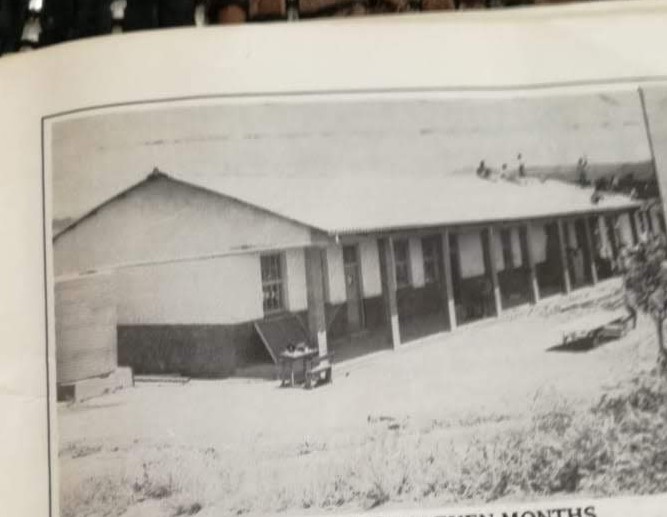
(This was the progress in the construction of the new school after 11 months)


Finally, the Natal Education Department came to the rescue to finance the school building project on a pound for pound basis.

Plans for five classrooms     were completed at an estimated cost of 26 300 pounds. Donations received from residents in Ottawa and Ottawa Sugar Estate were received. However, donations received were insufficient to cover the cost of the building.


                VOLUNTARY BUILDERS


In order to cover the COST OF LABOUR, it was decided to seek out people who could offer their building skills and services on a free and voluntary basis. Thus, Mr S.S. Maharaj, the School Grantee, founded the VOLUNTARY BUILDERS' ASSOCIATION; and Mr S.Badlu was elected the Foreman of the school building project because of his experience and expertise in the building industry. Together with Mr S.S.Maharaj, he approached the people of Ottawa who had some knowledge and skills of building. Among them were Mr M. Parthab, Mr M.M.Naicker, Mr Amrith Singh, Mr Bobby Singh, Mr Freddy Soobramoney and gradually other enthusiastic volunteers like Mr T. Balmohan and Mr Hiralall Maikoo joined in the spirit of selfless human solidarity and offered their services with love for the education of children in the Community of Ottawa.

(Mr S S Maharaj, seen here with his wife, was one of the most prominent leaders who played a major role in the promotion of education in Ottawa through the building of schools in the village.)


When the school project got off the ground in 1957, Mr S.S.Maharaj would go round Ottawa to round up the voluntary builders who promised to begin the project. Gradually, with the progress of construction the spirit of voluntary building spread among the people, and both young and old converged on the school building site to assist with the construction through the labour of love, excitement, and sheer enthusiasm.

All voluntary builders would meet on Saturdays, Sundays and Public Holidays and during their annual holidays. Work on the project would commence at 5.30 am and finish as late as 7.30pm in summer.

Lunch was provided for all builders and workers on site and the grocery and vegetables were all sponsored by merchants in Durban. The spirit of co-operation and hard work on a voluntary basis saw the school project progress brick by brick each week-end and holiday period until the first five classrooms were ready by the end of 1957. On completion of the first five classrooms, it was decided to transfer a few classes from the old wood and iron building to the new one.

(This was the school after 14 classrooms, kitchen and a caretaker's quarter were built in the early 1960s.)


At the subsequent meetings of the Committee, it was decided to extend the building from five classrooms to 14 classrooms, including an administrative office and staff room. It was also decided to add a kitchen for preparation of school meals and a caretaker's quarters. A terraced pavilion was also planned for the playground for pupils to sit.


MR M M NAICKER AND MR S BADLU – OPENING OF SCHOOL IN MARCH 1962


It took about five and half years to complete the whole project of the new Jhugroo State-Aided School. In honour of the excellent services rendered, Mr M. M. Naicker was given the honour to lay the Foundation Stone while Mr S.Badlu, the foreman of the project, was honoured with the official opening of the school on 24 March 1962.

With the final completion of the school project driven by the spirit of co-operation and selfless dedication, the voluntary builders, under the able supervision of Mr S. Badlu, finally breathed a sigh of relief and satisfaction of service rendered. More so, they were happy that the children of Ottawa would not be turned away from school for lack of accommodation. Jhugroo Primary School is the only school to be constructed exclusively by voluntary labour in the community of Ottawa. Today the school stands as an outstanding cultural monument of outstanding community effort for generations to come.


(Mr Dhanraj Sivasanker (seated centre) was one of the teachers at the new school. The principal seen here is Mr Krishna Maharaj (seated first left)


PRESENT AND FUTURE GENERATIONS MUST TREASURE THE JHUGROO PRIMARY SCHOOL


As a mark of respect and honour, it is hoped that the present and future residents of Ottawa shall treasure JHUGROO PRIMARY SCHOOL as an educational monument of selfless sacrifice in memory of the Pioneer Residents.

We also owe our heart-felt gratitude and blessings to all voluntary workers who devoted their time and energy under the able supervision and expertise of Mr S. Badlu for his commitment and high professional workmanship on a voluntary basis.

(Mr Sivasanker Badlu and his wife, Bhagirathri. Mr Badlu played a major role in the upliftment of education for the children of Ottawa through his untiring efforts in the construction of at least four school projects in the village.)


Mr S. Badlu's Life's purpose and passion to serve the community in which he lived was inspired by his Faith and Belief in "SERVICE TO GOD IS SERVICE TO HUMANITY" and in all humility he expressed his sincere gratitude to God for blessing him and his team of voluntary workers with excellent health, courage, strength and spiritual power to complete the project for the good of the present and future generations who attend Jhugroo Primary School.

And as a mark of great appreciation and inspiration, ex-students hold Jhugroo Primary in very high esteem as their alma mater and feel greatly honoured and grateful for the education received under the excellent tutelage and guidance of educators who made a significant difference to their lives. Their basic primary education had a positive influence on their progress and performance at high school where they eventually matriculated. Their matriculation certificates opened the doors to higher learning institutions such as colleges, technikons and universities where they qualified with degrees, diplomas and trade certificates.

Many of the past students over the years qualified as doctors, dentists, nurses, pharmacists, teachers, lawyers, accountants, engineers, architects and artisans. These men and women had fulfilled the dreams and wishes of the great forefathers who believed that education was the most valuable tool for humanity to survive in any society. Ends – Oct 16 2023


OTTAWA PIONEER RESIDENTS - INTRODUCTION


(This school photo is one of the historical memories of our village of Ottawa. In this photo are boys and girls from historical families and school teachers who are also from our village. They attended the new Jhugroo Primary School in the Tin Town area of the village. On the left is school principal, Mr S S Maharaj, and in the centre is Mr Dhanraj Sivasanker, who is part of the Sivasanker Badlu historical family of Kissoon Road. The name of the teacher on the right is not known.)


INTRODUCTION

This internet site has been created to publish the History and the stories of Pioneer residents of the little village of Ottawa, situated between the towns of Mount Edgecombe and Verulam, on the North Coast of the province of KwaZulu-Natal in South Africa.

The internet site is called Ottawa Pioneer Residents.

The articles, stories and photographs of the Ottawa Pioneer Residents will also be published on Facebook and What’s Up sites.