Sunday, July 14, 2024

GRIFFITH MXENGE AND MRS VICTORIS NONYAMEZELO MXENGE – FREEDOM FIGHTERS WHO SACRIFICED THEIR LIVES


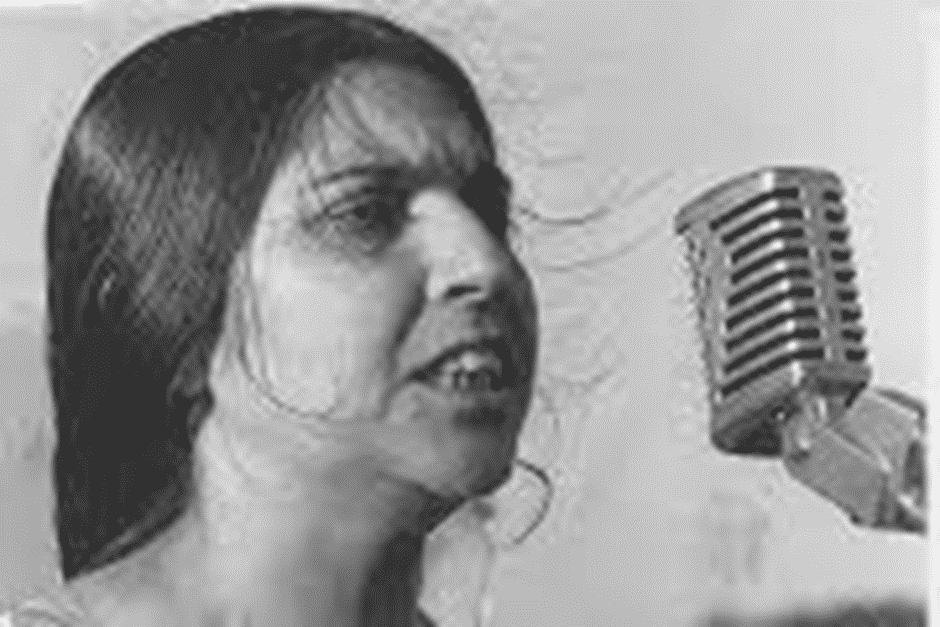
(Griffith Mxenge)                                                         (Victoria Mxenge)

REMEMBERING GRIFFITH MXENGE AND HIS WIFE,

 MRS VICTORIA NONYAMEZELO MXENGE – WHO

 WERE BOTH BRUTALLY MURDERED BY THE

 APARTHEID POLICE IN DURBAN IN NOVEMBER 1981

 AND AUGUST 1985 RESPECTIVELY

AUGUST 3 2024

INTRODUCTION:


On August 8 1985, the Press Trust of SA Third World News Agency, which paid a heavy price for supplying the world with news and reports about the struggles in South Africa at that time, published a lengthy article about the life of political trials lawyer, Mrs Victoria Nonyamezelo Mxenge.

We at PTSA had written the profile only seven days after Mrs Mxenge was brutally murdered in the driveway of her home in the Umlazi township in Durban. She was stabbed and shot to death by four unknown assailants after she got out of a car driven by the Reverend Mcebisi Xundu, who was the chairperson of the United Democratic Front (UDF) in Natal at that time.

Her husband, political activist, political trials lawyer and former Robben Island prisoner, Griffith Mxenge, was stabbed to death brutally more than 40 times five years earlier in November 1981.

Her death raised suspicions that apartheid death squads were cold-bloodedly culling the ranks of black activists in South Africa. 

Mrs Mxenge, who was one of the defence attorneys in the trial in which 16 UDF leaders faced high treason charges, was the 40th black activist to have been killed brutally or to have disappeared mysteriously since the violence in the townships erupted once again in September 1984. After our freedom in 1994, it was disclosed that apartheid security agents, led by Dirk Coetzee, had been responsible for their brutal murders. Sadly, they were granted amnesty by the Truth and Reconciliation Commission (TRC) after they disclosed their roles in the murders of the Mxenges.

                          (Griffith and Victoria Mxenge)

This article, written as a tribute to Mrs Mxenge’s sacrifices and dedication to the struggle, was supplied to news organisations and radio stations around the world in August 1985. The article was based mainly on interviews that this correspondent, Subry Govender, had  conducted with her after the brutal death of Griffith Mxenge in November 1981.

Subry Govender conducted the interviews with Mrs Mxenge under trying conditions because of the political repression of journalists and activists at that time. On the 39th anniversary of her demise, Govender writes that Mrs Mxenge’s life – especially her early years and when being married to Griffith Mxenge - was rich in history and should never be forgotten.

(Some activist members attending the funeral of Mrs Victoria Mxenge in the Eastern Cape in August 1985)

TEXT

----------------

When I spoke to Mrs Victoria Nonyamezelo Mxenge in 1982, she represented the life of being a typical political widow who had been forced out of circumstances to fill the roles of mother, father, breadwinner and even a  political personality in the community.

Born on 1 January  1942 in the little village of Tamara in the Eastern Cape region of South Africa,  she grew up as a country girl with a sister and two brothers who spent their young lives in carefree oblivion of the political situation developing in the rest of the country.

As the second child of simple and humble parents who were teachers, she began her education in the local village school where she was one of the top pupils in her class. At the tender age of 12 she had to leave home to attend secondary school at Beaufort West, also in the Eastern Cape. After obtaining her matriculation certificate, she joined the Lovedale Hospital in the university town of Alice to train as a nurse.

It was during her student days at the hospital that she came into contact with the young and idealistic Griffith Mxenge who went to visit an  aunt in Tamara. The young couple became friends after their first introduction.

She and Mr Mxenge, who was studying for his law degree at the University of Fort Hare at this time, began dating and by the time he went to Durban to complete his LLB (Bachelor of Law) degree at the University of Natal, their romance had blossomed and they married in November 1964.

In 1965, Mrs Mxenge moved to Durban to join her husband and enrolled at the King Edward V111 Hospital for a course in midwifery.

The young couple got their first taste of Pretoria’s political repression against opponents of apartheid when in April 1966 Griffith was detained by the then dreaded security police for 190 days. At the end of the detention, he was charged under the Suppression of Communism Act and in February 1967 was convicted for three years. Mr Mxenge served a part of his sentence on Robben Island with leaders such as Nelson Mandela, Walter Sisulu, Raymond Mahlaba, Govan Mbeki, Andrew Mlangeni and Ahmed Kathrada.

While Mr Mxenge was on the island, Mrs Mxenge gave birth to their first child, Madasa.

Although life with a newly-born son and without work was traumatic, she managed to make ends meet with the help of friends.

When Griffith Mxenge was released at the end of his three-year term, he was served with a two-year banning order and prevented from continuing with his studies at the University of Natal. Despite the pressures of security police harassment and financial problems, Mr Mxenge  completed his law degree with the help of a lecturer in February 1968. And when his banning order expired at the end of 1971, he joined Natal Indian Congress official,  Rabbi Bugwandeen’s law form as an articled clerk. But the security police and the apartheid system did not leave him alone. Just when he was about to complete his articles in 1973, he was slapped with another banning order.

Although they had to put up with the accompanying difficulties and problems, their  marriage had thrived and in December 1973 their second son, Viwe, was born. By this time, she  had completed her midwifery course and joined a clinic in Umlazi where she worked with a “wonderful white doctor”, Dr Wolfgang Bordenstein.

“When I went for an interview, I told the doctor all about Griff’s political activities but the good doctor accepted me without any question.

“The matter, however, did not rest there. A few days after I started work, the security police called on Dr Bordenstein and told him about my background. But since he was already aware of my position, he treated me with the greatest of respect.”

In 1975, her husband’s newly-established law practice was booming and Mr Mxenge was finding it difficult to cope with the work-load. He was looking for someone to assist him and soon found that he could not find a better person than his wife.

After some cajoling on her part, Mr Mxenge  employed her as his clerk. She immediately enrolled with the University of South Africa to study law and by the end of 1979 had passed all her subjects except for one – Afrikaans. With the assistance of a friend, she passed Afrikaans in 1980 and in 1981 joined Griffith as a fully-fledged lawyer in her own right.

But just when she and Mr Mxenge had earned the respect of the entire black community as dedicated political trial lawyers, she was woken up in the early hours of November 18 1981 and told her husband was found dead at the local Umlazi stadium.

When discussing her husband’s death, Mrs Mxenge conceded that she was very bitter.

“The perpetrators of the dastardly deed were not satisfied with the taking of his life only but like the butchers they are, they savaged every part of his body. Every vital organ in his body was savaged. His ears, stomach and even his liver was ripped open,” she whispered and the pain was clearly etched on her face.

(Freedom activists carrying the coffin containing the body of Mrs Victoria Mxenge during her funeral service in the Eastern Cape Town in August 1985.)

And as if the brutality inflicted on her husband was not enough, she had to bear the further pain of seeing the confusion suffered by her children, who could not understand why their father had been butchered in such a manner.

“My six-year-old daughter wanted to know why her father, who was so young had to die when her grandfather was still alive? “What could I tell her? And my eldest son, who was in the middle of his Junior Certificate examination, became a ‘zombie’ after he learnt of his father’s death. He was completely unapproachable. He did not shed a tear but just drew into himself. As his mother I could not even talk to him because I did not know what to say to him. Yet he completed his examination and after writing his last paper, flew with his father’s body from Durban to King William’s Town where the funeral took place.”

In 1982, almost a year after Griffith death, Nonyameselo Mxenge was picking up the pieces and building a new life for herself and her children without her beloved husband. She and her children were going about their lives in the full knowledge that Mr Mxenge had not died in vain – they were in fact confident that freedom struggle would be won with a matter of a few years.

“One day – in the lifetime of my children and myself – we will be free and independent.”
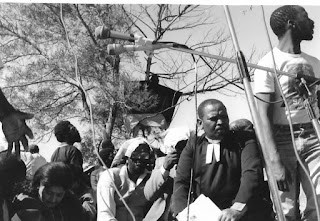
(Some anti-apartheid leaders at the funeral of Mrs Victoria Mxenge in the Eastern Cape in August 1985)

But, sadly she was not able to witness the arrival of freedom and the installation of Nelson Mandela as the first democratic president after the elections in April 1994. Like her husband, she too was brutally hacked to death on August 1 1985.

It was a painful and sorrowful life and, one hopes that she and her husband had not sacrificed their lives in vain. Their lives should become part of our history and not forgotten in our new South Africa. I am sure both Griffith and Victoria Mxenge must be deeply disappointed with the sad state of affairs affecting our country today. They must be hoping that the social, economical and political situation would be boosted to ensure “a better life” for all South Africans. Ends – subrygovender@gmail.com  August 3 2024


Wednesday, July 10, 2024

“ACTIVE LIFE STYLE” IS THE SOLUTION FOR SECOND GENERATION INDENTURED DESCENDENT WHO HAS TURNED 100


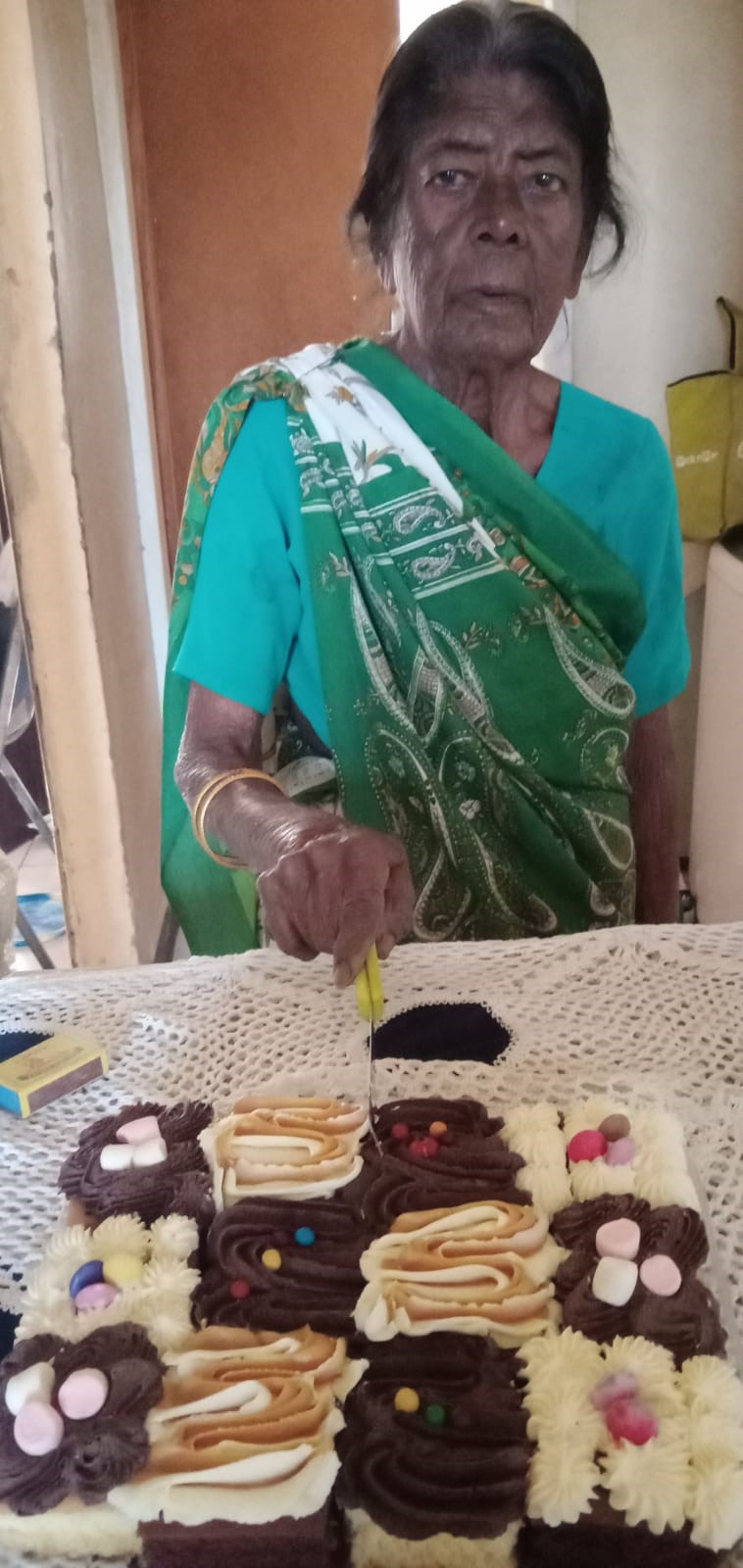
MRS CHANDERKALA DHANAI OF EASTBURY IN PHOENIX, DURBAN, WHO HAS TURNED 100


(Mrs Chanderkala Dhanai seen with family members, Dayanundh Ramsuran, and Mrs Jasoda Ramsuran at her home in Eastbury, Phoenix.)


CENTURION WORKED AS A GARDENER AT THE MOUNT EDGECOMBE SUGAR ESTATE GOLF COURSE FOR MORE THAN 40 YEARS


By Subry Govender


A second generation descendent of indentured labourers, who worked for a better part of her life as a gardener at the Mount Edgecombe sugar estate golf course, has just turned 100 at her home in nearby Phoenix.

Mrs Chanderkala ‘Thara’ Dhanai, who was born on June 13 1924, celebrated her remarkable milestone at her home in Eastbury, Phoenix, where she has been living with her daughter, Shamala Dhanai, for the past 42 years.

When I arrived at her home on the morning of July 3 to talk to Ms Dhanai about her mother’s life, she was busy “as usual” sweeping the yard and helping with the “clean up”.

“What you have just seen is nothing new or unusual about my mother. She is very independent and helping with the cleaning up of the house, washing the pots and dishes, preparing her own food and being hands-on are all part of her life now,” Ms Dhanai told me at the start of the interview.


(Mrs Chanderkala Dhanai celebrating her 100th birthday.)

Before we could get down to details about her life, the grand centurian surprised me by saying:  “Namasthe Bhai. Can I make you a cup of tea?”

 She made this gesture while at the same time ensuring that my seat was comfortable and everything was in order.

Her life as a cleaning lady and gardener at the Mount Edgecomnbe Sugar Estate golf course began in the late 1930s when at the young age of 13, her parents made arrangements for her to marry Mr Tunniah Dhanai, who lived with his family at the sugar estate Mill Barracks with his parents and siblings.

Re-living the early days through her daughter, Mrs Dhanai said the conditions were tough and arduous because for most part of the period she had to “work without shoes”.

While her husband worked at the Huletts Sugar Mill, she had to toil at the golf course for long hours under difficult conditions for more than 40 years. She also had to take care of her three sons and one daughter. One son passed away at an early age while staying in Phoenix.

Mrs Tuniah recalled that she was born on a farm in the Chatsworth area of Durban in the 1920s along with five brothers and three sisters. Her father, Harricharan Durga, worked as a printing technologist at the then Natal Mercury in central Durban. Her mother worked as a gardener.

Her grand-father, known as Budhai, arrived in South Africa as an indentured labourer in the late 1890s. He was at first recruited to work in the sugar cane fields in Trinidad and Tobago but due to some problems, he was escorted back to the ship and told that he was being taken back to India. But on the way he was allowed to disembark at the Port of Durban. He was recruited to work as an indentured labourer at one of the sugar estates in the then Natal Colony.

Mrs Dhanai’s adult life started at the young age of 13 when she was married off to her sugar cane labourer’s husband in Mount Edgecombe.  Here, while first working at the Briardene Prawns Factory and later at the Mount Edgcombe sugar estate golf course, Mrs Dhanai  bore four sons and a daughter.

Mrs Dhani, her husband, three sons and daughter were forced to move out of Mill Barracks after he was relieved of his position at the Hullets Sugar Mill.

The family moved to Campell’s Town in Mount Edgecombe in the 1960s and Mrs Dhanai and her husband had to struggle “to put food on the table”. Her husband was fortunate to find a labourer’s job at the old Hullets Hospital in Mount Edgecombe.

In 1982 Mrs Dhanai, her husband and daughter moved to a council house in Eastbury, Phoenix, at a time when her three sons had married and started their own families.

When in 1986 her husband passed away, Mrs Dhanai once again resumed her working life after being offered a job as a caretaker and cleaner at the nearby Stanmore Primary School.


(Mrs Chanderkala Dhanai outside her home in Eastbury in Phoenix recently.)

“Here my mother worked cleaning up classrooms and the school yard and ground for more than 10 years. After the tenure at Stanmore Primary, my mother continued to keep busy by cleaning sheep head and tortoise and selling the meat to local people,” said Ms Dhanai.

“In her old age now, she still keeps busy. Everyday, when she gets up in the morning, she has a bath and then prepares her own meal. She does not like a lot of curry. My mother then helps with whatever cleaning in the house and yard.

“She is very independent and does not want to lie idle. Only last week she helped with the cleaning of sheep head and tortoise and washing dishes at a family function.

“She also sews her own clothes. She also loves doing some gardening.”

Because of her active life style, Mrs Dhanai has stayed clear from chronic medication and is not affected by diseases such as Sugar Diabetes and Hypertension.

“You know during the Covid pandemic two years ago, she was also affected. But she overcame the pandemic without any problems.

“She has found no reason to visit doctors for a long time because she enjoys a healthy life.”

Mrs Dhanai, whose extended family has reached six generations, has four children, 13 grand-children and nine great-grand-children. She also has four brothers, three sisters and scores of nephews and nieces.

“My mother, at her age, still recognizes her family members through their names.

“She is a role model to her family, friends and the community around her.”  Ends – June 3 2024 : subrygovender@gmail.com

Friday, April 5, 2024

MANY SOUTH AFRICANS FEEL LOST AND UNCERTAIN AT A TIME WHEN THE COUNTRY’S 6TH DEMOCRATIC ELECTIONS TAKE PLACE ON MAY 29 (2024)


 BY SUBRY GOVENDER


With political parties and their leaders out in full force trying to influence the electorate for the May 29th general elections, a significant percentage of people find themselves in a state of “loss and uncertainity”.

This unfortunate situation has arisen despite the fact that many activists and members of the different communities believed that the new South Africa would be non-racial in character and they would have no worries.

The ANC became their first choice in 1994 after the progressive United Democratic Front (UDF) and the Natal Indian Congress, which was the mouthpiece of the Indian-origin community since 1894, was allowed to fade out of existence in the run-up to the first democratic elections about 33 years ago.

But after the race factor had been thrown around by some political leaders, a number of prominent progressive leaders and activists felt that some communities had no voice to articulate their aspirations and concerns in the new South Africa.

In this article on life after the UDF and the NIC, veteran journalist, Subry Govender, poses the question whether the decision to allow the UDF and NIC to fade out of existence in 1994 was the correct move? 


THE PEOPLE COMPLAIN OF A LACK OF LEADER OR ORGANISATION TO GUIDE THEM AND PROVIDE THEM WITH CONFIDENCE


 “If peace means keeping my mouth shut in the midst of injustice and evil, I don’t want it. If peace means a willingness to be exploited economically, dominated politically, humiliated and segregated, I don’t want peace.” – Martin Luther King, Jr.


( PROFESSOR FATIMA MEER) 


Sometime in 2008, I had the privilege of talking to one of our formidable social and political activists and authors, Professor Fatima Meer, when she was celebrating her 80th birthday. The quotation by American Civil Rights leader, Dr Martin Luther King, Jr, above reflected the feelings of Professor Meer at that time. I spoke to her at a time when many former activists of the UDF, NIC and other progressive organisations and leaders were becoming disillusioned at the movement away from our true values and principles of a non-racial and democratic society. 


                             RACIAL DIATRIBE  


This had come about following racially-inciting diatribe by some political leaders who wanted to gain the political limelight not through progressive values and principles, but through racial mongering.

It was also at a time when people were becoming concerned at the falling standards in our educational and health sectors; the increasing rate of unemployment among the poor and marginalised people; and the fact that most people live like hostages in their homes because of the high and increasing violent crime wave.

This disillusionment was reflected in the manner in which the people voted in the 2014 general election, the subsequent 2016 local government elections and once again in the 2019 general elections.


(SOME OF THE CONGRESS LEADERS OF THE PRE-1994 ERA - DR JERRY COOVADIA, THUMBA PILLAY AND SWAMINATHAN GOUNDEN - WHO TOOK PART IN AN ANTI-CORRUPTION PROTEST IN DURBAN IN 2016) 


UNITED DEMOCRATIC FRONT AND NATAL INDIAN CONGRESS 


Now in 2024, when political parties are busy with their election campaigns for the scheduled May 29 general elections, many people are asking whether the communities had been let down by the progressive and revolutionary UDF and NIC being  forced to shut shop in the early 1990s.

This action was taken when the ANC informed the leaders of the NIC at that time that there was no longer any need for the NIC because the people could now become members of the ANC and that there would be no need for any worries. 


                     NELSON MANDELA


This action was taken even though the leader of the ANC and the President of our first democratic South Africa, Nelson Mandela, advised that the NIC should remain because it had a historical background and linked to Mahatma Gandhi.


NIC LEADERS MEET WITH MANDELA IN JANUARY 1994 


Mandela outlined his views when leaders of the NIC held a meeting with him at the ANC headquarters in Shell House in Johannesburg on January 19 1994. Mandela told the NIC leaders that he appreciated the role played by the NIC during the struggle years. He pointed out that for all intents and purposes the NIC was the ANC when the organisation was banned since 1960 and when most of the leaders were either in exile, in jail, banned, detained or house-arrested. He said for this reason the NIC should remain as a historical partner of the ANC and to continue to mobilise the community. 


MANDELA WANTED THE NIC TO CONTINUE AS A SOCIAL PARTNER OF THE ANC


(ANOTHER NIC LEADER PRE 1994 - DR FAROUK MEER - TALKING TO PREMIER WILLIES MCHUNU AT A FUNCTION IN DURBAN A FEW YEARS AGO) 


Many leaders such as Judge Thumba Pillay, Dr Farouk Meer, George Sewpersadh, M J Naidoo, and Paul Devadas David supported Mandela in his view that the NIC should remain, not as a political party, but as a progressive social organisation aligned to the ANC.


Now 30 years into our new South Africa, many people are saying that most descendants of the 1860 generation are not only feeling “lost and uncertain”, but also don’t have an organisation that they could align to.

Their main concern is: “What is the future of our grand-children?” in a society where there’s so much racial profiling, racial mongering and lawlessness – all anti-social evils that are totally against the true values and principles of the ANC. 


                                    M J NAIDOO


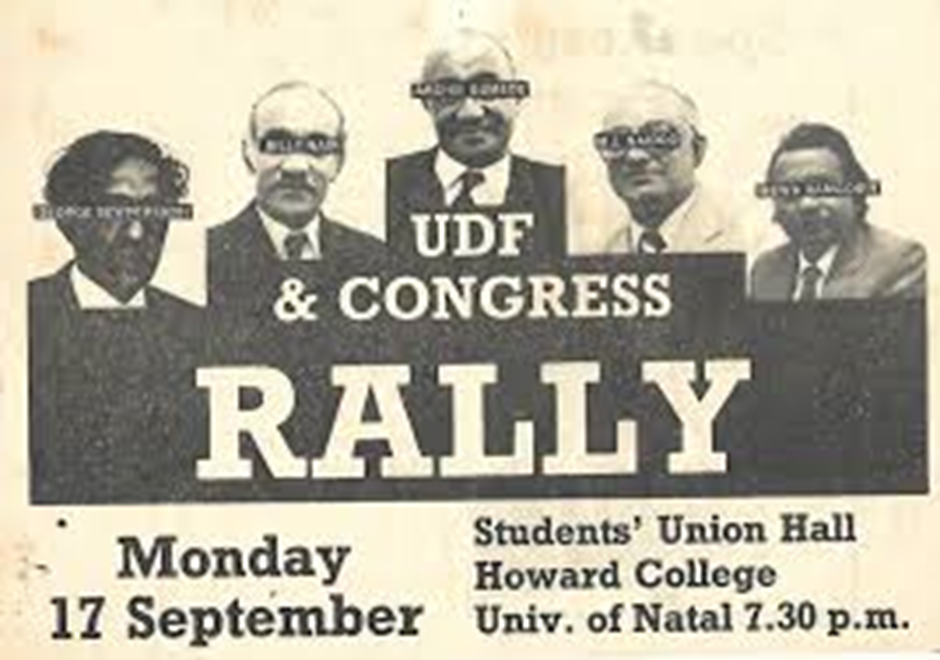
(M J NAIDOO (FOURTH FROM RIGHT) AND GEORGE SEWPERSADH, BILLY NAIR, ARCHIE GUMEDE AND MEWA RAMGOBIN WHO TOOK REFUGE AT THE BRITISH CONSULATE IN DURBAN IN THE 1980s to ESCAPE FROM THE APARTHEID SECURITY POLICE) 


They say that Mr M J Naidoo, a former president of the NIC, was one of the leaders who clearly outlined what kind of a future South Africa they would like to see.

This is what he said at a protest meeting in Durban in the 1980s:

“My message for South Africa is that everyone should show a concern for peace and prosperity for all its people. Where selfish interests, greed and a feeling of superiority and arrogance holds sway, there can be no real peace or prosperity.


“Everyone in South Africa – black, brown or white – should, therefore, dedicate oneself with the urgency that the South African situation deserves, to the task of building a United South Africa and to spreading the sunshine and plenty to all its people.” 

Many of the people say that the current ANC, which President Cyril Ramaphosa is trying his best to resuscitate and become relevant, has too many challenges to worry about people who are classified as a “minority”.

They say that if the NIC or any other progressive organisation like the UDF was around, then the people would not feel isolated or marginalised. 


                 PROFESSOR FATIMA MEER 


Sixteen years ago, when I interviewed Professor Meer on her 80th birthday she was also of the view, like Mandela, that the NIC or the UDF could have allayed the fears and anxieties of the people who feel marginalised and lost.

She told me: “You see the people had a very strong organisation in the Natal Indian Congress and I wrote to Mr Mbeki long, long ago that it had been a tragedy that the ANC had asked the NIC to be disbanded because that was an organisation founded by Gandhi in the last century.

“It was an organisation that stood by the ANC always. Now the ANC had made the biggest mistake. Politically as a political party, the ANC was fine and totally acceptable but to organise the people, they needed an organisation.”

Professor Meer was of the view that the history of the people of Indian-origin in the Natal Indian Congress, Transvaal Indian Congress and the South African Indian Congress could not be de-linked in the new South Africa.

“This was a very rich history. You don't want to miss out on that history. You want to build on that history. It is a pity that it was disbanded at all.

“I would prefer we resurrect our roots and our history and the ANC must recognise that what the Indian Congress had contributed in the time of revolution, will today, in the time of government, continue to give it support in all fields.” 

Many other former activist leaders such as Judge Thumba Pillay and the late Dr Farouk Meer, Swaminathan Gounden and George Sewpersadh also expressed similar sentiments since 1999.


GEORGE SEWPERSADH 


Mr Sewpersadh, president of the NIC when negotiations against white minority rule and domination were taking place in the early 1990s, was particularly concerned that those left behind after 1994 and those struggling for livelihoods would be affected gravely by the absence of an organisation such as the UDF or NIC.  


Early this week I talked to Ashwin Ramchand, a concerned South African who is involved in the import and export industry in Durban.

He expressed his serious disillusionment with the current social and political tendencies and state of affairs.

“I have no leader or organisation that I can look up to for advice or direction. There is no organisation that is taking up social and other issues of concern to me and other people in the different communities.

“I thought President Cyril Ramaphosa would be okay in 2019 but over the past five years he has demonstrated that he is not strong enough to tackle the serious challenges facing the people.

“What do I and others do under these circumstances? 

“If we had an organisation such as the UDF we would have no worries because we would know that someone is taking up our concerns. Now we are lost. As far as I am concerned the NIC always promoted the interests of all South Africans and not a particular people.” 

Mr Dhavanathan Govender, a building contractor of Verulam, told me he could take care of himself without any organisation but he asked: “What about the people living on the margins of society?”

He added: “At least if there was an organisation like the NIC or the UDF, the people who are struggling can look up to these organisations for direction and advice. Now they don’t have any leader or organisation who can give them hope. Many people in our communities are lost. “Something must be done to bring hope to the people.” Ends – subrygovender@gmail.com April 5 2024