Monday, January 28, 2013
ANNUAL KAVADY CEREMONY DRAWS IN TENS OF THOUSANDS OF DEVOTEES
By Subry Govender
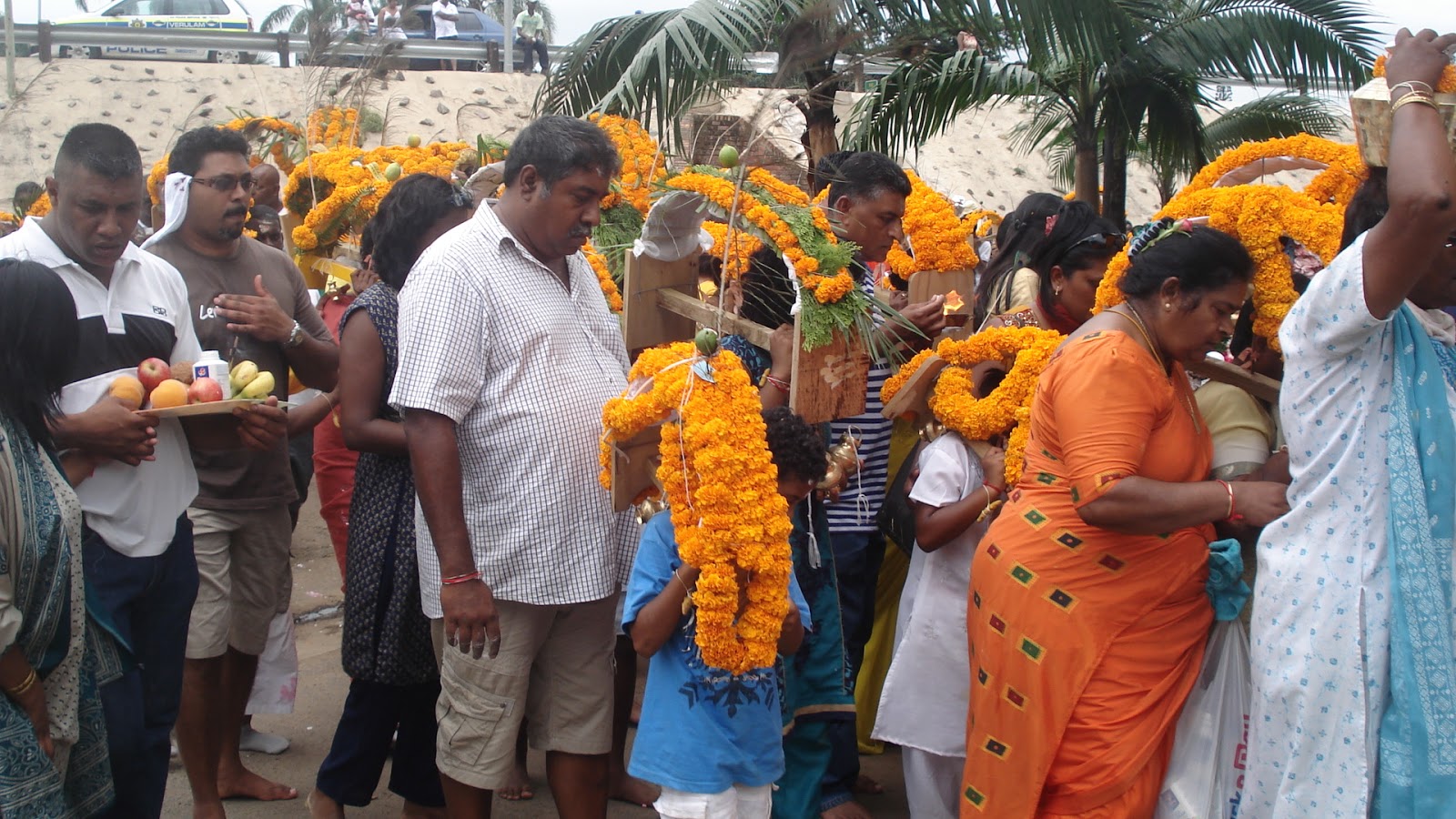
The annual Kavady ceremony has drawn thousands of worshippers, their families, friends and the people in general at temples and other religious intsitutions all over the country on Sunday, January 27.
The participants, dressed in traditional sacred clothing and with their foreheads bearing the Namo symbols, gathered for the ceremony all over the North Coast, South Coast, central Durban, Pietermaritzburg, Johannesburg, Pretoria, Cape Town and even in Port Elizabeth and East London.
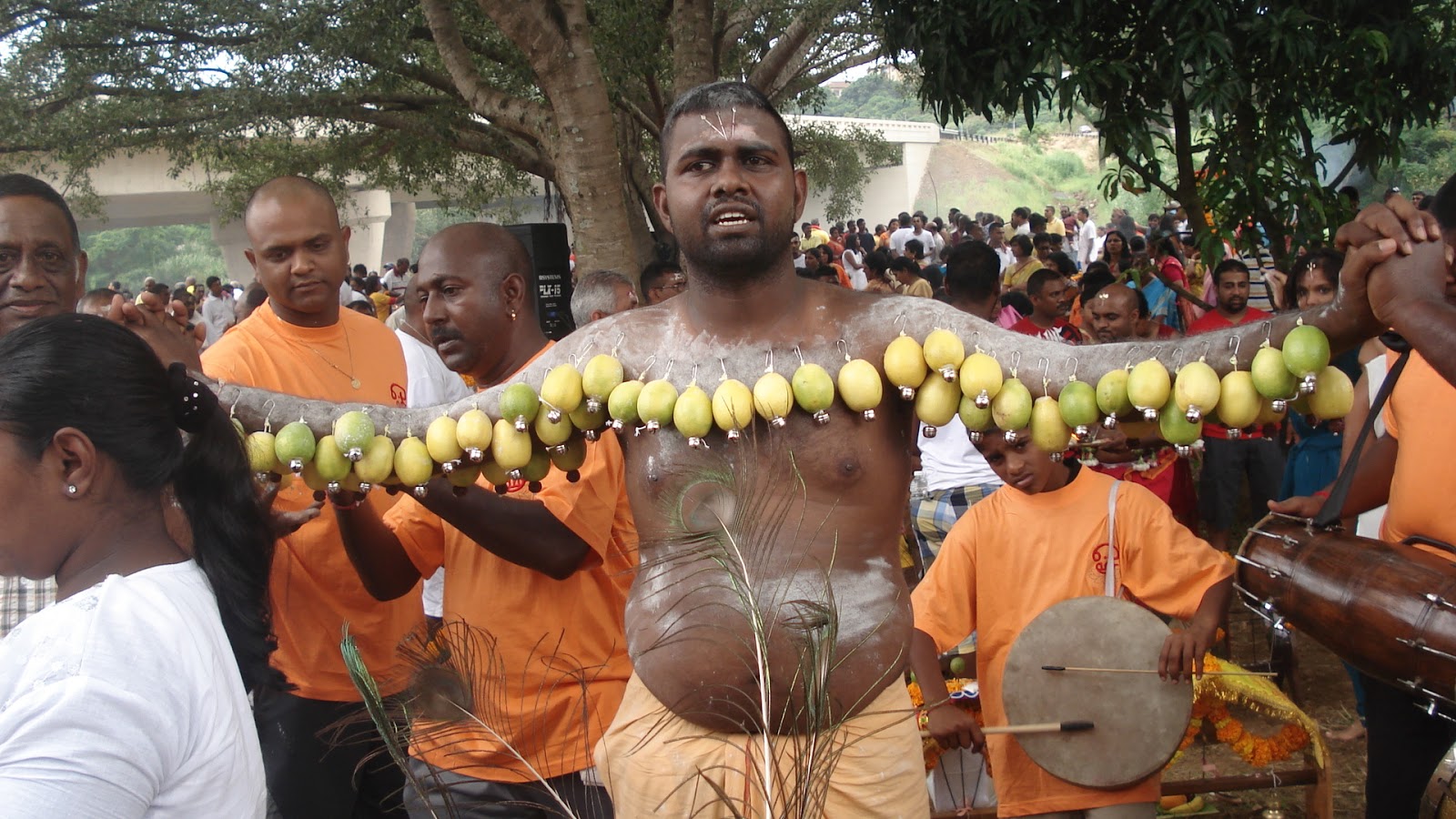
One of the biggest and well-attended ceremonies took place at the Umdloti Drift Shree Siva Subramaniar Alayam in Verulam. Here the devotees, many with their bodies, hands and faces bearing needles and other religious instruments, sang and danced with vigour and commitment - praising the deity, Lord Muruga. Lord Muruga is understood to heal the sick and eradicate all social and other problems encountered by the people.
There were more than 1 200 devotees standing in a long line to walk into the temple and conduct their prayers.
"This is one of the most holiest ceremonies conducted by the people since our forefathers came to this country more than 152 years ago," said Professor Sundru Kisten, who is the chairperson of the Umdloti Drift Temple.
"Our temple alone is more than 115 years old and this ceremony has been going on since its foundation. The devotees find that Lord Muruga answers their call to overcome any sickness and social problems they encounter.
"The devotees fast for 10 days, abstaining from all worldy luxuries and pleasures. We are so happy that thousands of people have come to the temple today to participate and witness this glorious religious ceremony."
Professor Kisten said the Kavady ceremony demonstrated the commitment of the people to becoming involved in their cultural and religious traditions and values.
Another senior official, Mrf Reggie Naidoo, said the Kavady ceremony involved a great deal of preparations by a dedicated group of people.
"For instance we had to prepare 28 pots of beryani and three pots of dhall to feed the people. In order to do this we had to speak to well-wishers and donors to obtain the necessary food stuffs. The people involved in cooking the meals had to come to the temple a little after mid-night on Sunday morning to carry out the necessary tasks.
"We are really grateful to all those involved in the preparations and successful conclusion of the Kavady ceremony."
Mr Naidoo said this year there were many people who were people with a Hindi background who had also taken part in the Kavady ceremony.
"We also had an African mother and her child carrying the Kavady this year," he said.
One of the devotees, Mr Barry Naicker, said the Kavady ceremoney brought a great deal of spiritual satisfaction to him and his family.
"We are truly blessed to participate in this Kavady and here at Umdloti we gain a great deal of spiritual upliftment."
A visitor to the Kavady, Mr Richard Govender, of Effingham, said he was highly-impressed with the huge turn-out and the manner in which the Kavady was organised.
"The people involved must be congratulated for their efforts. Their sacrifices in time and money are contributions to the development of our communities," he said.
"I want to urge our people to re-commit themselves to their spirituality, cultures and traditions because without this we will be a lost community. We have to preserve and promote all that is good that have been left by our forefathers, who sacrificed so much for us.
"I want to encourage Umdloti temple and others to continue with the very good and magnanimous work they are doing." ends
ANNUAL KAVADY DRAWS IN TENS OF THOUSANDS DEVOTEES IN SOUTH AFRICA
By Subry Govender
The annual Kavady ceremony has drawn thousands of worshippers, their families, friends and the people in general at temples and other religious intsitutions all over the country on Sunday, January 27.
The participants, dressed in traditional sacred clothing and with their foreheads bearing the Namo symbols, gathered for the ceremony all over the North Coast, South Coast, central Durban, Pietermaritzburg, Johannesburg, Pretoria, Cape Town and even in Port Elizabeth and East London.
One of the biggest and well-attended ceremonies took place at the Umdloti Drift Shree Siva Subramaniar Alayam in Verulam. Here the devotees, many with their bodies, hands and faces bearing needles and other religious instruments, sang and danced with vigour and commitment - praising the deity, Lord Muruga. Lord Muruga is understood to heal the sick and eradicate all social and other problems encountered by the people.
There were more than 1 200 devotees standing in a long line to walk into the temple and conduct their prayers.
"This is one of the most holiest ceremonies conducted by the people since our forefathers came to this country more than 152 years ago," said Professor Sundru Kisten, who is the chairperson of the Umdloti Drift Temple.
"Our temple alone is more than 115 years old and this ceremony has been going on since its foundation. The devotees find that Lord Muruga answers their call to overcome any sickness and social problems they encounter.
"The devotees fast for 10 days, abstaining from all worldy luxuries and pleasures. We are so happy that thousands of people have come to the temple today to participate and witness this glorious religious ceremony."
Professor Kisten said the Kavady ceremony demonstrated the commitment of the people to becoming involved in their cultural and religious traditions and values.
Another senior official, Mrf Reggie Naidoo, said the Kavady ceremony involved a great deal of preparations by a dedicated group of people.
"For instance we had to prepare 28 pots of beryani and three pots of dhall to feed the people. In order to do this we had to speak to well-wishers and donors to obtain the necessary food stuffs. The people involved in cooking the meals had to come to the temple a little after mid-night on Sunday morning to carry out the necessary tasks.
"We are really grateful to all those involved in the preparations and successful conclusion of the Kavady ceremony."
Mr Naidoo said this year there were many people who were people with a Hindi background who had also taken part in the Kavady ceremony.
"We also had an African mother and her child carrying the Kavady this year," he said.
One of the devotees, Mr Barry Naicker, said the Kavady ceremoney brought a great deal of spiritual satisfaction to him and his family.
"We are truly blessed to participate in this Kavady and here at Umdloti we gain a great deal of spiritual upliftment."
A visitor to the Kavady, Mr Richard Govender, of Effingham, said he was highly-impressed with the huge turn-out and the manner in which the Kavady was organised.
"The people involved must be congratulated for their efforts. Their sacrifices in time and money are contributions to the development of our communities," he said.
"I want to urge our people to re-commit themselves to their spirituality, cultures and traditions because without this we will be a lost community. We have to preserve and promote all that is good that have been left by our forefathers, who sacrificed so much for us.
"I want to encourage Umdloti temple and others to continue with the very good and magnanimous work they are doing." ends
Friday, January 18, 2013
Southside FM Radio - Latest developments
As at January 18 2013, Southside FM Radio is still negotiating with some political leaders about our attempts to obtain an FM frequency in and around the Durban area. ICASA has given FM frequencies in the Port Shepstone and Pietermaritzburg areas but we cannot start without Durban because it's in Durban that most of listeners, supporters and sponsors reside. ICASA says that it will consider a MW f...requency and we are awaiting their final details on this.
At the same time we are negotiating with the Parliamentary Portfolio Committee on Communications Chairperson, Mr Eric Kholwane, about our frequency problems in the Durban and his office has informed us that "Southside is our priority for 2013".
We are also making efforts to talk to the Premier of KwaZulu-Natal, Dr Zweli Mkhize.
As soon as our frequency is finalised, the hard work then begins. We will have to:
1). Finalise our premises with a proper lease agreement.
2). Recruit our presenters, reporters, advertising representatives and other staff members.
3). Train our presenters.
4). Build our studio.
It will take us at least three months to get off the ground once we obtain our frequency for Durban.
We will be a thoroughly professional outfit and fully independent of any outside influences.
If any one has any suggestion please contact: subrygovender@gmail.com or 082 376 9053/031 - 568 1309.
At the same time we are negotiating with the Parliamentary Portfolio Committee on Communications Chairperson, Mr Eric Kholwane, about our frequency problems in the Durban and his office has informed us that "Southside is our priority for 2013".
We are also making efforts to talk to the Premier of KwaZulu-Natal, Dr Zweli Mkhize.
As soon as our frequency is finalised, the hard work then begins. We will have to:
1). Finalise our premises with a proper lease agreement.
2). Recruit our presenters, reporters, advertising representatives and other staff members.
3). Train our presenters.
4). Build our studio.
It will take us at least three months to get off the ground once we obtain our frequency for Durban.
We will be a thoroughly professional outfit and fully independent of any outside influences.
If any one has any suggestion please contact: subrygovender@gmail.com or 082 376 9053/031 - 568 1309.
Tuesday, January 1, 2013
"Hey you coolies what you doing in our area," appeared to be the bark of the dogs.
MUNIEN KANIAMMA
DO DOGS DISPLAY THE CHARACTERISTICS OF THEIR OWNERS?
The controversy surrounding President Jacob Zuma's statement about people who love dogs more than human beings as "having a lack of humanity", brings another side to the issue.
I hold no brief for Zuma but his statement really brings to mind the situation during the dark days of apartheid and white "baas" mentality when dogs used to only bark at black people.
I recall my early days when my grand-mother, Mrs Kaniamma Munien, and I used to walk from Cato Manor to the Early Morning Market in Durban, we used to pass through white homes. My grand-mother, dressed in the traditional sari and carrying a basket on her arm, was one of the people who had no idea of the oppression inflicted on the black majority. All she knew was that the white man was "God" and the white woman was "madam" and we must treat them as such.
My grand-mother, descendant of indentured labourers, was married at a very early age to Munien, who arrived in South Africa at the age of nine with his aunt from a village called Damal in the southern Indian state of Tamil Nadu.
Kaniamma and Munien had nine children and they eked out a livelihood in the Cato Manor area of Durban. I was the son of their eldest son, Subramoney.
As a young boy I was regular at my grand-parents home and it was during these occasions that I used to accompany my grand-mother on foot to the Early Morning Market. We used to walk up a steep hill and then join the tarred road towards the market, which was situated in the Warwick Avenue area. I remember clearly that the University of Natal was situated in this area.
When passing through the white houses, the dogs used to run towards the gate and bark loudly at us. The dogs inside the properties of the white "basses" were vicious and they used to make us feel as if we were aliens - from another planet or outer space.
All kinds of vicious dogs from almost every white home used to bark at us until we were out of sight. Reaching the market area was a relief.
My grand-mother and I were not aware at that time that the white man's dogs were just displaying the racist attitudes of their masters.
In order to avoid any mishaps, we used to keep a safe distance from the gates of the homes we walked past.
There were buses running from Cato Manor to the Durban market area but my grand-parents were so poor that they could not afford the few cents for the bus fare. We had no other option but to walk.
After my grand-mother purchased the necessary vegetables, we used to take the same route back to Cato Manor Road. Once again the dogs gave us the same treatment.
"Hey you coolies what you doing in our area," appeared to be the bark of the dogs.
At that time it did not occur to me that the dogs barked at us because we were "dark skinned"?
Now why did these dogs bark at US only? Was it not because we were dark skinned - their owners were the "baas" and we were the "servants".
Why did the dogs not bark at white men, women and children?
Then there were experiences later in our lives when we progressed in our lives and moved to stay in an area on the North Coast. In this suburb most of the people were from the middle income class - they were teachers, lawyers, doctors, clerks and shop-keepers. They also lived behind high walls, huge gates and owned vicious dogs. These dogs also displayed the attitudes and behaviour of their owners.
They used to run to the gates and bark as loud as ever whenever they saw African people walk past. Now where did these dogs learn to bark only at African people?
Since1990, I have noticed that some dogs have changed their behaviour and now bark at all people. It seems all people - whatever your colour - are regarded as potential criminals and the dogs don't discriminate anymore? But do old attitudes die hard or do they just linger on?
I don't support the latest statement by Zuma because it's not the kind of statements that a First Citizen should be making at a time when we are trying to build a new, non-racial and democratic society.
But, nevertheless, we cannot run away from the fact that in many instances dogs imbibe and display the attitudes and characteristics of their owners.
DO DOGS DISPLAY THE CHARACTERISTICS OF THEIR OWNERS?
The controversy surrounding President Jacob Zuma's statement about people who love dogs more than human beings as "having a lack of humanity", brings another side to the issue.
I hold no brief for Zuma but his statement really brings to mind the situation during the dark days of apartheid and white "baas" mentality when dogs used to only bark at black people.
I recall my early days when my grand-mother, Mrs Kaniamma Munien, and I used to walk from Cato Manor to the Early Morning Market in Durban, we used to pass through white homes. My grand-mother, dressed in the traditional sari and carrying a basket on her arm, was one of the people who had no idea of the oppression inflicted on the black majority. All she knew was that the white man was "God" and the white woman was "madam" and we must treat them as such.
My grand-mother, descendant of indentured labourers, was married at a very early age to Munien, who arrived in South Africa at the age of nine with his aunt from a village called Damal in the southern Indian state of Tamil Nadu.
Kaniamma and Munien had nine children and they eked out a livelihood in the Cato Manor area of Durban. I was the son of their eldest son, Subramoney.
As a young boy I was regular at my grand-parents home and it was during these occasions that I used to accompany my grand-mother on foot to the Early Morning Market. We used to walk up a steep hill and then join the tarred road towards the market, which was situated in the Warwick Avenue area. I remember clearly that the University of Natal was situated in this area.
When passing through the white houses, the dogs used to run towards the gate and bark loudly at us. The dogs inside the properties of the white "basses" were vicious and they used to make us feel as if we were aliens - from another planet or outer space.
All kinds of vicious dogs from almost every white home used to bark at us until we were out of sight. Reaching the market area was a relief.
My grand-mother and I were not aware at that time that the white man's dogs were just displaying the racist attitudes of their masters.
In order to avoid any mishaps, we used to keep a safe distance from the gates of the homes we walked past.
There were buses running from Cato Manor to the Durban market area but my grand-parents were so poor that they could not afford the few cents for the bus fare. We had no other option but to walk.
After my grand-mother purchased the necessary vegetables, we used to take the same route back to Cato Manor Road. Once again the dogs gave us the same treatment.
"Hey you coolies what you doing in our area," appeared to be the bark of the dogs.
At that time it did not occur to me that the dogs barked at us because we were "dark skinned"?
Now why did these dogs bark at US only? Was it not because we were dark skinned - their owners were the "baas" and we were the "servants".
Why did the dogs not bark at white men, women and children?
Then there were experiences later in our lives when we progressed in our lives and moved to stay in an area on the North Coast. In this suburb most of the people were from the middle income class - they were teachers, lawyers, doctors, clerks and shop-keepers. They also lived behind high walls, huge gates and owned vicious dogs. These dogs also displayed the attitudes and behaviour of their owners.
They used to run to the gates and bark as loud as ever whenever they saw African people walk past. Now where did these dogs learn to bark only at African people?
Since1990, I have noticed that some dogs have changed their behaviour and now bark at all people. It seems all people - whatever your colour - are regarded as potential criminals and the dogs don't discriminate anymore? But do old attitudes die hard or do they just linger on?
I don't support the latest statement by Zuma because it's not the kind of statements that a First Citizen should be making at a time when we are trying to build a new, non-racial and democratic society.
But, nevertheless, we cannot run away from the fact that in many instances dogs imbibe and display the attitudes and characteristics of their owners.
Wednesday, December 26, 2012
South Africans express their concerns about the health of freedom icon Nelson Mandela
Dec 26 2012
By Subry Govender
"He's done great things for our country and to see him suffering like this it's hurting."
During the dark days of the struggle against apartheid and white minority rule, South Africans used to sing vigorously, loudly and without any fear for the release of Nelson Mandela from prison.
Now 22 years after his release and after leading South Africans to political freedom in 1994, the people are praying that the 94-year-old freedom icon will leave a Pretoria hospital bed in a fully recovered condition. Since December 8, 2012 he has been receiving treatment for a chronic lung infection and after he had surgery to have gallstones removed.
He was not even allowed to leave hospital to spend Christmas and the rest of the festive season with his family.
"It's very sad that he's been in hospital so many times," said Ms Gabu Khuzwayo, a young woman working at a supermarket in Durban.
"We would like him to be out very soon because we really love him and adore him a lot. He's done great things for our country and to see him suffering like this it's hurting."
Ms Khuzwayo is one of several people I spoke to about Mandela's hospitalisation.
A bank employee, Mr Krishna Kuppusamy of Phoenix, said: "Nelson Mandela has been our hero and the father of the country. We are really sad that he's in hospital at the moment and we wish him the best of luck and the speediest of recovery as early as possible."
A businessman in Umhlanga, Mr Owen Davids, said Mandela made his contribution to South Africa and people worshipped him.
"We hope that Dada gets better soon and returns home to his family," he said.
"He's definitely a leader that everybody looks up to, no matter and irrespective of what colour, race or culture."
This is the second time in 2012 that Mandela has been admitted to hospital. Early in February, he was admitted to a hospital in Johannesburg for abdominal pain and lung infection.
Previously he has received treatment for an enlarged prostrate gland, tuberculosis, and an eye infection.
Since his latest hospitalisation, Mandela has been visited at least three times by President Jacob Zuma, his grand-son Mandla Mandela, his wife Mrs Graca Machel and other close members of his family.
Zuma and the Government have called on South Africans to pray for his recovery and the latest communication is that Mandela has now made some recovery.
Presidential spokesperson, Mac Maharaj, has been keeping South Africa and the world informed of Mandela's condition over the past three weeks.
"The doctors are happy with the progress that former President Mandela is making. He's been in hospital you know since the 8th of December. He's in good spirits and the doctors are quite comfortable with the way things are developing, " said Maharaj.
Asked when it was likely that the former President would be discharged from hospital, Maharaj said it was up to the doctors to make the decision.
"This is a question that is entirely in the hands of the doctors and what they have said to us is that they want to be sure that he has made sufficient progress in his recovery before they consider his discharge from hospital. I think it's something we all wish for him. We'd like him to be with his family but at the same time we would like him to recover as well as possible."
The Zuma Government has over the past three weeks been severely criticised by the media and a great many people in general for not disclosing all the details about Mandela's hospitalisation. But the Government has made it repeatedly clear that it wants to protect the former President so that he could make a full recovery without the interference of the media and other people.
The local and international media have been camping at two hospitals in Pretoria since his latest hospitalisation.
Zuma's repeated calls on South Africans to pray for Mandela's recovery has heightened fears about whether the former freedom icon will make a full recovery. Mandela still inspires South Africans and one hopes that freedom icon and first democratic president will leave hospital soon fully recovered.
LATEST UPDATE ON SOUTHSIDE FM RADIO - THE ISSUE OF A FREQUENCY CAUSING DELAYS
It has been a long, arduous, and at times frustrating year for officials and supporters of Southside FM Radio who were struggling to obtain a frequency in the Durban area to launch our cultural radio station.
Since our glorious and successful fund-raising function at the Merebank Tamil School Society Hall in Durban in February, we have made various representations, through social, business and political leaders, to ICASA for a frequency.
The untimely passing away of Minister Roy Padaychie early in 2012 also hindered our efforts to obtain a frequency.
We had to make fresh representations to the political comrades to help us in obtaining a frequency.
The situation reached such a stage that we had to take up the issue with the Communications Committee in Parliament and towards the end of the year we had been arranging to hold consultations with the Chairperson of the Portfolio Committee, Mr Eric Kholwane, either in Durban or Cape Town. But these efforts did not prove successfull because of the non-availability of Mr Kholwane.
However, arrangements for us to meet Mr Kholwane at Manguang during the ANC conference in December also did not take place because of time constraints. The conference was too tiring and time consuming and any attempt to meet Mr Kholwane just couldn't take place.
Arrangements have now been made to hold talks with Mr Kholwane in the third week of January, 2013.
We have also made arrangements to talk to KZN Premier, Dr Zweli Mkhize, who I met at the Manguang conference. A comrade in his cabinet will make the arrangements for us.
In order to fully inform Mr Kholwane of our efforts, we have submitted the following Memorandum to his office:
SOUTHSIDE FM RADIO
(NPO No: 089 - 426)
------------------------------------------------------------------------------------------------
P.O. Box 486 Verulam 4340 Tel: 031 - 568 1309/082 376 9053
email: subrygovender@gmail.com
--------------------------------------------------------------------------------
MEMORANDUM ON THE NEED FOR THE ALLOCATION OF A FREQUENCY TO OPERATE A Community Radio Station
---------------------------------------------------------------------
INTRODUCTION
-----------------------------
The move for the establishment of a radio station for the descendants of indentured labourers was started in 2009 at a time when preparations were made to commemmorate the arrival of our forefathers and mothers 152 years ago.
The main proponents were Mr Swaminathan Gounden, a former struggle and political activist; Mr Balan Gounden, a cultural leader; and Mr Subry Govender (aka Marimuthu Subramoney), veteran struggle journalist and political activist.
They spoke to a wide range of people and organisations about the establishment of such a station.
The unanimous response was: "It's long overdue."
Although we have provided full details in our application for a community radio licence and in numerous communications with ICASA, we wish to make the following submissions:
1). Southside FM Radio represents South Africans whose mother tongues are Tamil and Telugu.
2). We make up nearly 55 percent of the more than 1,4-million South Africans of Indian origin.
3). We are mainly descendants of indentured labourers who worked almost as slaves on the sugar plantations of then Natal Colony since the 1860s.
4). The leaders emanating from this community over the past 152 years have played very important roles in the social, educational, business, sporting and political development of South Africa.
Some of the leaders who have emerged from this community include:
Dr Monty Naicker, who worked with leaders of the calibre of Dr Albert Luthuli; Mr Billy Nair, who spent more than 20 years on Robben Island with leaders such as Nelson Mandela and Walter Sisulu; political activists Swaminathan Gounden, R D Naidoo, Advocate M D Naidoo, Mrs Phyllis Naidoo; and Mr M N Pather, R K Naidoo and Mr Morgan Naidoo, who played leading roles in isolating apartheid sport and promoting the freedom struggles during the 1970s, 1980s and 1990s; MR Jay Naidoo, who played a leading role in our anti-apartheid struggles and the establishment of the Congress of South African Trade Unions (Cosatu), Mr Ronnie Govender and Mr Subry Govender - journalists who played important roles in promoting the freedom struggles through their work; and the late Cabinet Minister, Mr Roy Padaychie, who died in early 2012.
SOCIAL DEVELOPMENT
------------------------------------------
After having contributed to the liberation struggles, some of the leaders - including the late Mr Padaychie, Mr Balan Gounder, Mr Swaminathan Gounden and Mr Subry Govender, who retired from the SABC in 2009 after joining in 1994, got together and discussed what we should do to, not only to promote the rich cultures, languages and traditions of this community, but also to inculcate the values and principles of being full South Africans. One of these values is the promotion of the IsiZulu and other languages among this community.
At a meeting in October 2009, it was decided that we should establish a radio station in order to promote these values.
Southside FM Radio was thus initiated.
COMMITTEE
------------------------
A committee, under the chairpersonship of Mr Subry Govender, was elected at a meeting held at the David Landau Community Centre in Asherville, Durban, in October 2009.
Since the meeting, Mr Govender, Mr Gounder, Mr Gounden, Ms Keresha Govender(treasurer) and Mrs Thirupurasundrie Govender (secretary) got down to applying for a NPO registration number, a community radio licence and a frequency.
NPO
-----------
This was granted early in 2011 by the Department of Social Welfare.
The number is 089 - 426.
COMMUNITY RADIO LICENCE
------------------------------------------------------
After extensive communication with ICASA for nearly two years and after the submission of seven volumes of documents, we were granted a five-year community radio licence by ICASA in September 2011. The late Minister Roy Padaychie played an important role in promoting the expectation of a dedicated cultural and educational radio service to the historically-underserved and underserviced segment of the Indian-origin Community. As a matter of interest and pertinent to our appeal , the South Indian-origin Community represents the largest sector of the broader Indian-origin community by far. We estimate this to be approximately 68 percent.
The establishment of such a service is long overdue and we submit that the award of a ‘FREQUENCY’ should now be a top priority. It is administratively unjust to both neglect the needs of our community and then AWARD a LICENCE and frustrate the process by NOT making a 'frequency' available .
CHRONOLOGY OF EVENTS
=======================
CULTURAL EVENING
------------------------------------
In view of the tremendous interest shown by the community for the establishment of a radio station, we organised a cultural evening and fund-raising dinner at the MTSS in Merebank, Durban, on Saturday, February 25, 2012.
The function was a big success with more than 500 supporters, donors and sponsors supporting the scheduled launch of the radio station.
Nearly R1-million was raised on the evening for the establishment of the radio station.
FREQUENCY
-----------------------
In our communications with ICASA and Sentech, we have repeatedly and regularly pointed out in writing that our primary and main target market is situated:
* in and around the Cty of Durban - Chatsworth, Phoenix, and Pinetown.
* the North Coast - Verulam, Tongaat, Stanger, Richards Bay.
* the South Coast - Port Shepstone, Umzinto, Umkomaas, Amanzimtoti.
* Pietermaritzburg, Ladysmith, Dundee and Newcastle.
* Johannesburg - Midrand and Randburg/Fourways/Bryanstan
* Pretoria - Laudium/Benoni
* Cape Town, and
* Port Elizabeth-East London.
We made it clear that initially we wanted to start broadcasting to the primary target area of Durban and then extend to the other regions. This is a logical approach as the CRITICAL MASS is available in the urban precincts and makes the radio station self-sustainable .
Prior to the granting of the community radio licence in September 2011, we had been given a number of co-ordinates by ICASA and SENTECH. Two frequencies were allocated but not confirmed viz., 94.4 and 93.6 MHz.
We were advised on many occasions thereafter that the frequencies were clashing with one another or that they were in use by other radio stations.
We found that at least two frequencies used by community radio stations that had operated from Durban had not been broadcasting for more than two years. One of the community radio stations has since started to operate again through the assistance of the authorities.
But one of the community radio stations, (Durban Youth Radio) (as far as we are aware) is still out of operation for more than two years.
We have repeatedly pointed out that our main and initial target market is situated in the Durban area, north coast, south coast and the Pietermaritzburg region. But unfortunately we have been told that Durban area is congested and that there are no frequencies. If this is the case then we request that a review of existing allocated and utilised 'radio frequencies' take place with a view to its equitable distribution .
Instead we were told to apply for frequencies in the Pietermaritzburg area, Newcastle-Ladysmith, and Port Shepstone.
Subsequently we were told that Pietermaritzburg was not feasible and was only granted a frequency in the Port Shepstone area from Port Edward to Umkomaas.
After we received this frequency we consulted with our supporters and donors. We found that most people felt that our main target market is in and around Durban, north coast, south coast and Pietermaritzburg and it would not be financially feasible to broadcast only in the Port Shepstone region.
Our committee felt that we must point this out to ICASA and this was done when we held a meeting with ICASA in Johannesburg on June 19. We were informed at this meeting that we would also be granted a frequency in Pietermaritzburg, in addition to Port Shepstone.
We believe that:
1. It will not be financial feasible to broadcast only in the Port Shepstone area because most of our target market is in the Durban area and in the Johannesburg-Pretoria region.
2. ICASA must find a solution for us because our supporters and donors are looking forward to the launch of our radio station as soon as possible.
MEETING WITH ICASA
----------------------------------------
In light of the problems encountered in obtaining a frequency we held a meeting with two ICASA officials in Johannesburg on June 19, 2012. Our delegation was made up of Mr Subry Govender(Secretary); Ms Poomanie Naidoo, chairperson of the South African Tamil Federation; Mr Micky Chetty, former chairperson of the SATF and current chairperson of the International Organisation for the Promotion of Tamil; Mr T Chetty, Public Relations Officer of the SATF and Mr Savesh Pather, an MK veteran.
We gave the ICASA officials a detailed account of Southside FM Radio and repeated most of the information we had supplied in our application for a community radio licence.
After listening to our presentations, the two officials asked us to provide them with details of the premises in Durban, together with the co-ordinates, from where we would broadcast from.
They told the Southside delegation that once this was done they would select the premises with the maximum coverage and provide us with the frequency.
They also told us that we were granted frequencies in Pietermaritzburg and Port Shepstone regions.
As soon as we returned to Durban, we submitted details of seven premises together with the co-ordinates to ICASA. We completed the application forms with the assistance of Sentech.
Towards the end of July, one of the officials telephoned Mr Subry Govender and informed him that they might have some "good news" for us. He said they had identified a frequency and he would inform us soon of the latest development.
The official, at the request of Mr Govender, submitted this information to Southside. He pointed out that he still had to clear this with Sentech.
A few days later the ICASA official came back to Mr Govender to inform him through another letter that the frequency, 103.4 MHz, would clash with another radio station in Eshowe and, therefore, for the time being there was no frequency for us.
We wrote back to ICASA informing the communications agency that we were deeply disappointed and wanted to know what has happened to information we had supplied about the premises where we had hoped to broadcast from.
We also requested a response from ICASA as to what more must we do to be granted a frequency. We also requested another meeting with ICASA to discuss the situation.
HURDLE
----------------
We continue to have problems and would like your urgent intervention so that we could make speedy progress in the launch of our Southside FM Radio station which is eargerly awaited by the community
The late Minister, Roy Padaychie, told our cultural evening that "it's not right that you have been granted a community licence but a frequency has not yet been finalised".
CONCLUSION
----------------------------
In conclusion, we submit :
Southside FM Radio will be a progressive voice - not only promoting the cultures, languages, and traditions of people of South Indian origin but will also promote the full South African-ness of our target market.
We are South Africans and will promote this fully.
We are being supported in our project not only by the community in general but also by cultural, linguistic, musical, social, and business leaders but also by prominent leaders who played significant roles in our struggles for our new, non-racial democracy.
Our target market is not only in the Durban, north coast, south coast, Pietermaritzburg region but also in the Johannesburg-Pretoria region; Cape Town; Port Elizabeth-East London; Newcastle-Ladysmith and Richard Bay.
In terms of the National Communications Policy(NCP) of the ruling ANC and the Government, it is the policy of the Government to promote cultural and community radio stations of the communities that make up our non-racial and multi-cultural society.
We are puzzled as to why we cannot be accommodated when other religious and linguistic groups have been granted frequencies to promote their cultures, traditions, languages and music.
We are a progressive force and as such we should have no difficulty whatsoever of being, not only encouraged, but also assisted in our campaign to launch a cultural radio station for South Africans who are of South Indian origin.
Subry Govender
Secretary
----------------------------------
Thursday, December 20, 2012
INTEGRITY COMMITTEE TO ROOT OUT CORRUPT LEADERS AND MEMBERS WITHIN THE ANC
"The issue is to throw hammer blows until we have tackled this problem of conduct (corruption) that harms the image of the party."
The elective conference of the ruling ANC in South Africa has taken a major decision to root out corruption within its ranks and government by establishing an Integrity Committee.
The Committee will bring to book those leaders and members involved in corruption and who besmirch the image of the 100-year-old party. This was one of several top policy decisions announced when the conference ended on Thursday evening.
The more than 4 500 delegates who attended the 53rd elective conference in Manguang were not only involved in electing President Jacob Zuma and other leaders into office, but had also participated in serious discussions about socio-economic transformation of the country.
Among other things, they adopted the National Development Plan of Planning Minister, Trevor Manuel, as a long-term vision for the economic development of the country. They - however - dismissed wholescale nationalisation of mines and instead decided to impose greater tax on mining companies and also to establish a state bank.
But one of the major decisions to come out of the conference is the establishment of an Integrity Committee to monitor and bring to book those leaders and members who are using their positions to enrich themselves through corruption. Even those who hold the highest offices, including President Jacob Zuma, will be monitored by the Integrity Committee.
It's estimated that more than 30-billion rand or three-and-half billion US Dollars are wasted and squandered every year by government officials and other ANC members who become caught up in corruption.
David Makhura, a senior member of the ANC who was involved in promoting the adoption of the Integrity Committee, said in an interview it would consist of veteran leaders of the ANC and would come into operation within three months.
"This committee," he said, "which we call the Integrity Committee to ensure that all ANC leaders and public representatives live up to the expectation of ethical leadership".
"The issue is to throw hammer blows until we have tackled this problem of conduct (corruption) that harms the image of the party."
Makhura said they would only deploy into office and public life those members who were well-equipped, professional and possessed outstanding moral qualities.
Some delegates I spoke to fully supported the establishment of the Integrity Committee because they would like to be represented by leaders who are corrupt-free.
Said one delegate from KwaZulu-Natal: "This particular of an Integrity Committee shows to the whole world that we take issue with corruption and that we don't currupt people to lead Government or even the ANC itself."
A woman delegate from Mpumulanga said: "The ANC is joined by members and has members who are human beings and if then there is an element of corruption, the ANC needs to dig deep into that to get rid of that corruption. I am confident that the Integrity Commission will do its work to clean up the ANC."
But not all people believe that the new Integrity Committee will be able to root out corruption perpetrated by ANC members.
Political analyst, Lesiba Tefo, said the ANC had many documents that listed out the code of conduct but the organisation had failed to bring corrupt leaders to book.
He was not optimistic that the Integrity Committee would be effective:
"I would say no. Yes indeed it's a good idea but what it needs is political will and objective and consistent application of the rules."
Professor Tinuleko Malulekho of the University of South Africa was another analyst who had been monitoring the conference for the past week at Manguang.
He said that South Africans were tired of new terms such as Integrity Committee, Second Phase, and Continuity.
"These things are not edible. You know people would want something being done and not bombarded with new notions and new committees. "
Whether the ANC Integrity Committee would really tackle corrupt leaders, councillors and members would be of worth watching. The Government had introduced a number of measures to tackle corruption in Government and at one time relied on the Scorpions. But sadly this police unit was abolished after Zuma was charged with corruption. The corruption were withdrawn just before Zuma assumed the presidency after the last elections in 2009.

Another major talking point at the conference has been the future of Deputy President Kgalema Motlanthe - who lost out to President Jacob Zuma for the top position. While some people have predicted that he would step down as deputy president of the country - ANC leaders have stated that there was no plan to push him out of office. He would be allowed to stay in office until 2014 when the next general elections take place.
President Zuma announced in his closing speech that Motlanthe would head the ANC's Political Education Programme in order to educate new members of the history and policies of the ANC.
The elective conference of the ruling ANC in South Africa has taken a major decision to root out corruption within its ranks and government by establishing an Integrity Committee.
The Committee will bring to book those leaders and members involved in corruption and who besmirch the image of the 100-year-old party. This was one of several top policy decisions announced when the conference ended on Thursday evening.
The more than 4 500 delegates who attended the 53rd elective conference in Manguang were not only involved in electing President Jacob Zuma and other leaders into office, but had also participated in serious discussions about socio-economic transformation of the country.
Among other things, they adopted the National Development Plan of Planning Minister, Trevor Manuel, as a long-term vision for the economic development of the country. They - however - dismissed wholescale nationalisation of mines and instead decided to impose greater tax on mining companies and also to establish a state bank.
But one of the major decisions to come out of the conference is the establishment of an Integrity Committee to monitor and bring to book those leaders and members who are using their positions to enrich themselves through corruption. Even those who hold the highest offices, including President Jacob Zuma, will be monitored by the Integrity Committee.
It's estimated that more than 30-billion rand or three-and-half billion US Dollars are wasted and squandered every year by government officials and other ANC members who become caught up in corruption.
David Makhura, a senior member of the ANC who was involved in promoting the adoption of the Integrity Committee, said in an interview it would consist of veteran leaders of the ANC and would come into operation within three months.
"This committee," he said, "which we call the Integrity Committee to ensure that all ANC leaders and public representatives live up to the expectation of ethical leadership".
"The issue is to throw hammer blows until we have tackled this problem of conduct (corruption) that harms the image of the party."
Makhura said they would only deploy into office and public life those members who were well-equipped, professional and possessed outstanding moral qualities.
Some delegates I spoke to fully supported the establishment of the Integrity Committee because they would like to be represented by leaders who are corrupt-free.
Said one delegate from KwaZulu-Natal: "This particular of an Integrity Committee shows to the whole world that we take issue with corruption and that we don't currupt people to lead Government or even the ANC itself."
A woman delegate from Mpumulanga said: "The ANC is joined by members and has members who are human beings and if then there is an element of corruption, the ANC needs to dig deep into that to get rid of that corruption. I am confident that the Integrity Commission will do its work to clean up the ANC."
But not all people believe that the new Integrity Committee will be able to root out corruption perpetrated by ANC members.
Political analyst, Lesiba Tefo, said the ANC had many documents that listed out the code of conduct but the organisation had failed to bring corrupt leaders to book.
He was not optimistic that the Integrity Committee would be effective:
"I would say no. Yes indeed it's a good idea but what it needs is political will and objective and consistent application of the rules."
Professor Tinuleko Malulekho of the University of South Africa was another analyst who had been monitoring the conference for the past week at Manguang.
He said that South Africans were tired of new terms such as Integrity Committee, Second Phase, and Continuity.
"These things are not edible. You know people would want something being done and not bombarded with new notions and new committees. "
Whether the ANC Integrity Committee would really tackle corrupt leaders, councillors and members would be of worth watching. The Government had introduced a number of measures to tackle corruption in Government and at one time relied on the Scorpions. But sadly this police unit was abolished after Zuma was charged with corruption. The corruption were withdrawn just before Zuma assumed the presidency after the last elections in 2009.

Another major talking point at the conference has been the future of Deputy President Kgalema Motlanthe - who lost out to President Jacob Zuma for the top position. While some people have predicted that he would step down as deputy president of the country - ANC leaders have stated that there was no plan to push him out of office. He would be allowed to stay in office until 2014 when the next general elections take place.
President Zuma announced in his closing speech that Motlanthe would head the ANC's Political Education Programme in order to educate new members of the history and policies of the ANC.
Subscribe to:
Posts (Atom)