Wednesday, September 11, 2019
STEVE BANTU BIKO - REPUBLICATION OF SOME ARTICLES WRITTEN BY THE PRESS TRUST OF SA THIRD WORLD NEWS AGENCY IN THE 1980s ABOUT THE MURDER OF THE BLACK CONSCIOUSNESS LEADER BY THE APARTHEID SECURITY POLICE ON SEPTEMBER 12 1977. . THIS IS BEING DONE 0N THE 42ND ANNIVERSARY OF BIKO'S MURDER
“F0R WHEN BIKO THE MAN DIED, BIKO THE MARTYR WAS BORN”
Steve Biko – 42 years since being murdered by the apartheid security police on Sept 12 1977
On September 12 (2019) it will be 42 years since South Africa’s black consciousness leader, Steven Bantu Biko, was murdered by the then apartheid security police.
During this time I was working at the Daily News, situated at that time at 85 Field Street in the port city of Durban. Biko’s gruesome death evoked shock and anger and I followed the aftermath of his murder very intensely.
These were some of my articles published in the Daily News since September 13 1977:
Then when we started the Press Trust of SA Third World News Agency in 1980, I continued to follow up the developments following his cruel death.
We wrote a number of articles which I want to re-publish here.
AUGUST 16 1982
FIFTH ANNIVERSARY OF THE MURDER OF STEVE BIKO
On September 12 1977 the majority of South Africans and the world at large were shocked into silence and disbelief when one of the country’s brightest young black leaders met an untimely and gruesome death at the hands of Pretoria’s security police.
The young leader in question was Steven Bantu Biko, the 30-year-old leader of the Black Consciousness Movement (BCM). He died of head wounds and brain damage 25 days after being detained along with a close friend, Peter Jones, at a road block in the Eastern Cape region of the country on August 18 1977.
Biko became the 43rd South African political detainee to die under mysterious circumstances while under police custody.
Today, five years later, Biko still haunts the consciences of white South Africans and the white minority government that was responsible for his brutal demise.
Black South Africans, on the other hand, remember Biko as a martyr of the ongoing liberation struggle in South Africa.
The Azanian Peoples Organisation (AZAPO), which replaced the Black Peoples Convention (BPC) and the South African Students Organisation (SASO) that were banned after Biko’s death, has organised a series of events to mark the 5th anniversary of his death.
Among the activities include, “Biko Week”, which will be held from September 5 to 12, and a play on the life and death of the late black consciousness leader.
At the time of his unfortunate death, Biko, who was the banned president of the BPC, was reportedly involved in moves inside the country to unify the forces of the African National Congress (ANC) and the Pan Africanist Congress (PAC) in an attempt to co-ordinate the struggles against white minority rule.
It is reported that he and Peter Jones were on this particular mission when they were stopped at a road block between King William’s Town and East London and detained under the country’s security laws.
But what was reported to be merely an arrest for breaking his banning orders turned out to be one of the saddest events in the history of South Africa. He was held in solitary confinement with no proper washing facilities in a cell at the headquarters of the security police in Port Elizabeth. And later kept naked and hand-cuffed and leg-shackled to the iron bars of his cell.
On September 11 1977 when he was found to be in a state of collapse in the cell, he was transported, lying naked in a land rover, to the Pretoria prison more than 1 200km away. This the authorities said was done out of compassion for Biko because the medical facilities in Pretoria were far better than those in Port Elizabeth.
But the next day Steve Biko died a miserable and lonely death on a mat on a stone floor in the prison cell.
Immediately after his death reverberated throughout South Africa and the world, the then South African Minister of Justice, Jimmy Kruger, made small talk of the tragedy when he told a cheering meeting of his ruling National Party in the Transvaal province that Biko had starved himself to death.
JIMMY KRUGER : : “I am not sad, I am not glad, it leaves me cold”.
He echoed the callousness and satisfaction of the authorities when he announced: “I am not sad, I am not glad, it leaves me cold”.
Kruger’s callousness knew no bounds even when it transpired that Steve Biko died of brain injuries. The Minister’s response was typical:
“A man can damage his brain in many ways.”
He went onto imply suicide by saying: “I don’t know if they were self-inflicted. But I often think of banging my own head against a wall.”
“ASSAULTING TEAM”
Even the security police in charge of Steve Biko at the time of his death, a Colonel Goosen, tried to absolve himself and his men from any blame by saying that he had taken all measures to ensure the safekeeping of detainees, and to make sure that they did not escape or injure themselves. But in trying to find excuses he made a gigantic slip that really landed him in the soup.
He said: “I am proud that during Biko’s interrogation, no assault charges had ever been laid against my ASSAULTING TEAM.”
He later changed the phrase to “interrogating team”.
But the truth of the matter was that Steve Biko died of at least five brain lesions caused by the application of external force to his head.
The inquest into his death, however, found that no one was responsible and cleared the security policemen of any blame.
Five years later, while black South Africans again remember Biko, it is worth recounting the short life of the activist who was chiefly responsible for conscientizing and politicising the young people during the 1970s.
Biko was born to humble parents in the small town of Ginsberg in the Eastern Cape region of the country where he completed his early schooling and his matriculation. He proceeded to Durban to do a doctor’s degree at the University of Natal Black Medical School where he soon became involved in the activities of the multi-racial National Union of South African Students (NUSAS).
But his association with NUSAS led to disillusionment when he and his colleagues found that the black man could never gain liberation by joining the debating chambers of white-controlled organisations.
It was against this background that Biko and his colleagues established the South African Students Organisation (SASO) and later the Black Peoples’ Convention (BPC) to cater for non-students operating outside the apartheid system. Biko set the two organisations on their course when he outlined the philosophy of black consciousness by saying that blacks had to shake off all forms of imperialism – cultural, economical and psychological – in order to win physical freedom.
But his leadership was short lived.
The Pretoria authorities, sensing that he was a force to be reckoned with, slapped him with a five-year banning order in 1974 and restricted him to his home district of King William’s Town.
“F0R WHEN BIKO THE MAN DIED, BIKO THE MARTYR WAS BORN”
However, in spite of the restrictions and security police harassment, he continued to harness the thinking of the young people and to be in the forefront of international spotlight. He was such a charismatic and vociferous opponent of apartheid and white minority rule that scores of diplomats and international personalities used to literally search him out in the backdrop of Ginsberg for his views and thoughts about the situation in South Africa.
Therefore, when his death came suddenly and cruelly on September 12 1977, black South Africa and the world cried “murder” at the Pretoria authorities. To their shock and amazement an inquest into his death found that no one was responsible, and the security policemen, who were responsible for his detention, were cleared of all blame.
Steve Biko, a young freedom fighter and leader who initiated a fresh “revolution” and who had outmanoeuvred an almost Nazi-system, is no more but his values and ideals still live on in new organisations and projects. And they will certainly not disappear.
For when Biko the man died, Biko the martyr was born. Ends – Press Trust of SA Third World News Agency August 16 1982
Nearly eight years after the murder of Steve Biko, we published and distributed around the world the following article:
March 26 1985
BIKO SAGA CONTINUES
=====================
After eight years the shroud of secrecy surrounding the death in police custody of the South African black consciousness leader, Steve Biko, may at last be lifted.
But the full facts may never become known.
The dastardly manner in which he was treated by two district surgeons, Drs Ivor Lang and Benjamin Tucker, shortly before he died on September 12 1977, is finally to be investigated by the South African Medical and Dental Council (SAMDC).
The Medical and Dental Council was forced to take this action by the Supreme Court of the Transvaal province of the country recently after the Council refused to investigate the conduct of the doctors over the past eight years.
The Supreme Court found there was evidence to suggest “improper and disgraceful” conduct on the part of the two doctors after a court action was brought by six leading medical personalities.
The six initiators of the court action were Professors Timothy Wilson, Frances Ames, Trevor Jenkins and Philip Tobias and Drs Yousuf Variava and Dumisani Mzamane.
The Biko saga began when he was arrested at a roadblock near Grahamstown in the Eastern Cape on August 18 1977 and detained in Port Elizabeth under Section 6 of the Terrorism Act.
From September 7 to 11 he was treated by Drs Lang and Tucker. He was then removed to Pretoria where he died on September 12.
At the subsequent inquest, Mr M J Prins, the Chief Magistrate of Pretoria, found that Biko had died as a result of injuries sustained after a “scuffle” with members of the security police.
More pertinently he found that evidence led at the inquest suggested improper or disgraceful conduct on the part of the district surgeons.
Despite complaints lodged by the South African Council of Churches (SACC) and the Health Workers Association, the Medical and Dental Council continued to maintain that there was no evidence to merit a fully-fledged investigation.
The evidence indicated that at various periods Biko was manacled to the bars of his cell; that he fell into semi-coma; that Lang and Tucker found evidence of brain damage but did not inform the police and that regardless of the instructions of a neuro-surgeon he was not kept under observation.
Instead the doctors arranged for him to be moved back to his prison cell where he was found in a dazed condition and frothing at the mouth the next day. They thought he was faking but Tucker suggested Biko be admitted hospital.
Biko was then bundled into the back of a police van and driven more than 1 200km to Pretoria. He was kept naked throughout the trip, given no food and forced to use the back of the van to urinate. The only medical attention he received was a vitamin injection when they reached Pretoria. He died six hours later on a dust-covered floor in the back yard of a police station.
With the security police exonerated at the inquest and a thorough investigation of the conduct of the two doctors seemingly blocked by the Medical and Dental Council, it appeared that the Biko affair had run its course - despite the international uproar – and would be relegated to the files as just another death in detention.
Biko’s treatment by the doctors and the Medical and Dental Council’s refusal to act decisively on the matter had certainly not improved the image of the profession in the eyes of the world.
But ever since the Council first decided in April 1980 that there were no grounds to warrant an investigation, concerned members of the profession had been persistently trying to force the Council’s hand.
Now, after eight years of struggle, justice is most likely to be realised.
DR YOUSUF VARIAVA
Dr Variava, one of the doctors who brought the case against the Medical and Dental Council, said he was very pleased but added that the South African political situation, however, still remained the same as when Biko died.
“I am happy only from the medical ethics aspect of it but many people who handled Biko before he died until now have not been brought forward to a court of law.
“Those people must surely be charged with murder,” he said.
ISHMAEL MAKHABELA
The president of the Azanian Peoples Organisation (AZAPO), an organisation which took over from Biko’s Black Peoples’ Convention(BPC), Ishmael Makhabela, said the political bias and sickening double-standards of the white-controlled Medical and Dental Council had now become obvious.
“It is AZAPO’s contention that very little has changed in South Africa ever since our early leaders were dragged to Robben Island. We will only be satisfied when the Pretoria regime has been toppled,” he said.
Mr Makhabela said under the rule of the minority regime some 50 political prisoners had died in police custody from “causes” as varied as “slipping on soap” and “falling down stairs”.
“It’s clear that the surgeons, Lang and Tucker, had put the interests of the security police over and above those of Biko.
“If Biko’s prominence as a leader and political thinker could not provoke anything other than the most cursory treatment from the district surgeons, one wonders what the common detainee and the common citizen can expect from the authorities.”
“It is easy to understand the reluctance of an august body as the Medical and Dental Council to investigate the district surgeons.
“Indeed, Biko’s intellectual and political stature within the country and the international outcry precipitated by his death would on all accounts have behoved a meticulous purging of the profession – especially considering the searing nature of the evidence led at the inquest.”
TERROR LEKOTA
Mr Terror Lekota, the publicity secretary of the United Democratic Front (UDF), said:
“The Medical and Dental Council investigations will go a lot further than bringing the Biko killers to book. Hopefully, it will serve as a warning to doctors in South Africa to treat detainees as human beings.” - Ends – Press Trust of SA Independent Third World News Agency March 23 1985
STEVE BIKO DEATH PROBED AGAIN IN 1985
This is yet another article that we published and circulated to all parts of the world in July 1985 about the gruesome manner in which black consciousness leader, Steve Biko, died in police custody at the hands of the former apartheid regime on September 12 1977.
July 8 1985
JUSTICE AT LAST FOR BIKO DOCTORS?
INTRO: Ever since Black Consciousness leader, Steve Biko, died in police custody in September 1977, the South African Medical and Dental Council (SAMDC) has been reluctant to investigate the conduct of the district surgeons who treated him as he lay dying.
Earlier this year, however, following an application by six prominent doctors, the Supreme Court sitting in Pretoria, ordered the Medical and Dental Council to hold an inquiry into the conduct of Drs Ivor Lang and Benjamin Tucker.
This week a Disciplinary Committee of the Medical and Dental Council found the doctors guilty of improper and disgraceful conduct and then, merely, reprimanded them.
Subry Govender writes that considering the gravity of the offences, the leniency with which the Biko doctors have been treated is being seen by South Africans as yet another example of “racial” justice…..
JUSTICE FOR DOCTORS WH0 FAILED IN THEIR DUTIES WHEN TREATING BLACK CONSCIOUSNESS LEADER, STEVE BIKO
The evidence led at the inquest hearing into the death of Steve Biko on September 12 1977 has shocked South Africans and the international community at large.
It showed that by civilised standards Biko was treated barbarically before his death. He was kept manacled hand and foot and then transported naked in the back of a police van 1 200km from Port Elizabeth to Pretoria where he succumbed to his wounds.
This week, and only after being ordered by the Pretoria Supreme Court, the South African Medical and Dental Council, finally held an inquiry into the conduct of the doctors who attended to Biko in the five days before he died.
If anything, the evidence at the inquiry was even more horrific. The inquiry heard that when the doctors were first called in by the Security police to attend to Biko, they found him on a cell mat soaked with urine. His blanket and clothing were soaked and he was fettered hand and foot.
The doctors examined him by the light of a torch and issued a certificate, declaring him to be without evidence of pathology.
On a second occasion the doctors again found Biko to be soaked in urine, but could not make a diagnosis. They did ask, though, for Biko to be transferred to a provincial hospital.
Three days later Dr Tucker was called in for a third time to examine Biko. According to Colonel Pieter Goosen, the security policeman in charge, Biko appeared to be in a semi-coma and was frothing at the mouth. He was lying on the floor on mats and the police officer could get no reaction from him. Despite the fact that Biko was obviously seriously ill, Dr Tucker could again make no diagnosis. He merely repeated that Biko be taken to a provincial hospital.
BRAIN DAMAGE
According to the evidence Biko had been exhibiting various symptoms consistent with possible brain damage. His gait was irregular, he was foaming at the mouth, was confused, hyperventilating and bed-wetting, and had swollen feet and lesions on the forehead and lips.
A neuro-surgeon after finding blood in a lumber puncture tap had also recommended that both doctors closely observe the detainee.
Despite all these signs, the doctors, according to Colonel Goosen, maintained that they could find nothing wrong with the patient and never mentioned the possibility of brain damage.
Instead Dr Tucker agreed to Biko being transported 1 200km by road to Pretoria.
Eight years later, Dr Tucker has now been found guilty on 10 counts of disgraceful conduct and three counts of improper conduct.
The inquiry recommended that he be suspended from practice for three months, this itself suspended for two years. It recommended that Dr Lang, who was found guilty on eight counts of improper conduct, be cautioned and discharged.
The leniency with which the two doctors have been treated has drawn sharp reaction from the black community.
AZAPO PRESIDENT
The president of the Azanian Peoples Organisation (AZAPO), which follows the black consciousness philosophy of Biko, Mr Ishmael Makhabela, said they viewed the lenient sentences in a very serious light.
“These convictions are just a farcical action by the Medical and Dental Council to placate the international community and defuse the matter.
“Steve Biko’s death will, however, continue to haunt those who murdered him and those who were accomplices to his death.”
DR JOE PAHLA
Dr Joe Pahla, the permanent organiser of the National Medical and Dental Association (NAMDA), which is an alternative medical organisation that was started after Biko’s death, said the campaign by the black community and others had been vindicated by the doctors being found guilty of shirking their medical responsibilities.
“However, it was actually the system of detention without trial and other methods used by the security police that should be put on trial,” he said.
MRS HELEN SUZMAN
Veteran opposition leader in the white parliament, Mrs Helen Suzman, said that the recommended sentences were “superficial punishment, and astonishing in view of the offences of which the doctors have been found guilty”.
“It is reprehensible that the council had to be forced to take action and further more that these doctors should get so lenient sentences for acts which brought South Africa into disgrace.”
The leniency with which the doctors have been treated will rankle in the black community, especially as the statutory Medical and Dental Council had always contended that there were no grounds for an inquiry.
The inquiry may not have lifted the shroud of secrecy surrounding Biko’s death, but it is bound to spawn calls to bring to justice all those who were actually responsible for the untimely death of the brilliant black consciousness leader.
The Biko case will not be allowed to rest by the black people as long as his murderers are walking free in the corridors of power in the South African Government and in the security police establishment. Ends – July 8 1985 Press Trust of SA Independent Third World News Agency
STEVE BANTU BIKO - 42 YEARS SINCE BEING MURDERED BY THE APARTHEID SECURITY POLICE ON SEPT 12 1977
On September 12 (2019) it will be 42 years since South Africa’s black consciousness leader, Steven Bantu Biko, was murdered by the then apartheid security police.
During this time I was working at the Daily News, situated at that time at 85 Field Street in the port city of Durban. Biko’s gruesome death evoked shock and anger and I followed the aftermath of his murder very intensely.
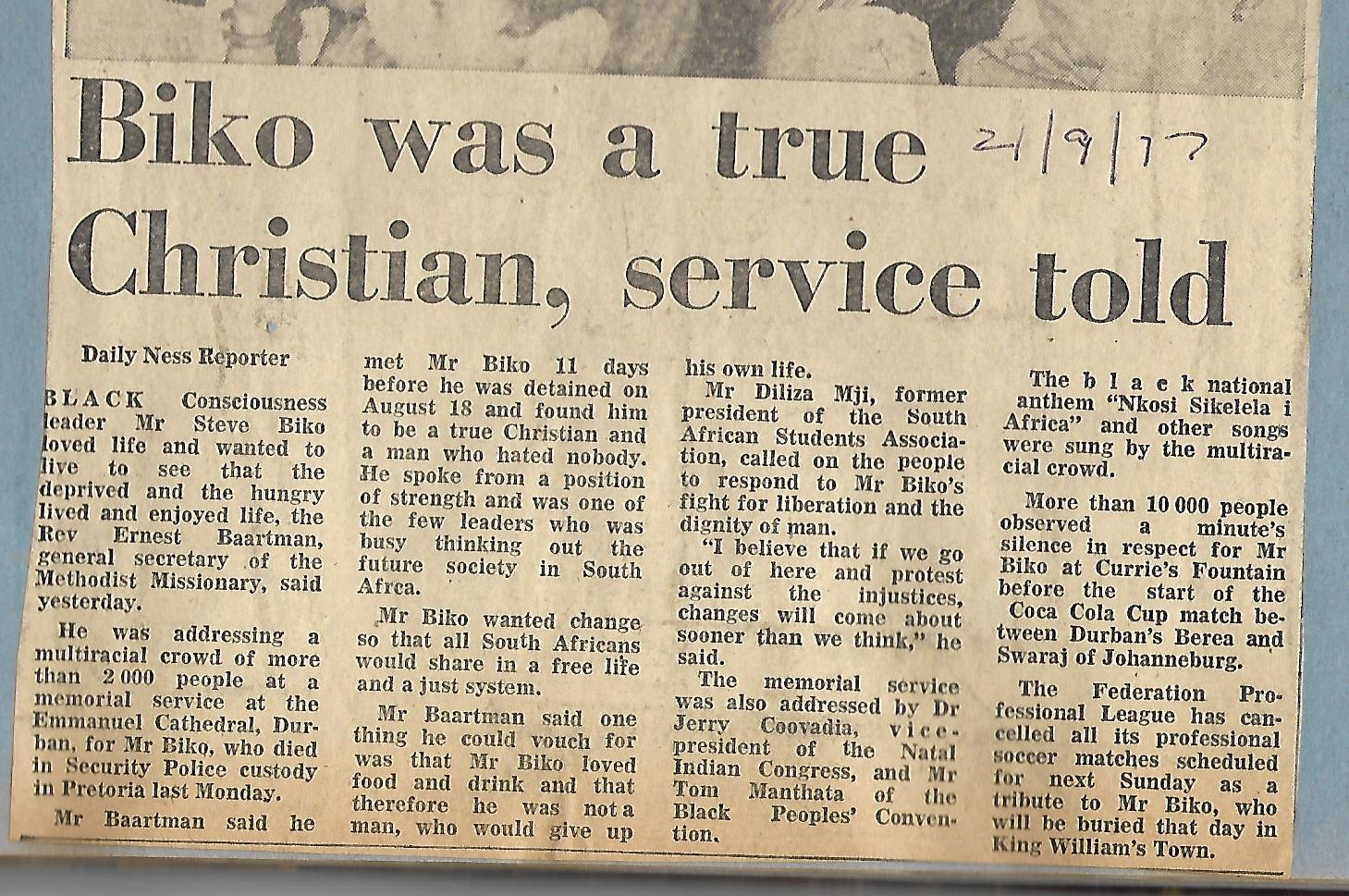
These were some of my articles published in the Daily News since September 13 1977:
DETAINED BLACK LEADER DIES IN HOSPITAL - SEPTEMBER 13 1977
STEVE TOO STRONG TO DIE OF HUNGER, SAYS WIFE
BIKO WAS DEDICATED "FREEDOM FIGHTER" - SEPT 15 1977
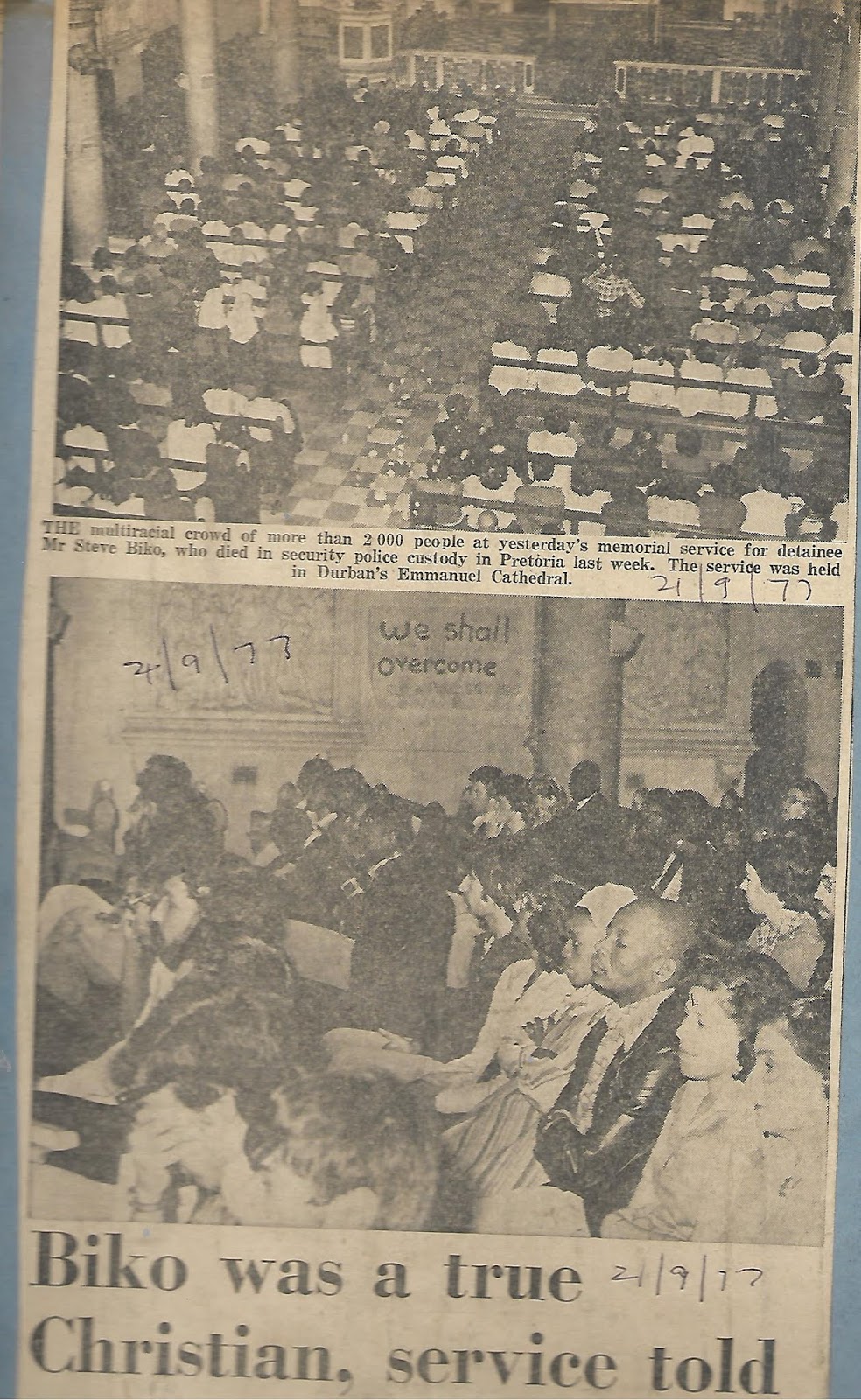
(THIS WAS THE CAPTION: THE MULTIRACIAL CROWD OF MORE THAN 2 000 PEOPLE AT YESTERDAY'S MEMORIAL SERVICE FOR DETAINEE MR STEVE BIKO, WHO DIED IN SECURITY POLICE CUSTODY IN PRETORIA LAST WEEK. THE SERVICE WAS HELD AT DURBAN'S EMMANUEL CATHEDRAL)
Monday, September 2, 2019
ELA GANHDI IN AN INTERVIEW IN OCTOBER 1984 RECOUNTS THE TRIALS AND TRIBULATIONS WHEN THE FORMER APARTHEID REGIME POUNCED ON MEWA RAMGOBIN AND OTHER NATAL INDIAN CONGRESS(NIC) AND UNITED DEMOCRATIC FRONT(UDF) LEADERS
(ELA RAMGOBIN (GANDHI))
In this period of August 2019 when South Africans celebrate our women folk, I have the privilege of bringing you an interview that I had conducted with one of the freedom heroines, Ms Ela Gandhi, in October 1984. The interview was about her experiences two months earlier when her late husband, Mewa Ramgobin, and other freedom fighters – the late Archie Gumede, late M J Naidoo, late Billy Nair and Sam Kikine – were detained by the then notorious security police. After they were released 15 days later following an application to the Pietermaritzburg Supreme Court, Mewa Ramgobin and five others – M J Naidoo, George Sewpersadh, Archie Gumede, Devadas Paul David and Billy Nair – sought refuge at the British Consulate situated at that time in a building at the corner of the former Field and Smith streets. After staying at the Consulate for one month – Ramgobin, M J Naidoo and George Sewpersadh – walked out to challenge the Pretoria regime’s oppressive stances. They were immediately arrested and charged with 13 others with treason on October 6 1984. The trial lasted until December 15 1985 when all of them were acquitted. The other treason trialists were Paul David, Archie Gumede, Essop Jassat, Aubrey Mokoena, Curtis Nkondo, Albertina Sisulua, Frank Chicane, Ebrahim Salojee, Ismail Mohammed, Thozamile Gqweta, Sisa Njikelana, Sam Kikine and Isaac Ngcobo.
Ela Gandhi Ramgobin in our interview in October 1984 told me about her trials and tribulations during the detentions and during the refuge that Ramgobin and his comrades sought at the British Consulate.
This is what we at the Press Trust of South Africa Third World News Agency October 1984 recorded of Ela’s experiences in her own words:
TRIALS AND TRIBULATIONS
“Since August 21 (1984) – the day on which the Pretoria Government cracked down on opponents of its new tri-cameral constitution – the lives of many people have been rapidly and drastically affected by the events that followed.
“As the wife of one of the detainees I would like to outline my own experiences. However, I would like to stress that in the South African context these experiences are not unique or isolated. Thousands of people are being daily subjected to unjust, arbitrary and surprise detentions.
“Our leaders were detained on the eve of the Coloured Representative Council elections on August 21 after the United Democratic Front (UDF), the Natal Indian Congress (NIC) and the United Committee of Concern in Natal fought a long and arduous campaign against the so-called new constitution.
“The detentions were preceded by a vicious campaign against the UDF and its leaders by the state-controlled radio and television services and by some state-influenced newspapers.
“Right-wing student elements at white universities and the Indian and Coloured candidates also helped to whip up sentiments against our leaders and organisations. Cries of ‘communist ties’, ‘violent actions’ and other unfounded allegations were just part of the diatribe directed against our people.
“My family became aware that a massive nation-wide swoop against our leaders was under way when we were rudely awakened by loud knocking on our door at our home in Everest Heights, Verulam, at 2am on August 21.
“My son, Kush, who opened the door, was surprised and shocked when two security branch policemen pushed past him and entered the house.
(MEWA RAMGOBIN ADDRESSING A PROTEST MEETING AT THE VERULAM TOWN HALL IN THE 1980s)
“Within minutes my husband, Mewa, our four other children and I came to the lounge to see what the commotion was all about.
“They told us that they had been instructed to take my husband into detention in terms of Section 28 of the Internal Security Act and they wished to search the house. They possessed neither a warrant of arrest nor a search warrant.
“After a thorough search of the house for about an hour they found two books that belonged to me. One was a handbook on forced removals in South Africa and the other a book on the struggles by women in the country. I told them the books belonged to me and that they had no right to take them.
“After a while they returned the books to me but left the house with my husband. I can say with pride that my children saw their daddy being driven away by the security police with courage and strength.
“Trips to the police station, jail and our lawyers, which has now become a regular feature in our lives, began in earnest on the morning of August 21.
C R SWART POLICE STATION IN DURBAN
“Our lawyers were able to see our husbands in detention at 11am. After being told that we could take food to our husbands we dashed to the nearest take-away to buy some food and cool drinks.
“While our lawyers were allowed access to our husbands, we, the relatives, had to stand in the corridors of the C R Swart Square police headquarters (now Durban Central Police station) for quite a few hours without any seating being provided.
“Eventually at 7pm, after supplying our husbands with ‘hot supper’ through an officer on duty, we left for home without seeing our men-folk. Half-an-hour later I had to attend an urgent meeting of the Natal Indian Congress and the United Democratic Front to discuss a rally planned for August 22.
“I only went to my house in Verulam, which is about 25 kilometres from Durban, at 2am. The next morning at 8am I set out once again for C R Swart Square after attending to my home chores and taking care of the needs of my two sons and three daughters.
CONSULTATIONS WITH AMERICAN AND BRITISH GOVERNMENTS
“On arrival at the police headquarters my lawyer and I were told that our menfolk – Mewa, Billy Nair, Archie Gumede, M J Naidoo and Sam Kikine – were being transferred to the town of Pietermaritzburg to be held in preventative custody.
“We were allowed to exchange a few words with our husbands through the cell doors.
“That morning an executive member of the NIC, Professor Jerry Coovadia, and I flew to Johannesburg to meet with the American Ambassador, Mr Herman Nickel, and a British Embassy official, Mr Graham Archer.
“We discussed the detentions and the propaganda against our organisations. We called on the American and British governments to actively support the democratic organisations in South Africa.
“We referred to the abstentions by the American and British governments on the resolutions against South Africa at the United Nations in New York and wanted to know what their attitudes were towards the detentions.
“We returned to Durban that same evening and rushed to attend the mass rally at the Students’ Union Hall, University of Natal, where more than 10 000 people packed every corner to listen to their true and authentic leaders.
“The massive turn-out of the people of all colours was a clear indication of the support we enjoyed among all democratic-minded people in South Africa.
“The next morning heralded a period of contacts with all the family members of the detainees, endless rounds of discussions with lawyers and decisions on what steps to be taken in our campaigns to get our men released.
DETAINED IN PIETERMARITZBURG
“We made three trips to Pietermaritzburg in two weeks to obtain visits and give our leaders some clean clothes. The authorities, however, refused to allow visits. We were only allowed to deposit some money for the needs of our leaders and to give them clean clothes.
“During this period of anguish and turmoil we, the families of the detainees, grew closer, supported each other, shared our anguishes and anxieties, and above all began to understand the unjust system that robbed us of our menfolk.
“This realisation brought us closer together to the ideals and aspirations of the leaders in detention and gave us added strength to fight for the cause – a cause for freedom, justice and democracy.
“Fifteen days after our leaders were first picked up, the Supreme Court in Pietermaritzburg upheld our application that the Minister of Law and Order, Mr Louis Le Grange, had not given sufficient reasons and information for detaining our menfolk.
“Our leaders were allowed to go free but the prison authorities only released them at 8:30pm that evening. After brief discussions our leaders informed us that they would not return home with us because they feared they would be re-detained. They wanted to take a ‘holiday’ for a few days.
“Although their decision was a painful one for us we accepted it because we also realised that re-detentions were a real possibility.
“Our fears were not unfounded. Within 24 hours Minister Le Grange issued new orders for their re-detentions. On September 9 at 1:30am we had another visit from the security police.
“Like their first visit their entrance into our home was rude and typical of oppressors. When they did not find Mewa at home they became aggressive and talked of the possibilities of ‘our husbands being found dead with their throats slit and gullets hanging out’.
“All the homes of the released leaders were similarly invaded that morning at the ridiculous hour of 1:30am. It is against this background of threats of ‘slit throats’, we learned with relief of six of our leaders making an ‘appearance’ at the British Consulate in Durban on September 13.
(MEWA RAMGOBIN LEADING A PROTEST MARCH OUTSIDE THE DURBAN CITY HALL IN THE EARLY 1980s)
RUSH TO BRITISH CONSULATE
“We rushed to the Consulate offices to re-assure ourselves that our menfolk were safe and in good health. But the British consular staff refused to allow us to see our leaders.
“After lengthy and persistent negotiations, we were allowed a brief re-union with our husbands – one family at a time for a few minutes.
“Having had the satisfaction of seeing them in good spirits and good health, we felt a little ease at mind. But the following day brought us face to face with the British ‘don’t care’ attitude when they refused to allow us regular visits to our menfolk.
“We immediately decided to resist by staging a sit-in hunger strike at the Consul offices. Our protest brought in immediate results for within half-an-hour we were told that visits would be allowed.
RIGHT-WING THREATS AGAINST THE CONSULATE SIX
“After the first week of the refuge at the consulate, our anxieties for the safety of our leaders grew when right-wing reactionaries threatened to blow up the building where our husbands took refuge.
“We began a 24-hour vigil at the building to monitor all movements. This was called off after we noticed that uniformed policemen had been posted to protect the building.
“Our life of normal work and family routine was disrupted. We now began to attend to the professional businesses run by our husbands, arranging all their requirements at the Consulate – blankets and pillows, cups and saucers, kettle and tea pots, chemical toilets, bath tubs and daily meals and change of clothing.
“We also had to attend and address meetings and institute a new law suit against the Minister.
“After our case was dismissed, three of our leaders – Mewa, M J Naidoo and George Sewpersadh – decided to challenge the authorities by walking out from the consul offices. But no sooner had they appeared on the street below, they were arrested by security policemen and taken to Pietermaritzburg for preventative detention.
“Our anxiety and uncertainity began all over again until we were allowed visits three times a week for a period of 40 minutes for each visit.
“The visits were non-contact visits and were separated by a glass window. We were allowed to converse through a ‘funnel-like” object.
“Although the journeys to Pietermaritzburg were long and tiring, we were, however, pleased to make the trips just to see and talk to our men folk.
“We have repeatedly asked the Minister for reasons to justify the continued detention of our leaders but he has failed to respond.
“In our view there is no justification for the detention of our leaders and we challenge the Minister to produce any evidence to show that our men have propagated or participated in violence.
“We are proud of the struggle being waged by our menfolk and stand by them in spite of the daily suffering we endure.”
Ends – Press Trust of South Africa Third World News Agency Oct 22 1984
Monday, August 26, 2019
FLORENCE MKHIZE - ONE OF SOUTH AFRICA'S WOMEN LEADERS WHO MADE ENORMOUS SACRIFICES FOR THE FREEDOM WE ENJOY TODAY
(SUBRY GOVENDER INTERVIEWING FLORENCE MKHIZE AT GRIFFITH MXENGE'S OFFICE IN THE FORMER GREY STREET AREA OF DURBAN IN AUGUST 1982. NOT SURE OF THE NAME OF THE COMRADE IN THE BACKGROUND)
BY SUBRY GOVENDER
One of the women leaders who made enormous sacrifices for the freedom that we enjoy today is Florence Mkhize of Durban. Born in 1932, Mkhize died in July 1999 at the age of 67. In August 1982 when she was serving her third five-year banning order imposed by the former apartheid regime, I had the opportunity of talking to her about her involvement in the political struggles. I spoke to her at the offices of another political stalwart and lawyer, Griffith Mxenge, in the former Grey Street area of Durban.
This is the article that I had written and circulated on August 19 1982:
“SUFFERING IS OUR LIFE”
When the true history of South Africa is written in the near future it is certain that the name of Ms Florence Mkhize will feature prominently in the section concerning the country’s women leaders.
Forty-two-year-old Ms Mkhize, who is serving her third term of five-year banning orders, is one of the many unsung heroes of the struggle for justice and freedom in South Africa.
Although she has been constantly harassed and intimidated since she was first banned in March 1962, Ms Mkhize has not lost her determination and hope that South Africa will be free sooner than many people cared to think about.
“No matter how tyrannical the white National Party Government becomes and how many people are banned, jailed, killed or forced into exile, we will eventually win because the Government cannot jail and ban all the people,” she told me.
“It is, therefore, important that the struggle must go on no matter what the sacrifice. Our struggle is a just and moral one.”
Ms Mkhize, who is the mother of four teenage children, first became involved in the struggle for justice in 1956 when she found the “pass law” offenders were being treated as criminals and the “bantu education system” was geared at producing slave labour for the mines and other capital industries than aimed at literacy.
In 1960 at the age of 20 she joined the South African Womens’ Federation, which was an affiliate of the African National Congress(ANC), in an attempt to improve the lot of African women who were the most exploited of the oppressed people of South Africa.
Within a year she became the secretary of the Natal branch of the organisation and an executive member of the national body.
But at the early age of 22 her introduction into the political struggle was cut short when the authorities served her with a five-year banning order in 1962.
Immediately after being banned and house-arrested, she began working for a group of Indian tailors, Chetty Brothers, in Durban with whom she is still employed 22 years later.
When Chief Albert Luthuli, the then banned president of the ANC died mysteriously in a train accident in August 1967, she began organising a memorial service with a group of ANC members. She was asked by the Durban security police to stop her involvement but she defied them and even travelled to Groutville, on the Natal North Coast, for Luthuli’s funeral.
The authorities arrested her and jailed her for three months.
When she was released, she was served with another five-year banning order, which this time restricted her to her home between 7pm and 6am every day. During her second banning order, she married a Transkei medical doctor, Amos Msimane, who was 30 years her senior.
“I married him because he was very understanding and accepted my involvement in the political struggles. Inspite of the heavy responsibility, we still managed to have four children who are now all grown up. Barnett is 24, Wiseman 22, Elizabeth 19 and Buthle, 15.
“They too are very understanding and do not regret one bit that their mother is banned and restricted. They know that we have to suffer and sacrifice if we are to win in the end.”
When the second banning order expired in 1973, she moved straight back into the hurly-burly of the political struggles by openly and vociferously condemning the Bantustan policy of the National Government and what she describes as “their puppet leaders”.
She was especially strong in her condemnation of some of the well-known bantustan leaders who claimed they were members of the ANC and followers of Chief Luthuli.
Late in 1978 when moves were started to get Nelson Mandela and other ANC leaders released from Robben Island, she immediately joined the Release Mandela Committee and worked tirelessly with the chairman, Mr Archie Gumede.
She also involved herself in the Natal Indian Congress’s boycott campaign against the National Party Government’s South African Indian Council(SAIC) elections.
She addressed a number of meetings in Durban and in the surrounding Indian townships, exhorting the Indian people to stay away from the “apartheid elections”. Her efforts were not in vain as 90 percent of the people, who were registered voters, boycotted the elections.
This and her opposition to the bantustans prompted the authorities to serve her with yet another five-year banning order in 1981.
“I am not worried because suffering is our life. As far as I am concerned the struggle goes on in spite the bannings, detentions, killings and jailing of our leaders.
“Peace will only come to South Africa when Pretoria negotiates with our true leaders on Robben Island and in exile.”
Ends – Press Trust of South Africa Third World News Agency, August 19 82
Sunday, August 25, 2019
RECALLING WHAT FORMER PRESIDENT, JACOPB ZUMA, PROMISED IN 2011 THAT LOCAL COUNCILLORS WHO DON’T CARRY OUT THEIR DUTIES EFFECTIVELY WOULD BE “FLUSHED OUT”.
NOW THAT A NUMBER OF COUNCILLORS IN THE ETHEKWINI MUNICIPALITY HAVE BEEN BOOTED OUT IN AUGUST 2019, I WANT TO BRING YOU AN ARTICLE THAT I HAD WRITTEN IN JUNE 2011 WHEN FORMER PRESIDENT JACOB ZUMA PROMISED TO "FLUSH OUT" COUNCILLORS WHO FAILED TO ACT IN THE INTERESTS OF RATEPAYERS AND RESIDENTS.
BY SUBRY GOVENDER (JUNE 1 2011)
Councillors should be accountable or face being "flushed out"
Now that the 2011 Local Government elections have been finalised and dusted, the real work begins. But whether the elected and PR councillors will deliver is another matter altogether.
In our interaction with ratepayers and residents prior to the elections, we have found that their concerns vary from area to area. For those living in informal settlements their main concerns revolve around provision of decent housing and facilities such as electricity, sanitation, proper roads, health care, proper schools, refuse removal and lack of sports grounds.
For those in townships and well-endowed suburbs their concerns are mainly about the upgrading of CBDs in towns such as Tongaat and Verulam, maintenance of sports grounds and open spaces, clean streets and verges, a clean environment, and tackling the high crime rate.
Soon after the election results were announced, President Jacob Zuma informed the successful elected councillors that they would have to commit themselves to uplifting the lives of people and attending to the civic and social problems in their wards and councils.
He warned that those who fail in their duties would be flushed out.
"Councillors must be accountable," he stressed.
The elected and PR councillors in the major Metros such as eThekwini, Johannesburg, Pretoria and Cape Town are paid huge salaries and perks. For instance in eThekwini, councillors are reported to earn as much as R350 000 a year. In any language, this salary is way too extravagant and excessive for many of the councillors when compared to the amount of work they really carry out on behalf of the people.
Except for a few committed councillors, for most their cosy work is not only about earning "easy money" but also to enrich themselves, their families and friends through tenders and other means. For them the concerns and problems of the people they are supposed to represent at local government level take second place. For them they have not heard of evils such as corruption, fraud, bribery, thievery and nepotism.
One of the councillors who appears to have some conscience is unfortunately not situated in our region. He is Mr Tony Ehrenreich, the secretary of Coastu in the Western Cape who stood as the ANC's mayoral candidate in Cape Town. Asked about his dual role as a trade union leader and councillor, he had this to say:
"I will not accept my councillor's salary in the traditional manner. As long as I'm still in Cosatu I will put the salary in a trust fund and use it to advance workers."
Although Ehrenreich did not say that he would not accept any salary as a councillor, the fact that he would not accept "two salaries" at the same time is an indication of his commitment to serving the people.
The fiery leader also appeared to know his priorities as a councillor, unlike the leeches we find in eThekwini and other municipalities. He made it clear that the rates collected should be used to address the needs of Cape Town's entire population. He would especially work to promote the concerns of the poor.
"We want to make sure we raise our points that the budget doesn't reject the urgent needs of poor communities."
Oh, how I wish we had the quality of an Ehrenreich in eThekwini. Let's sincerely hope the Tony Ehrenreichs are not a dying breed.
For those in our midst who don't qualify as a "Tony Ehrenreich", let's hope that they will at least try to be clean, honest, sincere and committed to serving the people in their wards. If not, they should be "flushed out" as promised by President Zuma. - Subry Govender, Chief Editor June 1 2011
RECALLING “MALEMA SAYS” IN 2011 WHEN JULIUS MALEMA WENT AROUND THE COUNTRY TO CANVAS FOR THE ANC DURING THE LOCAL GOVERNMENT ELECTIONS
By Subry Govender
The local government elections held on Wednesday, May 18 (2011) was one of the most hotly-contested elections since 1994.
The political parties and the candidates went overboard in their campaigns to outdo one another. During this process, some of the politicians used the lowest and basest rhetoric to smear their opponents.
The president of the ANC Youth League, Julius Malema, won gold medal for his "Malema says" when he travelled around the country, spitting and shouting at his opponents. His first stop was in Cape Town where he used the open-toilet saga in Khayelitsha to lampoon the DA for violating the human dignity of "African people".
The DA-controlled Cape Town city council was found to have built 51 toilets without enclosures in Makhaza, Khayelitsha in December 2009.
During his Cape Town electioneering campaign, Malema, his bodyguards and supporters drove to the house of the leader of DA, Ms Helen Zille, where they pasted ANC posters on an electricity pole just outside Zille's house. When asked by a reporter why he was putting up posters outside the home of Ms Zille, he responded by saying that the DA leader should also vote for the ANC because the DA was "in shit".
But while enjoying the agony in which the DA found itself, Malema had to quickly dash to Rammulotsi township, near Viljoenskroon in the Free State province where it was found that ANC-run Moqhaka municipality had built 1 600 toilets without any enclosures. What was even more embarrassing was that the Mayor, Mantebu Mokgosi's husband had been granted a contract to build the open toilets. They were called "toiletpreneurs".
All that the fazed motor mouth could do was to call for "heads to roll.
CRIMINALS
Despite being brought down to earth, the foul mouth continued with his ramblings at an election rally in Kimberley where he labelled white people as "criminals".
This is what he had said: "We have to take the land without payment, because the whites took our land without paying and transformed them into game farms. The system of willing seller, willing buyer has failed.
We all agree they stole the land. They are criminals, they should be treated like that. It is taking too long for the land to be handed back.
"The money is in the hands of only 10 percent of the population who are handling about 90 percent of the wealth in the country. The money is in the hands of the Oppenheimers. The Oppenheimers took our minerals. Galeshewe hasn’t shared in the bounty of the diamond mines."
At another election campaign meeting in Kimberley, Malema scolded township residents for protesting against the ANC when it was the ANC that provided them with jobs, schools, homes, electricity and water.
"You cannot complain about the lack of service delivery while watering the lawn in front of your RDP house. When protesting they burn tyres on a tar road but they complain no delivery."
'MUGABE OF SOUTH AFRICA"
In one of his several visits to KwaZulu-Natal, the "Mugabe of South Africa" took swipes at the leader of the IFP, Mangosuthu Buthelezi, calling him a "sickly old man" who don't want to retire. However, he did not have the courage to travel to hometown in Zululand to put up ANC posters outside Buthelezi's home. IFP supporters wanted to teach him "some manners".
"MADAM"
At the ANC's final and biggest election rally in Johannesburg, Malema received the loudest applause when he once again danced and shouted his racist comments.
He said:
"The DA is for the whites, it is not for you. The ANC has no serious challenger in the coming elections. Even 'the madam' knows that she cannot compete with the ANC."
This was an obvious reference to Helen Zille's vigorous campaigns in Soweto and mainly-black townships around the country.
Malema has himself been called all kinds of names by his opponents and political analysts. One of the most telling comments came from cartoonist, Nanda Soobben. He said: "We need a toilet duck to clean Malema's mouth... unfortunately, we have a 'lame' one."
"BLUE WITCHES"
A former leader of the ANC Youth League, Fikile Mbalula, also raised the attention of people when he addressed an election rally in Kimberley last week.
Referring to the women leaders of the DA, he said: "They are three little blue witches."
The leader of the ANC, Jacob Zuma, also drew the attention of the people when he told supporters at two meetings in Port Elizabeth and Lichtenburg that their ancestors will turn against those leaving the ANC.
"The ancestors will turn their backs against you and you will be bad luck forever if you leave the ANC unhappy. "When you vote for a party that is going to lose, then your vote is wasted. That vote does not help South Africa at all."
Zuma's latest comments had drawn sharp reactions from traditional and religious leaders, who previously had condemned the ANC leader for saying that "the ANC will rule until Jesus returns".
Said one commentator:
"I think the ancestors are turning in their graves at the liberties JZ is taking. He now speaks for me, the other voters, Jesus, God, the ancestors, who else only the all powerful Swami Zuma knows. Jacob, seeing that you are so well connected, tell Elvis 'Hi' from me and let Santa know that I am still p-off with the present I got in my stocking last year. I am now seriously doubting the mental stability of our president and his advisors.'
The election campaigns have done wonders for the country. Freedom of speech and multi-party democracy have been strengthened while at the same exposing the racism of the "Mugabe" who will turn our beautiful country into another Zimbabwe if he is not brought to heel soon. -
Subry Govender, Chief Editor (May 18 2011)
Wednesday, August 14, 2019
Subscribe to:
Posts (Atom)