Tuesday, November 5, 2013

Mahatma Gandhi and Jawaharlall Nehru would be embarrassed at the current New Delhi Government's stance on the genocide against Tamils in Sri Lanka

By Subry Govender Veteran South African struggle journalist I saw the Channel 4 reports on the war crimes perpetrated by the Sri Lankan Government and its soldiers. I was shocked into disbelief at the kind of atrocities and the genocide committed against the Tamil civilians towards the latter part of the civil war in Sri Lanka in 2009. I have seen men and women tied and shot from the back by the Sri Lankan soldiers.
What was more shocking and inhuman was the brutal humiliation and slaying of the TV presenter, Isai Priya. How can a government led by Rajapakse and his brother, Basil, commit such war crimes and still get away with it. It's tragic that India has not yet spoken out against the genocide of some 60 000 Tamils when it has such a huge Tamil population of its own. The Tamil Nadu Assembly has taken a unanimous decision calling on the New Delhi Government and Prime Minister Manmohan Singh not to attend the CHOGM summit in mid-November. Similar calls have been made by the Tamil diaspora in South Africa, United Kingdom, Canada, United States, Australia and other countries but the Indian Government has still not taken any decision to boycott the CHOGM summit.
It just demonstrates that New Delhi does not care about the atrocities and genocide committed against the Tamil people in Sri Lanka. Now, to add further ammunition to claims that it is protecting Rajapakse and his pack of war criminals, India is refusing to grant a visa to the producer of the Channel 4 documentaries about Rajapakse's war crimes. The Tamil diaspora will be holding an International Conference in Mauritius between Nov 8 and 10 to discuss the oppression of the Tamil people in Sri Lanka. Delegates from India and Malaysia, Singapore, South Africa, UK, United States, Canada, Australia and other countries would be attending.
The South African Solidarity Group for Peace and Justice in Sri Lanka has already called on its government to boycott the CHOGM summit and for the international community to pursue war crimes against the Sri Lankan Government leaders and others responsible for the genocide.
It's hoped that India would stop acting like a coward and take the lead, like Canada and Australia, in boycotting the CHOGM summit and also leading the way in pursuing war crimes against Rajapakse, his brother and others who gave orders for the senseless killings, rapes and murders of innocent men, women and children. One hopes that New Delhi will show some backbone and stop kow-towing to the people allegedly responsible for the slaying, torture and rapes of the Tamil people of Sri Lanka. It must be pointed out that not all Singalese are guilty of these war crimes. It's only the present Sri Lankan Government under Rajapakse, his brother and the soldiers who were given carte blanche licence to go on a rampage against the innocent souls of the north and east of Sri Lanka. If Mahatma Gandhi and Pundit Jawaharlall Nehru were alive today they would not have sat back and accepted what has taken place against the Tamils. They would have spoken out loudly and vociferously. What sayest thou Prime Minister Manmohan Singh?

Monday, November 4, 2013

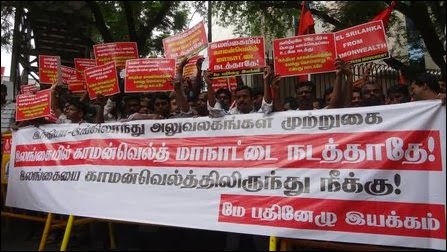
Tamil Nadu Protestors call for the expulsion of Sri Lanka from the Commonwealth

(Information and pictures obtained from the Global Peace Support Group based in London) EXPEL SRI LANKA FROM THE COMMONWEALTH Thousands of protestors in Chennai, Tamil Nadu, India at the weekend called for the expulsion of Sri Lanka from the Commonwealth because of the genocide committed against the Tamils of the Island. The protestors, who belonged to twelve political parties, also called on India, Britain and other countries to stay away from the CHOGM summit to be held in Sri Lanka in two weeks' time. The protestors demanded that Sri Lanka should be suspended from the Commonwealth until a referendum on independence of Eelam Tamils is held under UN supervision. The protests were held in front of the British High Commission in Chennai and in front of the Government of India office in the city.
The latest protest follows a unanimous resolution against India's participation in the CHOGM summit by the Tamil Nadu Assembly a week ago. The protests in Tamil Nadu coincide with similar protest actions and calls in the United Kingdom, Europe, the United States, Canada, Australia and South Africa for the Commonwealth conference to be moved out of Sri Lanka. The British TV network, Channel 4, has also broadcast several programmes on the war crimes and genocide committed by the Sri Lankan Government against the Tamil people. Channel 4 has asked the question: "How much more evidence does Britain and the world need for Sri Lankan leaders to be charged in the International Court of Justice on war crimes?"

Sunday, November 3, 2013

SOUTH AFRICAN TAMILS CALL ON THEIR GOVERNMENT TO BOYCOTT CHOGM SUMMIT IN PROTEST AGAINST THE GENOCIDE COMMITTED BY THE SRI LANKAN GOVERNMENT

By Subry Govender A strong call has been made to the ANC Government in South Africa to boycott the Commonwealth Heads of State Conference (CHOGM) to be held in Sri Lanka in two weeks' time. The call was made at a public meeting of the Solidarity Group for Peace and Justice(SGFPJ) held at the Arupta Kazgham Tamil Hall in the Indian-origin- dominated suburb of Chatsworth in Durban, South Africa on Sunday, November 3.
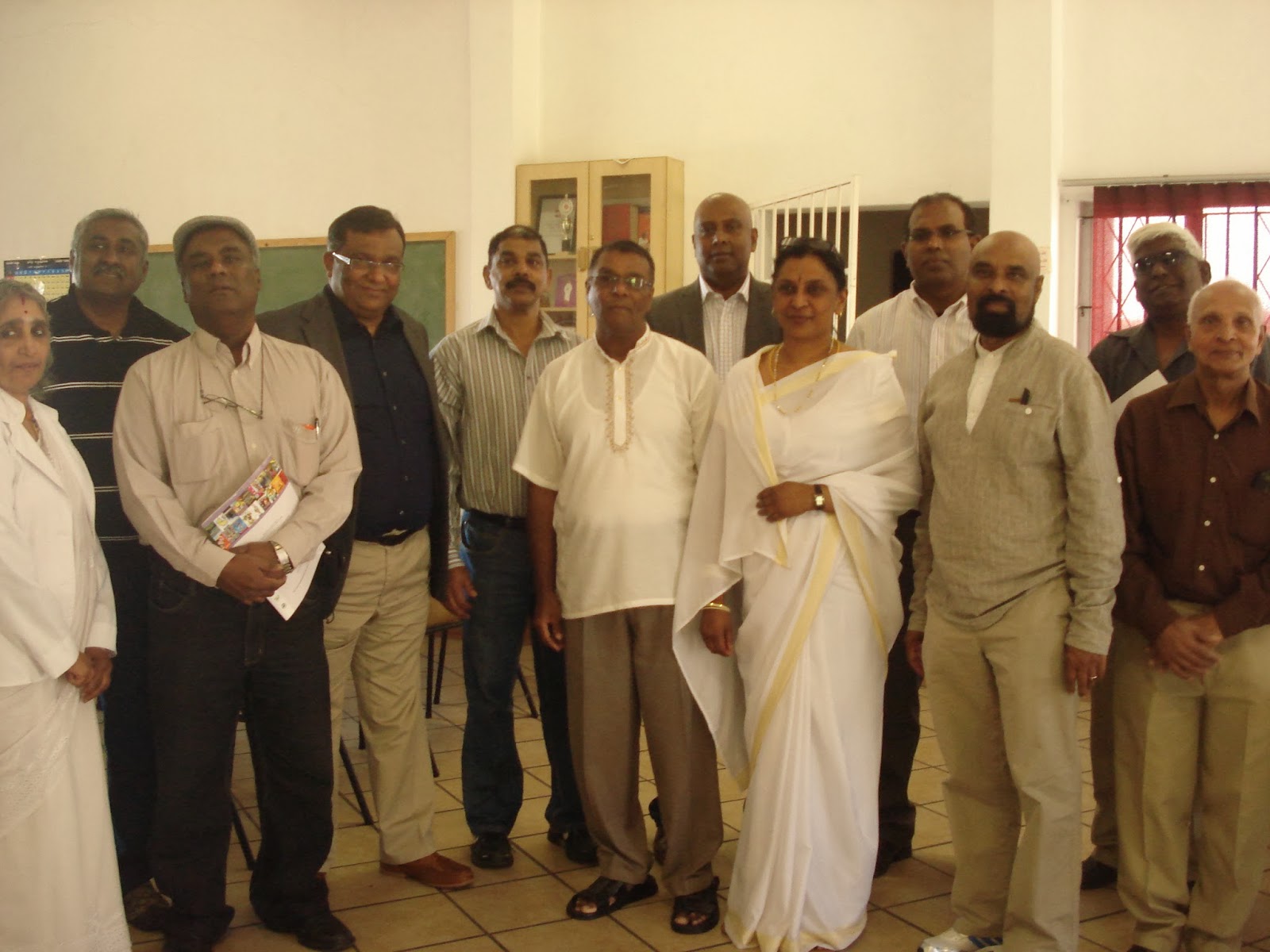
Mrs Sally Padaychee, wife of the late Minister Roy Padaychee, at the Solidarity meeting. On her left is Mr Kana Nirmalan of the British Tamil Forum and Mr Dees Pillay of the Solidarity Group. The meeting was attended by representatives of a number of Tamil organisations in South Africa and ordinary people. Mrs Sally Padaychee, wife of the late Cabinet Minister Roy Padaychee; Mr Les Govender, a member of the KwaZulu-Natal Legislature; Mr Richard Govender and Mrs Thiru of the former Tamil Co-Ordinating Committee; Mrs Veni Pather of the South African Tamil Federation; writer Dr Deena Padaychee and cultural leader, Dr Juggie Pather, were some of the people who attended the meeting.
Some of the people who attended the meeting
Mr Solly Pillay Public Relations Officer of the Solidarity Group The meeting was addressed by officials of the Solidarity Group - Mr Pregs Padaychee, secretary; Mr Solly Pillay, public relations officer, and Mr Dees Pillay, assistant secretary.
Mr Pregs Padaychee Secretary of Solidarity Group Three representatives of the British Tamils Forum - Mr V. Ravi Kumar, general secretary; Mr S. Mangales and Mr Kana Nirmalan also addressed the meeting. The BTF officials, who arrived in South Africa on Friday, had earlier held discussions with some leaders of the ANC, Mr Mac Maharah, official spokesperson for President Jacob Zuma, and Mr Sdumo Dlamini, president of the Congress of South African Trade Unions(Cosatu). The BTF officials had stopped over in South Africa prior to them attending the International Tamil Conference in Mauritius on November 8, 9 and 10.
Mr S Mangales, Mr V Ravi Kumar and Mr Kana Nirmalan of the British Tamil Forum The meeting resolved that Tamils in South Africa and the world abhorred the "atrocities and genocide" committed by the Sri Lankan Government soldiers towards the end of the civil war in 2009 and, therefore, the South African Government should boycott the CHOGM summit in Sri Lanka. "Just as the ANC and the people of South Africa fought against the oppression of the former apartheid regime, this meeting of representatives of the Tamil people urge the Government to boycott the CHOGM conference. "The South African Government is obliged to take the lead in supporting the cause of the Tamils in Sri Lanka," said Mr Solly Pillay when moving the resolution at the end of the meeting. The Canadian and Australian governments are the only Commonwealth nations who have so far announced that they would not attend the conference because of the human rights atrocities committed by the Sri Lankan Government and its soldiers against the Tamil people.
Some of the people who attended the meeting seen have a chat afterwards.
Mrs Veni Pather of the South African Tamil Federation The Tamil Nadu Government in India recently called on its own government, led by Dr Manmohan Singh, to boycott the CHOGM summit because of the violation of the rights of Tamil people in Sri Lanka. More than 60 000 Tamils were butchered and massacred by Sri Lankan soldiers during the end of the civil war between the Tamil Tigers and the Sri Lankan Government in 2009. The meeting heard from the British Tamils Forum leaders that they were puzzled at the attitude of the South African Government in refusing to come out strongly in support of the Tamil cause in Sri Lanka. "We believe that you people in South Africa must keep the door open with the Government and call on it to support the struggles of the Tamil people for justice and self-determination just as we supported the cause of the ANC against the apartheid regime," said Mr Kana Nirmalan, chief spokesperson for the BTF, who first addressed the meeting. Mr Nirmalan said those who committed the atrocities and genocide against the Tamils in Sri Lanka should be called to account for their actions by the international community. "In this regard we believe South Africa and India should take the lead on behalf of the Tamils of Sri Lanka," he said. "The Tamils of Sri Lanka are the original inhabitants of the island and we demand self-determination in the North and East of the country. We have been in the island for more than 3 000 years and we do not consider ourselves as being a 'minority'. "But what is happening now is that the Sri Lankan Government is embarking on a new kind of colonisation by settling tens of thousands of Singalese people on land occupied by Tamils. They want to make us a minority in our own traditional land." He said Tamils had been fighting for their self-determination and freedom for more than 30 years. The secretary of the Solidarity Group for Peace and Justice in Sri Lanka, Mr Pregs Padyachee, informed the meeting that actions of the South African Government in not supporting the cause of Tamils in Sri Lanka as "very disturbing". He said the ANC had always supported the Tamils in Sri Lanka when it was spear-heading the struggles for freedom in South Africa. "We are very concerned that there now seems to be some change. We cannot understand this latest situation," said Mr Padaychee. "The real reasons why there has been a change on the part of the South African Government will be released at the International Tamil Conference that is to be held in Mauritius on November 8, 9 and 10. Until then we will not say anything. "It's very painful that South Africa has not yet indicated that it will boycott the CHOGM conference in order to show its solidarity with the Tamil people of Sri Lanka," he said.
Mr Ebrahim Ismail Ebrahim(Centre), Deputy Minister of Foreign Affairs, had at one time tried to help the Tamils in Sri Lanka Mr Padaychee said the late Minister Roy Padaychee was instrumental in setting up the Solidarty Group to support the cause of the Tamils in Sri Lanka. The current Deputy Foreign Minister, Mr Ebrahim Ismail Ebrahim, had at one time headed a special committee of the South African Government to try and help resolve the Sri Lankan situation.

Monday, October 28, 2013

MEDIA STRUGGLES IN SOUTH AFRICA DURING THE 1970s, 1980s and 1990s TO BRING ABOUT A FREE AND DEMOCRATIC SOUTH AFRICA

By Marimuthu Subramoney (aka Subry Govender)
On October 19 2013, South Africans once again reflected on the state of the media in the new democratic South Africa when they observed the 36th anniversary of the crackdown on the media by the former apartheid regime on October 19, 1977. Marimuthu Subramoney, aka Subry Govender, recalls the struggles of the journalists during the 1970s, 1980s, and early 1990s and warns that South Africans must guard against the new elite trying to smother the media through its new Protection of the Information Bill.
Zwelakhe Sisulu One of our formidable struggle journalists during the 1970s and 1980s, Zwelakhe Sisulu, who died at the age of 61 on October 4 2012, was duly acknowledged for playing a crucial role in the struggles to bring about the new non-racial, free and democratic South Africa. In this article, I want to go back to the days when Zwelakhe and a large number of journalists put their lives on stake to contribute to the liberation struggles. Before I go into the meat of the topic, I want to submit that the suppression of the media during the apartheid era did not start when the white baaskap National Party came to political power in 1948. It had its roots when the first newspapers were started by the colonial authorities in the early 1800s. However, I am not going to go back in history but deal primarily with the period when the National Party introduced all kinds of laws to suppress, oppress, harrass and intimidate journalists - especially journalists of colour. Being white, colonial and racial driven - the media during this period was mainly concerned with maintaining and retaining white domination of the social, economic and political fabric of South Africa. The whites owned, controlled, managed and edited nearly all the newspapers - with the exception of one or two minor and insignificant publications - and the National Party monopolised the airwaves in the name of the South African Broadcasting Corporation(SABC). The National Party, which F W De Klerk unashamedly tried to sell to the people of Indian-origin, coloured people and Africans in the early 1990s, had in their arsenal more than 100 statutes that limited the freedom of the Press. The repressive atmosphere really began after the Sharpeville uprisings on March 21 1960 when police shot dead peaceful marchers who were protesting against the carrying of the hateful Dom-Pass. The National Party Government introduced a state of emergency and banned the ANC and the PAC and crushed all opposition to white minority rule.
Joe Thloloe Publications such as the New Age, Fighting Talk, Advance and Guardian were forced to close shop and the journalists working in these and other progressive newspapers either had to flee the country or go underground. During this period of repression, some of the only black-oriented newspapers that were allowed to operate were the Drum magazine and the Golden City Post. Although they reported on some political developments, they were, however, no danger to the existence of the white state. Being white-owned and managed, these newspapers concentrated on the sensational - sex, crime and gangs and sport - in order to survive. There were some journalists during this period in the 1980s who dared to question the white status quo - but they too were quickly intimidated and forced to flee the country or tone down.
Some of the journalists who paid a heavy price for Press Freedom in South Africa In the early 1970s - when the black consciousness movement took root after the establishment of the South African Students Organisation(SAS0) - a number of black journalists came to the fore - prepared to take on the white oppressors irrespective of the consequences. These journalists were primarily working at that time for newspapers such as the World and Weekend World, and socially-conscious journalists working for mainstream newspapers such as the former Rand Daily Mail, the East London Daily Dispatch, the Cape Times and Argus, the Johannesburg Star and the Durban Daily News. They tried to introduce a new and dynamic approach to journalism by tackling the social, economic, sporting and political oppression of the black majority. The struggle for freedom of the Press and the liberty of the people had just started in earnest once again.
SteveBiko But no sooner had black journalists - with a black consciousness background - began to tackle real and fundamental issues affecting the majority - the System struck back with vengeance in 1974 when the Frelimo rally was scheduled to be held at Durban's Currie's Fountain. The apartheid regime banned the rally and prohibited newspapers from publishing any news item that would amount to publicising the event. This correspondent was at this time with the Daily News and assigned to cover the rally. This correspondent was not only detained and interrogated but my editor, Mr John O'Mally, was charged for publicising the event. Another colleague, Joan Dobson, skipped the country and fled into exile because the apartheid regime suspected she was in league with the organisers of the rally. After the dawn of our new demcoracy in April 1994, she began reporting from Harare for the SABC's AM and PM live programmes at that time.
Strini Moodley As a matter of interest, black consciousness leaders like the late Strini Moodley, Saths Cooper, Aubrey Mokoape and others were charged under the infamous Terrorism Act and as a result of the rally were convicted and sentenced to Robben Island. Further onslaughts against the media began after the 1976 Soweto uprisings when school children protested against the imposition of Afrikaans as a medium of instruction in their schools.
Dr Saths Cooper Two months after the Soweto uprisings nine black journalists, who played a leading role in reporting events in Soweto, were detained under the regime's Internal Security Act, and two others were incarcerated under Section 6 of the Terrorism Act.
Dr Aubrey Mokoape Among the very first to be arrested was Joe Thloloe, who was at that time working for the World Newspaper; Peter Magubane, South Africa's world-famous photo-journalist who worked at that time for the Rand Daily Mail and Miss Thenjiwe Mntintso, who worked at the Daily Dispatch in East London at that time. The majority of them were held for about four months without being tried in a court of law. They were released at the end of December 1976 but some were re-arrested in 1977. Joe Thloloe was one of those re-arrested and he was held incommunicado for 547 days under Section of the Terrorism Act.
Willie Bokala
Percy Qoboza, former Editor of World The others were Willie Bokala, a reporter for the banned World newspaper who was held in detention for more than a year; Jan Tugwana, a reporter for the then Rand Daily Mail who was also held in detention for more than a year under Section 6 of the Terrorism Act; Ms Juby Mayet, a doyen of black journalists who was held incommunicado under the Internal Security Act at the Fort Prison in Johannesburg; Isaac Moroe, the first president of the Writers Association of SA (WASA) in Bloemfontein; and Bularo Diphoto, a free-lance journalist in the town of Kroonstad who was also detained under Section 6 of the Terrorism Act. Another journalist, Mr Moffat Zungu, who was a reporter for the World Newspaper, was an accused in the Pan African Congress (PAC) trial that took place in Bethal, near Johannesburg. He was first detained under Section 6 of the Terrorism Act.
Joe Thloloe and other veterans The blackest day in the history of Press Freedom in so far as the black majority was concerned took place on October 19 1977 when the notorious Jimmy Kruger banned the only two newspapers respected among black people - the World and Weekend World. Mr Kruger, who became infamous for describing Steve Biko's death two months earlier as - "It leaves me cold" - at the same time banned the Union of Black Journalists(UBJ) and 17 other organisations; the publication of the UBJ - AZIZTHULA; religious and student publications; locked up the editor and news editor of the World and Weekend World - the late Percy Qoboza and the late Aggrey Klaaste respectively; and banned for five years the Editor of the Daily Dispacth, the late Donald Woods. The regime also confiscated all our stationery and equipment and seized our funds. Six other journalists were also detained at this time - including Thenjiwe Mntintso, a former ambassador now based at the ANC headquarters in Johannesburg; and Enoch Duma - who worked for the Star newspaper at that time. He fled into exile after being released after more than two years in detention. He returned to the country recently and is currently writing his autobiography and also involved in the academic field. Almost every member of the UBJ was visited by the security police all over the country; their homes and offices raided and searched and interrogated. All the raids were carried out at the unearthly hours of 4am and 5am in the morning. I remember my mother knocking my door and saying in our Tamil mother tongue: "Some white people are here asking for you." My rooms were searched and all literature relating to the UBJ were confiscated. They even confiscated a letter I had written to the late Prime Minister of India, Mrs Indira Gandhi. I don't know whether that letter reached Mrs Gandhi because India at that time was leading the international struggle against minority rule in South Africa. After completing their raid, they took me to the Daily News in Field Street in Durban where they searched my desk. When representations were made to Mr Kruger for the release of the detained journalists, he had the temerity to announce that the detentions were not meant to intimidate the Press and that his Government had good reasons to detain the journalists. It was during this traumatic period that another publication of the UBJ, UBJ Bulletin, and all subsequent editions were banned. The UBJ Bulletin contained some revealing articles about the activities of the South African Police during the Soweto uprisings. Four UBJ officials - Juby Mayet, Joe Thloloe, Mike Nkadimeng and the late Mike Norton - were charged for producing an undesirable publication. Inspite of world-wide condemnation of the banning, detention and harrassment of journalists, the state security police continued with their jack-boot tactics.
Juby Mayet In Durban two Daily News journalists - Wiseman Khuzwayo and Quarish Patel - were detained without trial for more than three months. On November 30 1977, the day white South Africa went to the polls to give John Vorster another mandate to continue to oppress the black majority, 29 black journalists, including Zwelakhe Sisulu and Ms Juby Mayet, staged a march in the centre of Johannesburg against the banning of the UBJ and the detention of journalists. They were detained for the night at the notorious John Vorster Police station and charged under the Riotous Assemblies Act and fined R50 each. Some of our colleagues who found it impossible to continue to work in South Africa skipped the country under trying circumstances. They included Duma Ndhlovu, Nat Serache, Boy Matthews Nonyang and Wiseman Khuzwayo. Those who remained - including Juby Mayet, Zwelakhe Sisulu, Philip Mthimkulu, Joe Thloloe, Charles Nqakula, Rashid Seria, this correspondent and many others - vowed to continue the struggle. We committed ourselves in the belief that there could be no Press freedom in South Africa as long as the society in which we lived was not free. But the regime was also determined to make life difficult for us. In July 1977 when we scheduled to hold a gathering of former UBJ members in Port Elizabeth to chart our future course of action - the regime banned our gathering and prohibited us from travelling to the Easten Cape city. But being determined to take on the regime head-on we quickly re-scheduled our meeting to be held in the town of Verulam, about 25km north of Durban. Unknown to us the dreaded Security Police tapped our telephone conversations and had the Starlite Hotel in Verulam bugged. The Security Police were listening to the entire proceedings of our meeting and immediately decided that we were a bunch of "media terriorists" who should be taken out of society. At our meeting we decided to establish our own daily and weekly newspapers and a news agency because we were of the firm belief that the establishment media was not catering for the black majority. The white establishment media of that era, as you have already been informed, was aimed at protecting and promoting the privileges of the white minority. But sadly we did not have the resources to embark on such ambitious projects. Nevertheless many of us who became frustrated with the establishment media began to make arrangements for the establishment of regional newspapers that would provide an alternative voice to the establishment media and the National Party-controlled SABC.
UBJ officials and members When the regime leaders realised that black journalists were not prepared to cow down and submit to their dictates, they intensfied their harrassment. In June 1980 when school children all over the country bocyotted classes against the unequal and inferior education system for black children, the security police once again targeted journalists. They detained many of us for lengthy periods, claiming that black journalists had been encouraging black children to boycott classes. Zwelakhe Sisulu was during that period of repression detained for nearly two years. In Durban, Cape Town, Johannesburg, Port Elizabeth, East London and other centres - black journalists continued to work with the community in an attempt to establish alternative newspapers. In Durban, the Press Trust of South Africa Third World News Agency was established as one of the first moves to provide the outside world with accurate information about the situation in South Africa. The news agency was established to operate alongside the running of the alternative newspaper, Ukusa. But just when the newspaper was set to start publishing with the blessing of the community, the state struck again and banned its Managing Editor - this correspondent; and also Zwelakhe Sisulu, Joe Thloloe, Philip Mthimkulu and Charles Nqakula in December 1980. This was a massive blow for the alternative media because all the journalists were fully involved in the various projects. Some of the publications that they were involved in were UKUSA in Durban, Grassroots in Cape Town, Speak in Johannesburg and Umthonyana in Port Elizabeth. The South African Council of Churches also sponsored the publication of a newspaper called The Voice. Philip Mthimkulu and Juby Mayet worked for this newspaper before they were banned. The journalists in question were put out of circulation for three years until the end of `1983 when their banning orders expired. But during their period of forced exile, the journalists did not remain idle - for instance the Press Trust of South Africa News Agency continued to operate under some trying conditions, intimidation and harrassment. All the banned journalists also kept in touch with one another and on one occasion two of us - Zwelakhe Sisulu and the writer - even met under secrecy in Johannesburg to discuss the establishment of alternative newspapers once our banning orders expired. During this period Charles Nqakula skipped the country to join the ANC. Upon his return he served the new government in various positions, including Minister of Defence. Between 1980 and 1983 - the Press Trust News Agency managed to supply news to the outside world about the struggles in South Africa. When our banning orders expired - most of us went straight back to our task of continuing to provide an alternative voice for the black majority. In Johannesburg - Zwelakhe Sisulu initiated the establishment of the New Nation newspaper with the assistance of the South African Catholic Bishops Conference; in Cape Town Rashid Seria initiated the establishment of the South Newspaper; and in other parts of the country many other progressive forces and journalists began to establish alternative publications. Student organisations and leaders also produced a variety of alternative publications. In Durban we continued with the Press Trust News Agency and supplied on the spot and analytical reports to radio stations in the United States, Europe, New Zealand, Australia, Singapore and at one time we even supplied information to the Tass News Agency, which was based in Zimbabwe after that country's independence in 1980. Some of the radio stations we supplied reports to included the BBC, Radio Netherlands, Radio Deutsche Welle or Voice of Germany, Radio France Internationale and the Zimbabwean Broadcasting Corporation. In Durban some journalists also established the New African newspaper. While we were determined to report the struggles for a free society - the apartheid regime was also determined to crush us. It began another round of repression through P W Botha and in 1986 introduced some of the most repressive methods to suppress journalists. At this time the regime had introduced the tri-racial parliament for whites, coloured people and people of Indian origin; while the progressive forces established the United Democratic Front(UDF). The UDF, together with the alternative media, the churches, trade unions and student organisations provided the regime with the biggest challenge - that the days of white minority rule are nearing an end. Most of us - who were in the forefront of the alternative media - were under constant surveillance. For instance during the emergency regulations in 1986 and 1987 - every time there was a knock on our door - we lifted our heads to see if it was the Security Police. On one occasion more than 10 Security Policemen raided our office situated at that time in Protea House in West Street in Durban and confiscated a pile of documents. On another occasion - our offices were mysteriously burgled and a computer, printer, computer discs, casettes, and even an automatic telephone were stolen. We reported the incident to the police and when one finger-print expert came to the office - we told him not to look too far for the thieves because the culprits would be either in the security police or national intelligence offices. The period of sustained security police intimidation and harrassment we experienced was just an example of what the alternative media organisations and individuals encountered during that period. All of us were also denied passports to travel overseas - the regime pontificated that we were "a danger to the security of the state" and, therefore, our movements had to be restricted. The New Nation and the Weekly Mail - two alternative newspapers in Johannesburg - were banned several times from 1986 to 1990. The only time we were give respite was after the ANC, PAC, SACP and other organisations were unbanned early in 1990. The sad demise of Zwelakhe Sisulu, 18 years after the dawn of our new South Africa, is an occasion for us to reflect on the contributions made by "struggle journalists" and whether we still face problems in the new democratic order. There's no doubt that certain moves currently by the ruling ANC to introduce the Protection of Information Bill is a reminder that those we have put in power have now become a threat to the freedom of speech, freedom of information and the freedom of the Press. Personally I see no need for any law to protect any information - except for information that threatens the security of the state. But all other information are of interest and importance to the citizen. We need to know how state officials, politicians and others are ripping us off through bribery, corruption and state tenders. A country without a free media is not free at all and this must be communicated to the current people in political power. Our first democratic president, Nelson Mandela, repeatedly told us how much he appreciated the work we had done for their freedom and how it was important that we continued to keep a check on the new politicians. He made it clear that the new politicians are answerable to the citizenry and not the other way round. It seems our work is not finished. A La Continua - the struggle continues.

Sunday, October 27, 2013

COMMUNICATIONS DEPARTMENT ACTS TO PROVDE SOUTHSIDE FM RADIO A FREQUENCY

SOUTHSIDE FM RADIO'S APPEAL TO COMMUNICATIONS' MINISTER PROMOTES ACTION OVER FREQUENCY
Minister Yunus Carrim The office of the Minister of Communications, Mr Yunus Carrim, has informed Southside FM Radio that action is being taken to provide it a frequency in the Durban area. The Minister's Chief of Staff, Ms Siphokazi Shoba, has disclosed that all the role players held a meeting in Johannesburg on Monday, October 21 to fulfil a commitment given in April last year for Southside FM Radio to launch and start broadcasting. The meeting, held at the initiative of the Chairperson of the Parliamentary Portfolio Committee on Communications, Mr Eric Kholwane, was attended by the Acting COO of the SABC and senior representatives of ICASA, Sentech and the Department of Communications. The outcome of the meeting was that: "1. SABC has agreed to allow Sentech to conduct the Tests as initially agreed at the meeting in Durban. "2. SABC to apply to ICASA by end of this week for a temporary trial spectrum Licence so as to allow Sentech to commence with the tests. "3. ICASA to process the SABC application upon receipt thereof and ultimately issue a Licence. "4. Sentech to commence the tests once temporary Licence has been issued to SABC. "5. SABC recommended Lynn Mansfield to be part of the tests. "6. The steps that follow thereafter will be as per the meeting held in Durban between SABC, Sentech, ICASA, DoC , Southside FM and PPCC chairperson."
Mr Eric Kholwane The different role players have decided to take active steps after Southside FM Radio secretary and initiator, Subry Govender, wrote the following letter to Minister Carrim on October 17: "Dear Minister Carrim We are writing to you in order to seek your intervention regarding our long struggles to obtain a frequency in the Durban area for the launch of our cultural/socia/progressive radio station, Southside FM Radio. The late Minister Roy Padaychie played an important role in helping us because he knew that our Board of Governors is made up of former struggle stalwarts and that we would play a progressive and developmental role in our new non-racial and democratic South Africa once we are granted a frequency. He was even a chief guest at our fund-raising dunner at the Merebank Tamil School Society(MTSS) in Durban in February 2012. Unfortunately, his untimely death robbed us of a comrade. His wife, Mrs Sally Padaychie, has continued with his work and is a member of our Board of Governors.
Late Minister Roy Padaychie President Jacob Zuma gave a promise to Mrs Padaychie after Minister Padyachie's death that all the late Minister's projects would be carried through and completed. With this support, we persevered with our efforts and continued our negotiations with the leaders and senior officials of ICASA about our frequency requirement. We even sought the assistance of Mr Eric Kholwane, Chairperson of the Parliamentary Portfolio Committee on Communications, who made several trips to Durban to hold discussions with us about the problem we found ourselves in. In April this year, Mr Kholwane convened a meeting of all role players from ICASA, Sentech and the SABC to help us with our frequency requirement. At this meeting, the SABC CEO gave an undertaking that she would ensure we are assisted in us launching as soon as possible. The chairperson of Sentech, Dr Ncube, even told the meeting that he was looking forward to our launch at the end of this year and that he would be grateful to be invited to the launch. With this commitment from all sides, we informed our target market of the "good" news and began preparations to select our premises, build our studio and to recruit the necessary staff. We, however, could not carry out these tasks without the frequency.
Mr Zweli Mkhize, former KZN Premier But once again delays cropped up and we travelled to Johannesburg to hold talks with Mr Monde Mbanga and other officials of ICASA and also continued with our talks with Mr Patrick Sikhosana, Manager of Sentech in KZN. While we were at the offices of ICASA in Johannesburg, Mr Mbanga gave us an assurance that everything was on track and that they were just waiting for Sentech to finalise the testing in Durban. Mr Mbanga even telephoned Mr Sikhosana during our meeting in Johannesburg to finalise discussions with him about the frequency for Southside FM Radio. Mr Sikhosana gave an undertaking that they had carried out all the tests and were just waiting for a letter from the SABC to finalise the testing and for a report to be submitted to ICASA. While we were awaiting our frequency confirmation, we entered into negotiations with the Premier of KZN, Dr Zweli Mkhize, who gave us his full support and even arranged for us to hold talks with his Director General in Pietermaritzburg. Mrs Sally Padaychie, along with the writer, was one of the officials who travlled to Pietermaritzburg to hold talks with the DG. The Premier's office gave us their full support and promised to assist us when we obtain our frequency. We even sought the assistance of the Department of Arts and Culture and held talks with the Director General early in September about Southside FM Radio and its role in the new South Africa. We reported this to Sentech and ICASA. We had also continued to seek the assistance of Mr Kholwane. Only a week ago we held another meeting with Sentech in Durban and Mr Sikhosana once again re-iterated that he was waiting for the letter from the SABC but it seemed the SABC was not keen on providing Sentech with the letter. He, nevertheless, promised to take the matter up once again as he would be holding talks with his seniors at the end last week (September 13). At the same time he called on us to take up the matter once again with Mr Kholwane and other political leaders. At his request we we wrote another letter to Mr Sikohsana, asking him to help us in our struggles to obtain the frequency.
Traditional south Indian dancers at Southside fund-raising dinner at MTSS in February 2012 I wrote to Mr Sikohasna on Monday, September 16 2013, checking with him whether he had some "good news" for Southside FM Radio. He telephoned the writer at about 10am the same and started of by saying: "Hi Comrade Subry. I am telephoning you because what I am going to say to you I did not think it would be adviseable to put in writing." He went on to say that it seemed "the SABC is retracting from its commitment given at the meeting with Mr Kholwane". "They don't want to co-operate with us for us to finalise the testing and for us to submit the report to ICASA." He suggested that Southside FM Radio should continue to take up the matter with Mr Kholwane, Minister Yunus Carrim and if need be even with President Zuma as he had given an assurance that "all of Mr Padaychie's projects would be fulfilled". We are now writing to you, Mr Minister, to kindly intervene and to ensure that Southside FM radio is assisted in getting off the ground. We are a progressive force and we cannot understand why we are being frustrated in our efforts to launch our radio. We have been struggling for the past four years to launch, ever since some struggle stalwarts decided that our target market is an important sector of South Africa's population to be catered for and to become a full part of our new, non-racial and democratic South Africa. Members of our target market, supporters, and donors are becoming impatient and whenever we meet the people they inquire about when we are going to launch our radio station. "The launch of Southside FM Radio is long overdue" is the frustrating feedback. We would be grateful to hear from your goodself at your early convenience and would be grateful if you could kindly grant us an audience to discuss our initiative with you. Thanks and kind regards. Subry Govender Secretary --------------------- Board of Governors: Mr Balan Gounder (chairperson), Ms Keresha Govender (treasurer), Mrs Sally Padaychie (widow of the late Minister Roy Padaychie), Ms Thirupuriesundrie Govender (asst secretary), Mr Logan Naidoo, Mr Swaminathan Gounden (former political activist), Mr Richard Naidoo (deputy chairperson), Mr Denis Naidoo(former activist) and Mr Subry Govender (secretary and former struggle journalist/activist)" The Board of Governors of Southside FM Radio are hopeful that a frequency will be made available soonest for the radio station to be launched and start boradcasting. Meanwhile, we await the awarding of the frequency, we would like to appeal to all those who had shown an interest to become presenters, advertising representatives and reporters to contact Mr Subry Govender on: subrygovender@gmail.com or 082 376 9053. ends - Subry Govender.

Friday, October 4, 2013

MINISTER YUNUS CARRIM SURPRISED THAT SOUTHSIDE FM RADIO NOT GRANTED FREQUENCY

MINISTER YUNUS CARRIM ASKS ICASA AND OTHER ROLE PLAYERS TO RESPOND TO SOUTHSIDE FM RADIO'S FREQUENCY REQUIREMENTS
We wish to report that we had to take up our struggles for a frequency in and around the Durban region to the Minister of Communications, Mr Yunus Carrim, in the third week of September 2013 after being frustrated by new negative developments. Sentech was supposed to have finalised the testing of a frequency in the Durban area after being instructed to do so by ICASA, following the meeting convened by the Chairperson of Parliamentary Portfolio Committee on Communications, Mr Eric Kholwane, in Durban in April this year. At the April meeting all the role players, including Sentech, ICASA, and the SABC, gave a commitment that our frequency will be formalised within a matter of months. The chairperson of ICASA, Dr Stephen Ncube, even commented that he would like to be invited to attend our launch sometime in December. With this commitment, we had set about trying to finalise our premises - either at the Mt Edgecombe Mariammen Cultural Centre or at the ABH in Chatsworth - and also began the process of identifying talented presenters and other staff members. We even set the ball rolling to establish our live streaming and our own web page.
But after several further meetings with ICASA in Johannesburg and Sentech in Durban, we were informed by telephone by Mr Patrick Sikhosana of Sentech in Durban, that the SABC was reluctant to give them the necessary letter for them to conduct tests for the frequency for us. The reaction of the SABC was most unexpected, especially after one of its senior officials gave an undertaking that they would help to launch soonest. After being advised to take the matter to higher level, even to the highest office in the land, we had written a detailed letter to Minister Carrim on September 17 2103 for his attention. This is the letter we had penned to him: "SOUTHSIDE FM RADIO (NPO No: 089 - 426) 59 Musgrave Road, Durban P.O. Box 486 Verulam 4340 Tel: 082 376 9053/ 031 - 568 13009 email: subrygovender@gmail.com September 17 2013 Mr Yunus Carrim Minister of Communications ------------------------------ Dear Minister Carrim We are writing to you in order to seek your intervention regarding our long struggles to obtain a frequency in the Durban area for the launch of our cultural/socia/progressive radio station, Southside FM Radio. The late Minister Roy Padaychie played an important role in helping us because he knew that our Board of Governors is made up of former struggle stalwarts and that we would play a progressive and developmental role in our new non-racial and democratic South Africa once we are granted a frequency. He was even a chief guest at our fund-raising dunner at the Merebank Tamil School Society(MTSS) in Durban in February 2012. Unfortunately, his untimely death robbed us of a comrade. His wife, Mrs Sally Padaychie, has continued with his work and is a member of our Board of Governors. President Jacob Zuma gave a promise to Mrs Padaychie after Minister Padyachie's death that all the late Minister's projects would be carried through and completed. With this support, we persevered with our efforts and continued our negotiations with the leaders and senior officials of ICASA about our frequency requirement. We even sought the assistance of Mr Eric Kholwane, Chairperson of the Parliamentary Portfolio Committee on Communications, who made several trips to Durban to hold discussions with us about the problem we found ourselves in. In April this year, Mr Kholwane convened a meeting of all role players from ICASA, Sentech and the SABC to help us with our frequency requirement. At this meeting, the SABC CEO gave an undertaking that she would ensure we are assisted in us launching as soon as possible. The chairperson of Sentech, Dr Ncube, even told the meeting that he was looking forward to our launch at the end of this year and that he would be grateful to be invited to the launch. With this commitment from all sides, we informed our target market of the "good" news and began preparations to select our premises, build our studio and to recruit the necessary staff. We, however, could not carry out these tasks without the frequency.
But once again delays cropped up and we travelled to Johannesburg to hold talks with Mr Monde Mbanga and other officials of ICASA and also continued with our talks with Mr Patrick Sikhosana, Manager of Sentech in KZN. While we were at the offices of ICASA in Johannesburg, Mr Mbanga gave us an assurance that everything was on track and that they were just waiting for Sentech to finalise the testing in Durban. Mr Mbanga even telephoned Mr Sikhosana during our meeting in Johannesburg to finalise discussions with him about the frequency for Southside FM Radio. Mr Sikhosana gave an undertaking that they had carried out all the tests and were just waiting for a letter from the SABC to finalise the testing and for a report to be submitted to ICASA.
While we were awaiting our frequency confirmation, we entered into negotiations with the Premier of KZN, Dr Zweli Mkhize, who gave us his full support and even arranged for us to hold talks with his Director General in Pietermaritzburg. Mrs Sally Padaychie, along with the writer, was one of the officials who travlled to Pietermaritzburg to hold talks with the DG. The Premier's office gave us their full support and promised to assist us when we obtain our frequency. We even sought the assistance of the Department of Arts and Culture and held talks with the Director General early in September about Southside FM Radio and its role in the new South Africa. We reported this to Sentech and ICASA. We had also continued to seek the assistance of Mr Kholwane.
Only a week ago we held another meeting with Sentech in Durban and Mr Sikhosana once again re-iterated that he was waiting for the letter from the SABC but it seemed the SABC was not keen on providing Sentech with the letter. He, nevertheless, promised to take the matter up once again as he would be holding talks with his seniors at the end last week (September 13). At the same time he called on us to take up the matter once again with Mr Kholwane and other political leaders. At his request we we wrote another letter to Mr Sikohsana, asking him to help us in our struggles to obtain the frequency. I wrote to Mr Sikohasna on Monday, September 16 2013, checking with him whether he had some "good news" for Southside FM Radio. He telephoned the writer at about 10am the same and started of by saying: "Hi Comrade Subry. I am telephoning you because what I am going to say to you I did not think it would be adviseable to put in writing." He went on to say that it seemed "the SABC is retracting from its commitment given at the meeting with Mr Kholwane". "They don't want to co-operate with us for us to finalise the testing and for us to submit the report to ICASA." He suggested that Southside FM Radio should continue to take up the matter with Mr Kholwane, Minister Yunus Carrim and if need be even with President Zuma as he had given an assurance that "all of Mr Padaychie's projects would be fulfilled". We are now writing to you, Mr Minister, to kindly intervene and to ensure that Southside FM radio is assisted in getting off the ground. We are a progressive force and we cannot understand why we are being frustrated in our efforts to launch our radio. We have been struggling for the past four years to launch ever since some struggle stalwarts decided that our target market is an important sector of South Africa's population to be catered for and to become a full part of our new, non-racial and democratic South Africa. We would be grateful to hear from your goodself at your early convenience and would be grateful if you could grant us an audience to discuss our initiative with you. Thanks and kind regards. Subry Govender Secretary --------------------- Board of Governors: Mr Balan Gounder (chairperson), Ms Keresha Govender (treasurer), Mrs Sally Padaychie (widow of the late Minister Roy Padaychie), Ms Thirupuriesundrie Govender (asst secretary), Mr Logan Naidoo, Mr Swaminathan Gounden (former political activist), Mr Richard Naidoo (deputy chairperson), Mr Denis Naidoo(former activist) and Mr Subry Govender (secretary and former struggle journalist/activist)"
Mr Carrim, who is a former comrade of some of us in Southside's Board of Governors, personally telephoned the writer on two occasions and promised that he would refer the matter to the people concerned. Then on Friday, October 5 2013, Minister Carrim responded with the following letter: "Dear Subry SOUTHSIDE FM RADIO "It was nice to hear from you after some while, and to see that you are still very active in the media sector. From your emil of 17 September, it seems you had considerable negotiations on securing a licence for Southside FM rADIO, and it does seem surprising that it has not yet been granted. As you will appreciate, this is a matter that will have to be decided by ICASA and the SABC, and I am referring your correspondence to them to come back to you on a final decision as soon as possible. I am also referring your letter to all the other individuals you have contacted in this regard. I see that you have a very impressive range of activists, including veterans, on your board of governance and hope that you will be successful in securing the necessary licence. "I have also referred your letter to the Director-General, Rosey Sekese, to attend to the matter, and she will keep you abreast of developments. "I thank you for your attention and convey good wishes. "Yours sincerely "Yunus Carrim MP "Minister of Communications."
We are hoping that now that the Minister has intervened, the bosses at ICASA, Sentech and others would take the necessary measures to make available the frequency to us. We have been waiting for far too long and this delay is of concern to our target market, supporters, donors and sponsors. Southside FM Radio is a vital necessity for our target market, especially at a time when all South Africans face numerous social and economic difficulties. Southside FM Radio sees itself as a progressive force and we want to play a full role in not only promoting the cultures, languages, traditions and music of the people of south Indian-origin, but also to be a force to be reckoned with in promoting social cohesion and national consciousness among all people. It's for this reason that the Board of Governors of Southside have decided that one of the languages that will be taught when we go on air will be IsiZulu. After all the hard and relentless work that we have put in over the past four-and-half-years, it's of paramount importance that the powers that be grant us the frequency to start broadcast at the earliest possible time.