Monday, March 30, 2015

OUR RICH HISTORY - BILLY NAIR PROPOGATED UNITY - PART THREE

OUR RICH HISTORY - BILLY NAIR  PART THREE


One of the doyens of the liberation struggles was Billy Nair, the son of indentured labourers, who was imprisoned on Robben Island for 20 years for fighting against white minority rule and domination. After his death at the age of 79 on October 23 2008, Subry Govender compiled a three-part series as a special tribute in honour of this struggle icon.
We publish the three reports as part of our information for those who are interested in learning about OUR RICH HISTORY. This is Part 3......


(Billy Nair (left) in a Natal Indian Congress message with George Sewpersadh)


By Subry Govender

On Friday, 14th November 2008 hundreds of Billy Nair's comrades and struggle friends gathered at the Shree Veerabraga Emperumal Temple Hall in Tongaat on the KwaZulu-Natal north coast to hold a memorial service in his honour.
Among those who paid special tributes to the struggle icon who was imprisoned for 20 years on Robben Island included the Deputy leader of the ANC in KwaZulu-Natal, Willis Mchunu; Yusuf Bhamjee,  a member of the provincial executive member of the ANC and former Natal Indian Congress activist, Swaminathan Gounden.
There were also former activists of the calibre of Pravin Gordhan, who was the Receiver of Revenue at that time; former Robben Island prisoner, Sunny Singh; and Paud Devadas David, who was a former leader of the Natal Indian Congress.
The memorial service was held only a day after  new developments that saw struggle stalwart,  Professor Fatima Meer, throwing her weight behind the breakaway, Congress of Democrats, which later became of the Congress of the People(COPE).
One of its leaders, former defence minister,  Mosioua Lekota, ws in Durban to gain Professor Meer's support. Lekota also held talks with other former activists.
During his life time and after he was released from Robben Island in February 1984, Blly Nair constantly spoke out against personality  differences and factions within the progressive forces. There's no doubt that if he was alive today he would have spoken out boldly in favour of unity and called for comrades to resolve their differences.


(Students at UDW saluting Billy Nair)


(Students at UDW in 1985 listening to Billy Nair)


              "Close ranks, unite as never before"
                         
He made this call when he spoke at a protest meeting at the University of Durban-Westville in 1985:
"Here I want to emphasise this and I am making this call in all seriousness," he told the students. We must not point fingers and say hey you UDF, hey you AZASM, but for us to close ranks. There is need for us not to engage in debates or polemics not to split hairs from grassroots right up to leadership level.
"Close ranks, unite as never before. Bring all democratic forces - white AND BLACK - african, coloured, Indian and white - the trade unions , womens organisations, political, non-political, church whatever. All those opposed to apartheid should close ranks and unite"


(A brave photographer (I forget his name) taking pictures of riot police action against protests headed by Billy Nair and other NIC leaders)


PUPPETS SHOULD BE SHOWN THE DOOR


 (Police keeping watch on anti-apartheid activists during an address by Billy Nair and other NIC leaders)

Billy Nair would have reminded the comrades what the struggle was all about:
"We have reached a situation where we have to decide whether we are going to allow this government and its puppets to continue to rule over us. The time has come when we have to stop it. We have to embark on determined efforts to remove this regime from power before it causes more destruction."
Most former activists are currently involved in a programme to unite the progressive forces. The rank and file are hoping that they will live up to the morals, values and principles set by leaders of the calibre of Billy Nair. - ends: subrygovender@gmail.com

BILLY NAIR - A STRUGGLE STALWART WHO COMMITTED HIMSELF TO FIGHT FOR A FREE AND NON-RACIAL DEMOCRACY TILL HIS LAST BREATH.


OUR RICH HISTORY - BILLY NAIR

One of the doyens of the liberation struggles was Billy Nair, the son of indentured labourers, who was imprisoned on Robben Island for 20 years for fighting against white minority rule and domination. After his death at the age of 79 on October 23 2008, Subry Govender compiled a three-part series as a special tribute in honour of this struggle icon.
We publish the three reports as part of our information for those who are interested in learning about OUR RICH HISTORY. This is Part 2......


By Subry Govender

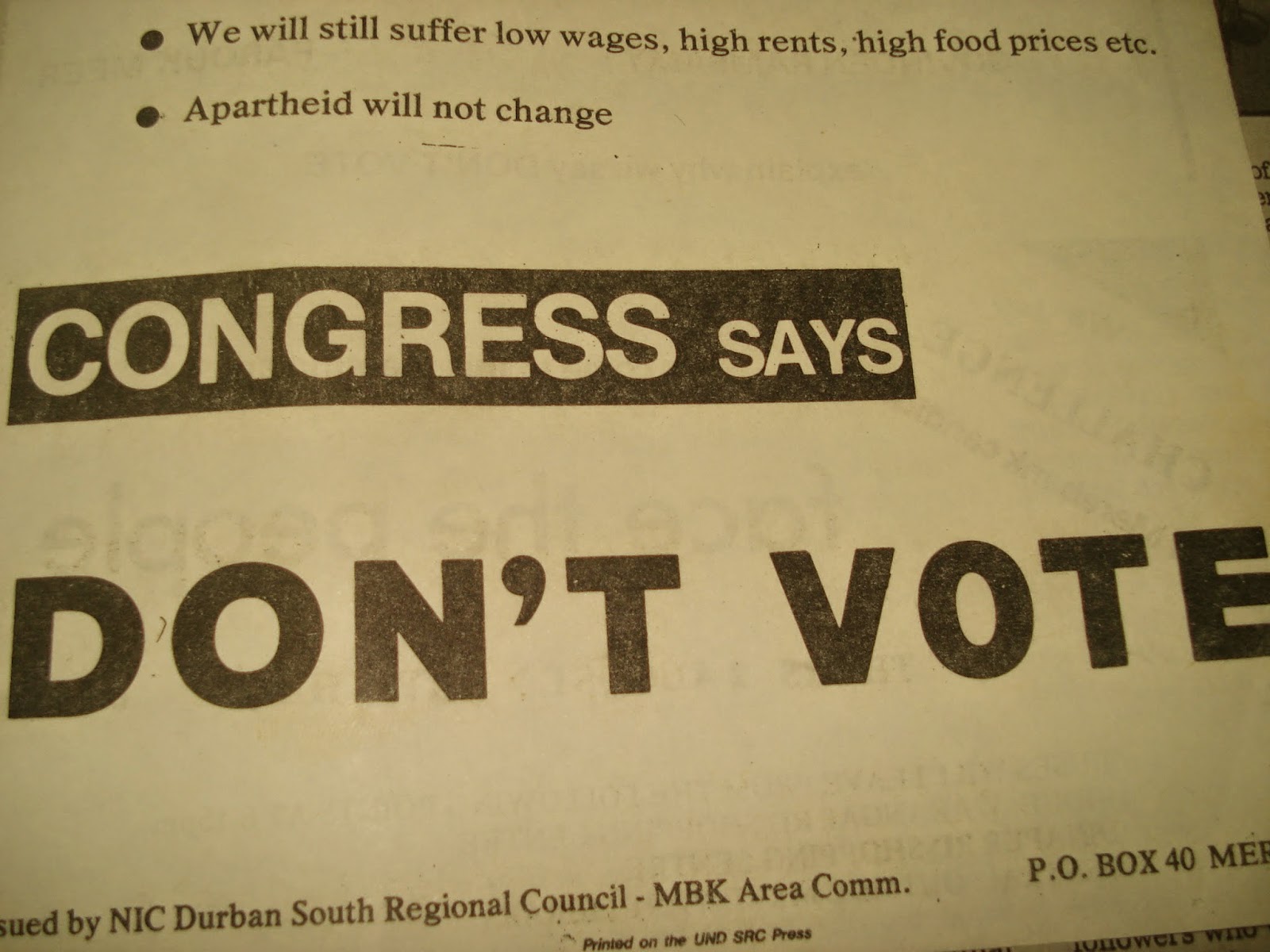
Six months after his release in February 1984 from 20 years on Robben Island,  Billy Nair was again detained, tortured and brutalised for opposing the tri-cameral elections. The tri-cameral elections were some of the devious plans by the former apartheid regime to co-opt the coloured and Indian-orign communities.
Billy Nair took his case to the High Court and succeeded in winning his release from detention.


THREE MONTHS AT THE BRITISH CONSULATE IN DURBAN


He, thereafter, took refuge at the British Consulate in Durban along with Mewa Ramgobin, M J Naidoo, Archie Gumede and Paul David. All these leaders were activists of the Natal Indian Congress(NIC), the Release Mandela Committee(RMC), the United Democratic Front(UDF) and other progressive organisations.
Nair spent three months at the Consulate and soon after he walked out of the consulates office in December 1984,  I spoke to Billy Nair about the political struggles at that time.

          BRUTALISED BY SECURITY POLICE

I asked him about the brutalisation he suffered at the hands of the then dreaded security police.
"In the first place six months after I was released from Robben Island I was actually detained for opposing the tri-cameral elections," he told me. "After four months of detention and my stay at the Consulate with my colleagues I was released. "This indicates clearly that the state was persecuting me. Whenever I came into the custody of the special branch I was assaulted. "There's a charge of assault pending against the police who assaulted me. I was assaulted and subjected to quite humiliating experience in prison and one could say that I was subjected to it was a quite a torrid experience."


                      STRUGGLE WILL CONTINUE


Billy Nair showed no signs of being beaten by the brutal actions of the apartheid regime. Instead he re-iterated that as long as the National Party regime at that time refused to negotiate with the authentic and real leaders of the people, the struggle will continue.
"As long as the National Party Government remains intransigent and refuses to meet the authentic leaders of the people," he said, "the unrest will naturally continue and what I urge the National Party Government and all those at the helm of power and and the powers that be is to come to their senses and negotiate and discuss with the authenthic leaders of the people to resolve the problems of the country".

                     UNITED DEMOCRATIC FRONT


The United Democratic Front, of which Billy Nair was a senior leader, was facing a crisis at this time because of the widespread detentions of thousands of leaders and activists around the country and the charges of treason brought against most of the top leaders.  But Billy Nair was unruffled. He was of the view that as long as the UDF was the authentic voice of the people, it would continue to operate. This, despite the oppressive actions of the then apartheid regime.
"The setback the UDF and its affiliates suffer at the moment will make them to re-group because, after all, an organisation is not founded on futile principles but an organisation which is found on firm basic principles with widespread support of the massive of the people it has the support of 30-million people. An organisation like this will prove invincible and emerge victorious and triumphant, not withstanding the present difficulties.


TOTAL REJECTION OF TRI-CAMERAL PARLIAMENT


Billy Nair also totally rejected any form of association with the regime's tri-cameral parliamentary offer to the coloured and Indian-orign communities. He made it clear that he would struggle on for a non-racial and free South Africa till his last breadth.
"The democratic loving people, the people who want democracy and freedom urge the white minority government to sit and work out with people and not for the people. Not withstanding the repression that I have suffered and am suffering I will continue with the struggles for as long as I live. I will continue to struggle for a free and non-racial democracy for both black and white as long as I live."

                         
POLITICAL FREEDOM, NOT MONETARY GAINS


Billy Nair remained totally dedicated to the full political, social and economic emancipation of all South Africans ---  without expecting anything in return.  He had followed in the footsteps of many other great freedom leaders. One hopes that Billy Nair's rich life will not be lost now that he's no longer with us. The younger generation must be able to learn from the unselfish lives of Billy Nair and scores of others.  - ends: subrygovender@gmail.com

BILLY NAIR - A STRUGGLE ICON WHO SACRIFICED 60 YEARS OF HIS LIFE FOR OUR FREEDOM

OUR RICH HISTORY - BILLY NAIR


One of the doyens of the liberation struggles was Billy Nair, the son of indentured labourers, who was imprisoned on Robben Island for 20 years for fighting against white minority rule and domination. After his death at the age of 79 on October 23 2008, Subry Govender compiled a three-part series as a special tribute in honour of this struggle icon.
We publish the three reports as part of our information for those who are interested in learning about OUR RICH HISTORY. This is Part 1......


BILLY NAIR - A STRUGGLE STALWART WHO SACRIFICED 60 YEARS OF HIS LIFE FOR OUR FREEDOM


"What you find in South Africa here today is a serious conflict between the minority ruling class and those fighting for democracy, non-racialisism, for freedom for a non-racial and free South Africa."

Billy Nair,  who was 79-years-old when he passed away on October 23 in 2008, had said this when he addressed a protest meeting at the former University of Durban-Westville in August 1985 - only a year after being released from Robben Island after being imprisoned for 20 years.
He had re-integrated himself into the liberation struggles despite the heavy hand of the former regime in trying to silence and wipe out all activists at that time.
At this time students and pupils all over the country had risen in unision, not only demanding the release of political prisoners like Nelson Mandela, Walter Sisulu, Ahmed Kathrada and Govan Mbeki, but also for political freedom and equality for all South Africans.


                                                           "SOUTH AFRICA IS ON FIRE"


In his speech, Nair did not pull any punches.
"As a matter of fact South Africa is on fire and the cause of it is the Pretoria regime," he told the militant students.
He added: "And we also want to warn that those who bolster the Pretoria regime in the name of the Rajbansis, Hendrickses and the Matanzimas, Sebes and other racketeers are co-responsible for the state of affairs in this country.
"Now the question that arises is is South Africa normal? Is it normal when you have insane men sitting in power dividing the country into bantustans, into Indians, Hindustans and what have you."
Who was this fire-brand who sacrificed nearly 60 years of his life for the freedom and the non-racial society that we enjoy today?


                    PARENTS - INDENTURED LABOURERS FROM COCHIN IN INDIA


Nair was born in Sydenham, Durban on 27 November 1929 to parents who came from the Cochin district of Kerala in south India.
While still a teenager,  he became aware of the plight of the poor and the oppressed. He became a trade union leader and over the years involved himself in the Natal Indian Congress, the ANC, the South African Congress of Trade Unions and after his release in the United Democratic Front.
The meeting he addressed at the University of Durban-Westville in August 1985 was called to inform the minorty regime that South Africans would not submit to defeat despite the violence of the state. Billy Nair was the main speaker and he gave the students and others who attended a lesson in history about the confict in the country at that time.
"What you find in South Africa here today a serious conflict between the minority ruling class and the rest of the populace, those fighting for democracy, non-racialisism, for freedom for a non-racial and free South Africa. A minority clique is perpetuating a system of apartheid where a minority of minorities sits in power and rules over the majority.
"Now this serious division between the two is actually the cause of the crisis in the country. Now we the people, the oppressed,  have been supported in the past and are still being supported by the entire civilised world."


                                            NON-RACIAL SOCIETY FOR ALL


Billy Nair, not cowed by 20 years of imprisonment on Robben Island,  told the young students that if there was no change,  there would only be disaster.
"When a Government that lacks legitimacy we  want a rejection of this government even by white South Africa. Those industrialists who actually support this government, the state of emergency must quickly change their minds because the longer they support this government, the longer will be the trail of blood and violence and disaster. "
Billy Nair, the freedom fighter who sacrificed everything for the cause of freedom and liberty for all South Africans,  was clear at that meeting in 1985 about the kind of South Africa he wanted to see emerge.
"We want a South Africa of the people for the people by the people. A South Africa that will not be determined in the drawing rooms of the National Party, its caucus or the NIS (National Intelligence Security) or by roping in a few of the puppets by saying: accept this and you find the puppetes dancing to their tunes of their masters in Pretoria."
Billy Nair has left South Africa and South Africans a rich legacy. When he passed away,  he did not leave behind millions or billions of rand in bank accounts - only a life of sacrifice for the betterment of all South Africans - including the poorest of the poor. - ends- subrygovender@gmail.com

ANN COLVIN - AN INDOMITABLE ANTI-APARTHEID ACTIVIST REMEMBERED

OUR RICH HISTORY

In the late 1970s and 1980s - those who participated in the struggles were mainly anti-apartheid Indian, coloured and African activists. White activists were far and few between. On September 12 2010 one of the anti-apartheid activists who played an active role in a number of progressive organisations, Ann Colvin, passed away at the age of 88. Subry Govender had the opportunity of talking to the indomitable lady about a year before her passing. The reproduction of this article is part of a series that Subry Govender has embarked on in paying tribute to some of the anti-apartheid activist. It's hoped this will provide some information about our struggles for the those who are interested.


By Marimuthu Subramoney
(aka Subry Govender)

During the height of the resistance against the former apartheid regime in the 1970s and 1980s, a number of middle-aged white women in Durban used to lend their support at almost all the protest meetings and rallies. One such person was the energetic, sprightly, spirited, passionate and politically strong Ann Colvin, who used to at that time live in St Thomas Road on the Berea.


                                                 BLACK SASH


She was, in addition to being associated with various social and community organisations, an official of Black Sash; and worked closely with the socio-religious anti-apartheid organisation, Diakonia; Detainees Parents' Support Committee; End Conscription Campaign(ECC); Support for Conscientious Objectors; the Release Mandela Campaign; and the Natal Indian Congress.
On Sunday, September 12,  2010 this exceptional and indomitable fighter for justice died in her sleep at the ripe-old age of 88. A large group of family, friends and former anti-apartheid politicial activists held a simple service at the Botanical Gardens Education Centre in the city on Friday(Sept 17) to pay tribute to her.

                                                    END CONSCRIPTION CAMPAIGN


Who was this little-known political activist? Sometime early in 2009 just before the general elections I had the privilege of interviewing Ann Colvin at a time when she had just completed her 86th birthday.
Born in Durban in March 1922, she came from a somewhat privileged background.  She and her twin sister attended the Durban Girls College where she completed her matriculation.
In 1946 at the age of 24 she married a British pilot and because of her husband's work she lived most of her married life outside South Africa in England, Hong Kong, Lebanon and Kuwait.
In the late 1960s when her husband retired from British Airways, she returned to South Africa with her husband and four young children - two boys and two girls - to settle in Durban.
Immediately on her return she became drawn to the anti-apartheid struggles because she and her children did not experience the kind of racial prejudice that existed in South Africa at that time.
"From the very first time when I landed and came back here I was horrified by what I saw," she had said.


                                                            NATAL INDIAN CONGRESS


"I was not surprised not so much by seeing apartheid in action but by the fact that white people accepted it. I couldn't believe it. Some of these people were my peers, people I grew up with. I couldn't believe that they could accept something so totally unjust.
"So I told myself that I either join the anti-apartheid struggles or leave the country."
The first organisation she joined was the Black Sash,  an organisation made up mainly of white women who provided help to black people on labour matters and other social issues. She was the chairperson of the Durban branch of Black Sash for more than 20 years and also became closely involved with, among other organisations, the Natal Indian Congress, which at that time was one of the main above-board organisations leading the struggles against repression and oppression.
"I went to all the meetings and didn't think that my skin colour was a problem. We were all there fighting for non-racialism and speaking out against the injustices of the apartheid regime. The people in the Natal Indian Congress were a great bunch of people. I really admired them for what they were doing and I was made one of them. There was no such thing as skin colour."
But, she said, it was not all smooth sailing. The dreaded security police of that era kept a close watch and they didn't like seeing a white woman involved in the struggles with African, Indian, and coloured people.
"What really got their goats to put it crudely was the fact that here we were whites, Indians, Africans and coloured people protesting and working together. They couldn't believe that we could be together. They didn't do anything overtly against me but they let you know they were watching you."
Ann Colvin only voted for the first time in 1994. She and her children could not find themselves voting previously in a system that they totally abhorred.
"Words can't express it. It was absolutely incredible. I was elated. I remember I never went to sleep that night. I worked all night . It was terrific. It was wonderful wonderful time in 1994. It was very exciting to be part of it. Tiny tiny part of it."


                                                         NELSON MANDELA


Like many other political activits, All Colvin also missed Nelson Mandela at this time of our political life.
"I missed Nelson Mandela after 1999 because of his tremendous humanitarian and leadership qualities. I didn't agree with Thabo Mbeki because of his stance on HIV-AIDs, Gear, the arms deal and the internal squabbles. Yes my feelings went from disappointment to despair to disgust."
Ann Colvin wants to see democracy strengthened in the country and want to see strong political parties emerging.
"I think it is a sadness that in so many countries around the world democracy has not worked," she had said.
"We demand our human rights but on the other side of the coin is social responsibility."
She said despite being disappointed and disillusioned with the current "goings on", she was still committed to the ideals of non-racialism, an open society and a vibrant democracy that she and other activists had fought for. ends - subrygovender@gmail.com


Friday, March 27, 2015

TRIBUTE TO FORMER ANTI-APARTHEID ACTIVIST, D K SINGH, WHO PASSED AWAY ON FRIDAY, AUGUIST 20 2010 (This article was written a week after his passing)


"I saw the the injustices being done to our people and without thinking about it I felt that I had a duty to our people both locally and nationally."


 (MR D K SINGH (LEFT) WHEN HE WAS PRESIDENT OF THE OF THE NON-RACIAL SWIMMING FEDERATION. ON THE RIGHT HIS MR ARCHIE HULLEY, WHO WAS THE SECRETARY UNDER MR SINGH. MR HULLEY HAS ALSO PASSED ON.)


By Subry Govender

"He indeed was a champion of the underdog. He was a stalwart who inspired many generations of Congress activists by his unflinching and dedicated conduct, even in the face of great adversity."
This is how former anti-apartheid activist, Swaminathan Gounden, described his close comrade and veteran struggle activist, Dharamraj Kissoon Singh, who died at his home in Durban last Friday at the age of 81.
Mr Singh, known fondly as "DK" to his comrades and friends,  was one of the anti-apartheid leaders and lawyers who featured prominently in a number of community, political, social and sporting organisations in the struggles against the former racist regime in the 1970s and 1980s.
His funeral service, held at the Claire Estate Crematorium on Sunday, was attended by a large number of family, friends, colleagues and former comrades such as Finance Minister, Pravin Gordhan; KwaZulu-Natal Human Settlement MEC Mrs Maggie Govender; Dr Dilly Naidoo, and Sunny Singh.
Former Transport Minister, Mac Maharaj; Constitutional Court judge Zac Yacoob and Mr Gounden addressed the funeral service about his social, community, political and sporting contributions to the realisation of the new democratic order in South Africa.
Born into a humble working-class family at Umzinto on the KwaZulu-Natal south coast in 1929,  Mr Singh became actively involved in the struggles for social, economic and political liberation while still a student at the University of KwaZulu-Natal in Durban.
He played an active role in the Students Representative Council and came under the influence of  Dr Monty Naicker who was then president of the Natal and South African Indian Congresses in the 1940s and 1950s.
During this period he took part in many of the campaigns initiated and led by Dr Naicker.
He qualified as an attorney in 1958 and immediately became one of the progressive lawyers who made himself available to take up the legal struggles of many political activists and organisations facing harrassment at the hands of the former apartheid regime.
For more than two decades Mr Singh operated from the centre of the former Grey Street "Indian" area in Durban in partnership with the late Pat Poovalingham and Mr Vahed. The law firm was known as: "D K Singh, Poovalingham and Vahed."
Over the next 40 years he became actively involved in the anti-apartheid civic, political and sporting struggles.
He became an executive member of the Natal Indian Congress when it was revived in the early 1970s, served as president of the Asherville Ratepayers Association for 23 years, was one of the founding members and president of the Durban Housing Action Committee(DHAC) for 12 years, president of the David Landau Community Centre for 14 years and president of the Amateur Swimming Union of Natal for five years. Mr Singh was also secretary of the Durban Citizens Action Committee, which assisted activists detained by the former notorious security police; represented victims of the Group Areas Act; and provided free legal service for the Aryan Benevolent Home and the Durban Blind and Deaf Society.
At the same time Mr Singh assisted trade union organisations such as the former Durban Integrated Employees Society(DIMES).
For all his legal work for the civic, political and trade union organisations, Mr Singh did not charge a single cent in legal fees.
This correspondent, who had known Mr Singh since the early 1970s, had the opportunity of interviewing him a few years ago when he had retired from his legal work and his active community, social and political work.
He told me that he became an activist during the apartheid era because he could not just sit back and allow the apartheid regime to continue with its discriminatory and repressive policies.
"Well repression itself caused me to take an active interest in various community affairs," he told me.
"I saw the the injustices being done to our people and without thinking about it I felt that I had a duty to our people both locally and nationally."
One of the features of his life was that he did not charge any legal fees for the work he had undertaken on behalf of activists and social and community organisations. I had asked him why had he not done so and this is what he had said:
"How can I even dream of charging any fees for the defence of comrades who played such an active role in promoting our freedom and in trying to get a better deal for the community generally?"
I had also questioned Mr Singh about the new democracy and he was of the view that South Africa had come a long way although there was still a lot of work to do.
This is what he had said: "The country is doing fairly well. We still have immense problems which we have to solve - the housing backlog, the employment problems. All these things need to be attended to. But I think the Government is trying its best and I am sure given the time they will achieve much more than they have already achieved."
Mr Singh was of the view that the young people had to take an active interest in the future of the country because it was the new generation that would inherit the new democracy.
"The young people must carry the struggle forward for social and economic equality.
"They must take an active interest in the problems of the country. They must ensure that they make a meaningful contribution to the development of the country and to the attainment of a truly-rainbow nation where everybody has equal rights," he told me.


(MR SWAMINATHAN GOUNDEN, WHO PAID TRIBUTE TO MR SINGH AT HIS FUNERAL IN 2010)


In his speech at the funeral service Mr Gounden, who had worked with Mr Singh for more than 30 years in the social, political and community fields,  summed up the feelings of the people when he said:
"In the long period of our oppressed peoples' history, many have come into the folds in their desire to serve the community, many have come and served for a little while, others for the better part of their lives, yet others whose long presence have made their name synonomous with the organisations that they have served - and so it is with Comrade D K Singh.
"I have no doubt that the life this remarkable man will continue to inspire all of us in the community. In the life of our community he played a noble part and there can be no doubt that his memory will live long and that by his deeds alone he has left monuments to the everlasting memory of one who lived simply but loved deeply." = ends - Marimuthu Subramoney

Wednesday, March 25, 2015

TAMILS IN SOUTH AFRICA EMBARK ON MASSIVE PROTEST CAMPAIGN AGAINST INDIAN CONSUL RULING IN DURBAN


By Subry Govender

South Africans of Tamil-origin have embarked on a massive campaign to expose the discriminatiory practice of the Indian Consul office in the city of Durban to force those wanting to learn Tamil at the Consul office to pay for their tuition while not imposing a similar ruling  for those learning Hindi.
They are also collecting signatures of protest to hand petitions  to the Indian High Commission in Pretoria.
The latest moves follow the failure of their talks with the Consul General, Mr Rajagopalan Raghunathan, at the Consul office on Monday, March 24.


(Mr Karthi Moothsamy, president of the SATF (left), and his secretary, Mr Mari-Pillay Ramaya)


The president of the South African Tamil Federation, Mr Karthi Moothsamy; the President of the International Movement for Tamil Culture in South Africa/Africa, Mr Micky Chetty; Mr Richard Govender, president of the KwaZulu-Natal region of the Tamil Federation; and Ms Mala Lutchman, a Tamil teacher and scholar; Mrs Mallie Pillay, a Tamil scholar, held talks with the Consul General following the controversy over the Consul decision.
Ms Pillay said they were disappointed at the manner in which they were treated.
"The Consul General spoke to us in the reception area and did not have the decency to host us in his board room," she said.
"He told us that he was merely implementing a decision taken in New Delhi and, therefore, could not help us."
"We were all disgusted at the manner in which we were treated. What we cannot understand is that while we in South Africa are recovering from racial discrimination, the action of the Indian Consul office amounts to promoting ethnic divisions within the Indian-origin people here.
"What is surprising is that we were using the Consul office for three years free of charge. It was only in June last year that they asked to pay R50 a month. Some of us paid the money but when we were asked to pay the fee again this year, we felt that this was not fair. One of my friends who was learning Hindi said she could not understand why we should pay," she said.
Ms Pillay said all the organisations would send the petititions to the Indian High Commission.
Mr Moothsamy, president of the Tamil Federation, said the "the matter is being handled".


(Mr Swaminathan Gounden)


A veteran struggle stalwart, 86-year-old Mr Swaminathan Gounden, whose father and mother were from Tamil Nadu, said it was shameful that such a ruling should have been introduced by the Consul.
"We struggled all our lives to overcome racial discrimination but now we are being discriminated along language lines by those representing  India here," he said.
Mr Gounden, who was banned and house-arrested for more than 10 years during the dark days of apartheid, is now a Board member of Southside FM Radio, a radio station to be launched for those whose mother tongues are Tamil and Telegu.
"I sincerely hope that reason would prevail and that no barriers are put in place for those who want to learn Tamil at the Indian Consulate.
"India has played a great role in our liberation and now must not be found to be discriminating against South Africans whose mother tongues are Tamil. We want to promote our languages, cultures, traditions and music so that our future generations will not lose their roots and heritage."
The president of the KwaZulu-Natal region of the South African Tamil Federation, Mr Richard Govender, said the Indian Government should not practise discrimination of any kind.
"We want to  make it clear that there should be no discrimination whatsoever in the promotion of our languages by the Indian Government.  We make up the majority of the people of Indian-origin in South Africa and we believe that both Tamil and Hindi should be taught by the Consul without any financial constraints," he said.
The Indian Consul, Mr Rajagopalan Raghunathan, was not available for comment.

Monday, March 23, 2015

SOME PICTURES OF JOURNALISTS DURING THE 1970s


In the early 1970s journalists Deven Moodley (left), Subry Govender and Christy Murugan (Right) attending a function. O'h how the times have flown. We were all colleagues covering the non-racial soocer, cricket, tennis and other events.


Colleagues R. Brijlall, Ismail Khan and Deven Moodley at Golden City Post Offices at 202 Goodhope Centre in Queen Street in Durban in the early 1970s.


Golden City Post editorial team in the early 1970s: Bobby Harrypersadh (editor), Farook Khan, Deven Moodley, R. Brijlall, I A Khan and Ranjith Kally


Golden City Post reporters, Deven Moodley and M S Roy, and a colleague from the Daily News at Currie's Fountain in the 1970s.